
 100% FREE ACCESS
7th Standard CBSE Syllabus & Materials
7th Standard CBSE
CBSE 7th Social Science Theme E - Understanding Market - New Sample Question Papers Study Material - QB365 Set A
NEW7th Standard CBSE
CBSE 7th Social Science Theme E - From Barter to Money - New Sample Question Papers Study Material - QB365 Set A
NEW7th Standard CBSE
CBSE 7th Social Science Theme D - The Constitution of India- An Introduction - New Sample Question Papers Study Material - QB365 Set A
NEW7th Standard CBSE
CBSE 7th Social Science Theme D - From the Rulers to the Ruled : Types of Governments - New Sample Question Papers Study Material - QB365 Set A
NEW7th Standard CBSE
CBSE 7th Social Science Theme B - The Age of Reorganisation - New Sample Question Papers Study Material - QB365 Set A
NEW7th Standard CBSE
CBSE 7th Social Science Theme B - The Rise of Empires - New Sample Question Papers Study Material - QB365 Set A

Published on: 31/10/2025
Download CBSE Class 7th Standard CBSE Science question papers, sample papers, important questions, and previous year solved papers in PDF format. Get free study materials, NCERT solutions, and exam preparation resources for Class 7th Standard CBSE Science
Questions + Answers key
Take MCQ Science Test
1.
Explain how the water wasted at individual level.
2.
Explain the relation between water table and ground water.
3.
What is the meaning of shortage of water?
4.
What is the source of water in each of the following?
(a) Wells
(b) Ground
(c) Atmosphere
5.
From where do the following usually get water? In which form is water present in them?
(a) Clouds
(b) Plants
(c) Mountain tops
(d) Aquifer
(e) Animals
6.
A number of problems can be faced due to shortage of water. List some of them.
7.
Certain pattern of the rainfall in our country leads to scarcity of water. Explain that pattern. Which part of the country gets rainfall twice a year?
8.
How can you observe the three forms of water (a) in nature and (b) at home?
9.
The water bearing layer of the earth called Pis made up of two components Q and R, in which R water collect under the ground. The top level of layer P is called S. When too many tubewells are used in an area, the level of S in that area goes down. What are P, Q, R and S?
10.
Complete the given table.
| Form of water | Process by which formed | Location where found |
| (a) Liquid | ||
| (b) Solid | ||
| (c) Gaseous |
11.
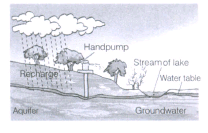
Make a sketch showing groundwater and water table. Label it.
12.
Explain the factors responsible for the depletion of water table.
13.
You have been asked to maintain a garden. How will you minimise the use of water?
14.
There are 10 tubewells in a lane of 50 houses, what could be the long term impact on the water table?
15.
Explain how groundwater is recharged.
1.
There are various reasons of wastage of water at individual level. All of us waste water while brushing teeth, shaving, bathing, washing and during various other activities. Leaking taps is also a big source of huge water waste. We generally leave the taps running at public places. This habit makes huge loss of potable water.
2.
If we dig a hole in the ground and dig deeper and deeper, we could reach a level where all the space between particles of soil and gaps between rocks are filled with water. The upper limit of this layer is called the water table. The water found below the water table is called groundwater.
3.
The amount of water recommended by the United Nations for various uses of a person per day is 50 litres. Millions of people in our country do not get enough water to fulfill minimum requirement, this means shortage of water.
4.
(a) The source of water in walls is groundwater
(b) The source of water on ground is rain.
(c) The source of water in atmosphere is evaporation.
5.
| Source of water | Form of water | |
|---|---|---|
| Clouds | Land | Liquid form (droplet of water) |
| Plants | Soil | Liquid form |
| Mountain tops |
Atmosphere | Solid form |
| Aquifer | Rain | Underground water |
| Animals | Waterbodies | Liquid |
6.
The number of problems that can be faced due to shortage of water are as follows
(i) Less amount of pure drinking water will be available.
(ii) Lack of equal distribution of water.
(iii) Drought.
7.
We face shortage of water mainly because water is not evenly distributed by the nature on the earth. Some places such as North East India get so much rains, so that it gets flooded almost every year.
On the other hand, Thar desert in Rajasthan may get rains rarely in the monsoon season. This uneven pattern of rains causes water scarcity in India at some places.
8.
The three forms of water
(a) in nature are snow (solid), water (liquid) and water vapour (gas).
(b) at home are ice (solid), water (liquid) and steam (gas).
9.
P - Aquifer, Q - Soil, R - Permeable rocks,
S -Water table
10.
The complete table is given below
| Form of water | Process by which formed | Location where found |
| (a) Liquid | Condensation and melting | Waterbodies like rivers, lakes, etc |
| (b) Solid | Freezing | Cold regions like high mountains poles, etc |
| (c) Gaseous | Evaporation | Atmosphere |
11.
Sketch showing groundwater and water table,
12.
The factors responsible for depletion of water table are as follows:
(i) Increasing population It decreases the open area for seepage of water into the grounds,
(ii) Increasing industries Most of the stages of manufacturing processes in industries require water. If the number of industries increases, then the water required by them will also increase and will lead to the depletion of water table.
(iii) Agricultural activities The water for agriculture is mainly utilised from groundwater, rainwater and canal water. The increased population causes pressure on agricultural practices. This inturn causes increase the use of groundwater and leads to the depletion of water table.
13.
To maintain a garden, water is necessary. Therefore, to minimise the use of water, we can apply the drip irrigation method. In this method, water is supplied directly to the base of the plants using narrow pipes, thereby reducing the loss of water.
14.
If these tubewells are used for long time continuously, then the groundwater level would be reduced. Thus, we can say that population increase is one of the major cause for depletion of water table.
15.
The groundwater is recharged in the following manner:
(i) Rainwater and the water from waterbodies on the earth surface pass through the soil by the process of infiltration.
(ii) The infiltrated water then gets accumulated in the aquifer deep under the ground.

7th Standard CBSE Syllabus & Materials
7th Standard CBSE
CBSE 7th Social Science Theme B - New Beginnings : Cities and States - New Sample Question Papers Study Material - QB365 Set A
NEW7th Standard CBSE
CBSE 7th Social Science Theme A - Climates of India - New Sample Question Papers Study Material - QB365 Set A
NEW7th Standard CBSE
CBSE 7th Social Science Theme A - Geographical Diversity of India - New Sample Question Papers Study Material - QB365 Set A
NEW7th Standard CBSE
CBSE 7th Science Earth, Moon and the Sun - New Sample Question Papers Study Material - QB365 Set A



NCERT Books

Syllabus

Exam Pattern

Sample Question Papers

Previous year Question Papers

Important Notes

MCQ Practice test

NCERT Exemplers

Case study Questions

Image Based Questions

Passage based Questions

HOT Questions

Value Based Questions

Model Questions Papers
NCERT ( Book Back ) Questions

Assertion and Reason
Important Questions And Answers

CBSE 7th Standard CBSE Subjects
CBSE Standards


