
 100% FREE ACCESS
7th Standard CBSE Syllabus & Materials
7th Standard CBSE
CBSE 7th Social Science Theme E - Understanding Market - New Sample Question Papers Study Material - QB365 Set A
NEW7th Standard CBSE
CBSE 7th Social Science Theme E - From Barter to Money - New Sample Question Papers Study Material - QB365 Set A
NEW7th Standard CBSE
CBSE 7th Social Science Theme D - The Constitution of India- An Introduction - New Sample Question Papers Study Material - QB365 Set A
NEW7th Standard CBSE
CBSE 7th Social Science Theme D - From the Rulers to the Ruled : Types of Governments - New Sample Question Papers Study Material - QB365 Set A
NEW7th Standard CBSE
CBSE 7th Social Science Theme B - The Age of Reorganisation - New Sample Question Papers Study Material - QB365 Set A
NEW7th Standard CBSE
CBSE 7th Social Science Theme B - The Rise of Empires - New Sample Question Papers Study Material - QB365 Set A

Published on: 31/10/2025
Download CBSE Class 7th Standard CBSE Science question papers, sample papers, important questions, and previous year solved papers in PDF format. Get free study materials, NCERT solutions, and exam preparation resources for Class 7th Standard CBSE Science
Questions + Answers key
Take MCQ Science Test
1.
Some definitions are given which can be corrected by changing one word. Correct them.
(a) Aquifer is groundwater stored between layers of hard rock above the water table.
(b) The process of evaporation of water in the ground is called infiltration.
(c) The evaporation of water from oceans and its arrival back into oceans is called vapour cycle.
2.
Boojho made an electromagnet by winding 50 turns of wire over an iron screw. Paheli also made an electromagnet by winding 100 turns over a similar iron screw. Which electromagnet will attract more pins? Give reason.
3.
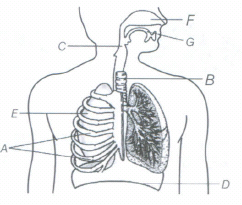
Observe the given diagram of human respiratory system. List the organs from (A) to (G).
4.
Differentiate between a uniform and non-uniform motion.
5.
How would you test the presence of starch in leaves?
6.
Water is very precious for all the living beings. What will happen in future, if we do not save water now?
7.
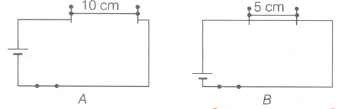
Paheli took a wire of length 10 cm. Boojho took a wire of 5 cm of the same material and thickness both of them connected with wires as shown in the circuit given in figure. The current flowing in both the circuits is the same.
(a) Will the heat produced in both the cases be equal? Explain.
(b) Will the heat produced be the same, if the wires taken by them are of equal lengths but of different thickness? Explain.
8.
List some animals around you. Now group them as follows:
(a) Animals that can breathe only through skin.
(b) The animal that can breathe through skin as well as through lungs.
(c) The animal that can breathe through lungs.
(d) Animals that can breathe through gills.
(e) Animals that can breathe through spiracle and tracheae?
9.
Distance is a
Vector quantity
Scalar quantity
Both (a) and (b)
None of these
10.
Algae is:
Parasite
Saprotroph
Autotroph
None of these
11.
Which of the following characteristic is most suitable material for making the care of an electromagnet?
Brass
Aluminium
Iron
Steel
12.
Choose the correct option. The total water
in the lakes and rivers of the world remains constant
under the ground remains constant
in the seas and oceans of the world remains constant
of the world remains constant
13.
Two students were asked to plot a distance-time graph for the motion described by Table A and Table B.
| Distance moved (m) | 0 | 10 | 20 | 30 | 40 | 50 |
| Time (min) | 0 | 2 | 4 | 6 | 8 | 10 |
| Distance moved (m) | 0 | 5 | 10 | 15 | 20 | 25 |
| Time (min) | 0 | 1 | 2 | 3 | 4 | 5 |
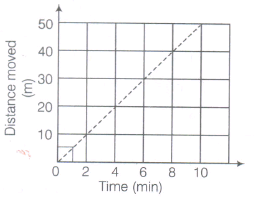
The graph given in figure is true for:
Both A and B
Only A
Only B
Neither A nor B
14.
Spiracles on the body of insect are connected to a network of thin air tubes called
lungs
tracheae
gills
blow holes
15.
What are the main respiratory organs in humans?
16.
Which property of a conducting wire is utilised in making electric fuse?
17.
What is water table?
18.
What are Nutrients?
1.
(a) Aquifer is groundwater stored between layers of hard rock below the water table.
(b) The process of seeping of water in the ground is called infiltration.
(c) The evaporation of water from oceans and its arrival back into oceans is called water cycle.
2.
Since the magnetic effect directly depends on the number of turns of the coil. As, Paheli's coil has more number of turns than Boojho. So, her electromagnet is stronger than Boojho.
So, electromagnet of Paheli attracts more pins as compared to Boojho.
3.
The human respiratory system have following organs:
A- Ribs
B- Trachea
C- Pharynx
D - Diaphragm
E- Lungs
F- Nasal passage
G- Oral cavity
4.
When a body travels equal distance in an equal interval of time, then the body is said to be in a uniform motion.
When a body travels unequal distance in an equal interval of time, then the body is said to be in non-uniform motion.
5.
The presence of starch, a carbohydrate in leaves can be tested by iodine test. Iodine turns starch solution into blue-black colour. Pour few drops of dilute iodine solution on a boiled leaf. The leaf becomes blue-black in colour which proves the presence of starch in it.
6.
Water is needed for various life activities. If we continue the misuse of water and do not conserve it, the groundwater level will be depleted. This may result into various consequences like
(i) Lowering of the water table Excessive pumping can lower the groundwater table.
(ii) Reduced surface water supply Groundwater and surface water are connected. When groundwater is overused, the lakes, streams and rivers connected to groundwater, can also have little supply.
(iii) Loss of plants from land We fully depend on the plants for food directly or indirectly. Plants need water to prepare their food. If there will be scarcity of water on earth, the plants will be unable to prepare their food. This inturn will lead to the end of the life because world without plants means no food, no oxygen, not enough rain and other innumerable problems. Therefore, it is true that water is a precious resource
7.
(a) No, the amount of heat produced in both the wires will be different because amount of heat produced in a wire on passing electric current depends on the length of wire and here length is different for both the wires.
(b) No, the amount of heat produced in the wire of same length but different thickness cannot be same because amount of heat produced in a wire also depends on the thickness of the wire.
8.
(a) Animals that can breathe only through skin are earthworm and leech.
(b) Animals that can breathe through skin as well as through lungs are frogs.
(c) Animals that can breathe through lungs are buffaloes, human, and dolphins.
(d) Animals that can breathe through gills are tadpole and fish.
(e) Animals that can breathe through spiracles and tracheae are grasshopper, cockroaches, ants, housefly and mosquito.
9.
(b)
Scalar quantity
10.
(c)
Autotroph
11.
(c)
Iron
12.
(d)
of the world remains constant
13.
(a)
Both A and B
14.
(b)
tracheae
15.
()
In humans, respiration occurs through lungs.
16.
()
Low melting point
17.
()
A level where all the space between particles of soil and gaps between rocks are filled with water is called water table.
18.
()
The compounds or components of food which are necessary for our body are called nutrients.

7th Standard CBSE Syllabus & Materials
7th Standard CBSE
CBSE 7th Social Science Theme B - New Beginnings : Cities and States - New Sample Question Papers Study Material - QB365 Set A
NEW7th Standard CBSE
CBSE 7th Social Science Theme A - Climates of India - New Sample Question Papers Study Material - QB365 Set A
NEW7th Standard CBSE
CBSE 7th Social Science Theme A - Geographical Diversity of India - New Sample Question Papers Study Material - QB365 Set A
NEW7th Standard CBSE
CBSE 7th Science Earth, Moon and the Sun - New Sample Question Papers Study Material - QB365 Set A



NCERT Books

Syllabus

Exam Pattern

Sample Question Papers

Previous year Question Papers

Important Notes

MCQ Practice test

NCERT Exemplers

Case study Questions

Image Based Questions

Passage based Questions

HOT Questions

Value Based Questions

Model Questions Papers
NCERT ( Book Back ) Questions

Assertion and Reason
Important Questions And Answers

CBSE 7th Standard CBSE Subjects
CBSE Standards


