
 100% FREE ACCESS
7th Standard CBSE Syllabus & Materials
7th Standard CBSE
CBSE 7th Social Science Theme E - Understanding Market - New Sample Question Papers Study Material - QB365 Set A
NEW7th Standard CBSE
CBSE 7th Social Science Theme E - From Barter to Money - New Sample Question Papers Study Material - QB365 Set A
NEW7th Standard CBSE
CBSE 7th Social Science Theme D - The Constitution of India- An Introduction - New Sample Question Papers Study Material - QB365 Set A
NEW7th Standard CBSE
CBSE 7th Social Science Theme D - From the Rulers to the Ruled : Types of Governments - New Sample Question Papers Study Material - QB365 Set A
NEW7th Standard CBSE
CBSE 7th Social Science Theme B - The Age of Reorganisation - New Sample Question Papers Study Material - QB365 Set A
NEW7th Standard CBSE
CBSE 7th Social Science Theme B - The Rise of Empires - New Sample Question Papers Study Material - QB365 Set A

Published on: 31/10/2025
Download CBSE Class 7th Standard CBSE Science question papers, sample papers, important questions, and previous year solved papers in PDF format. Get free study materials, NCERT solutions, and exam preparation resources for Class 7th Standard CBSE Science
Questions + Answers key
Take MCQ Science Test
1.
Soil erosion
2.
Snails and slugs
3.
Soil profile
4.
Sandy soil
5.
Upper layer of the soil
6.
Why chemicals, solvents and insecticides should not be thrown down the drain?
7.
What are converging and diverging lens?
8.
Ruminants such as cows and buffaloes swallow their food hurriedly and then sit restfully and chew their food. Can you reason why?
9.
Sometimes we see that farmers loosen the soil. What is the reason behind it?
10.
List the substances which pollute the soil.
11.
When a candle burns, both physical and chemical changes occur. Explain.
12.
Distinguish between an open circuit and a closed circuit.
13.
Why should we worry about the conditions and issues related to forest far from us?
14.
Describe the function of the heart.
15.
The swallowed food moves downwards in the alimentary canal. Explain.
16.
Transport of food in plants takes place through;
Xylem
Phloem
Lenticels
Bark
17.
The hardest layer of the soil is
The top soil
The middle layer
The third layer
The lower most layer
18.
What is the relation between distance and speed?
Distance = Speed \(\times\) Time
Distance = Speed/Time
Distance = Time/Speed
None of the above
19.
Boojho and Paheli were given one mirror each by their teacher. Boojho found his image to be erect and of the same size, whereas Paheli found her image erect and smaller in size. This means that the mirrors of Boojho and Paheli respectively are
plane mirror and concave mirror
concave mirror and convex mirror
plane mirror and convex mirror
convex mirror and plane mirror
20.
Sometimes when we do heavy exercise, anaerobic respiration takes place in our muscle cells. What is produced during this process?
Alcohol and lactic acid
Alcohol and CO2
Lactic acid and CO2
Lactic acid only
21.
Paheli wanted to buy a gift made of animal fibre obtained without killing the animal. Which of the following would be the right gift for her to buy?
Woollen shawl
Silk scarf
Animal fur cap
Leather jacket
22.
Which of the following is not a forest product?
Gum
Plywood
Sealing wax
Kerosene
23.
The word monsoon is derived from the word
mausam
monsoon
museum
storm
24.
The raw material used by plants during photosynthesis
N2 and O2
O2, H2, CO2
CO2 and water
water and minerals
25.
The coldest region on the earth is the
polar region
tropical region
temperate region
coastal region
26.
The distance-time graph of standing vehicle is a straight line parallel to x-axis.
27.
Where underground sewerage systems and refuse disposal systems are not available, the high cost onsite sanitation system can be adopted.
28.
The balance between CO2 and O2 is maintained by the plants.
29.
Condensation of steam is not a chemical change.
30.
Diarrhoea can be treated by only giving water to the patient.
31.
What are conductors of heat and insulators? Discuss their practical applications.
32.
Explain the water absorbing capacity of soil with the help of an activity.
33.
Explain how the forest act a natural absorber of rain water.
34.
Give the properties of the images formed by the following:
(i) Plane mirror
(ii) Concave mirror
(iii) Convex mirror
(iv) Concave lens
(v) Convex lens.
35.
(a) Respiratory process occurs in two phases, what are those two major steps of respiration? Describe each one.
(b) Define the term breathing rate.
36.
The warm air is ______ than cold air.
37.
Changing of right side to the left side is called _________.
38.
Carbon dioxide and .............. synthesize .................
39.
The water bearing layer of the earth is_____________________
40.
Wool yielding animals bear ______ on their body.
41.
Why do we wear light coloured clothes when it is hot?
42.
Contaminated water is a potential health hazard. Name any two diseases that could be caused by consumption of contaminated water.
43.
Name the process which maintains the amount of water on earth.
44.
How many chambers are there in human heart?
45.
Define corrosion
46.
What do you think will happen to the paper?
47.
Can you suggest can method to let more rain water percolate and reach the water underground?
48.
Why is convex lens called a converging lens?
49.
Name any two main elements of weather.
50.
Tiny pores present on the surface of the leaves are called ..................
1.
()
Removal of upper soil
2.
()
Surface of shaded moist soils
3.
()
Different layers of soil.
4.
()
Large particles
5.
()
Dark in colour
6.
Chemicals like paints, solvents and insecticide should not be thrown down the drain as they may kill microbes that help to purify water.
7.
A convex lens bends inwards the light falling on it. It is called a converging lens. On the other hand, concave lens bends outwards the light and is called diverging lens.
8.
To digest their food completely.
9.
The farmers sometimes loosen the soil. This helps the root to respire through the air present in the space between soil particles.
10.
The substances which pollute the soil are
polythene bags, plastics, waste products, chemicals, pesticides, etc.
11.
It is true that when a candle burns, both physical and chemical changes occur. initially, candle burns to produce heat and light. It is a chemical change because candle burns with the formation of gases. Due to the heat produced, some candles simultaneously melts. This is a physical change as the molten candle wax behaves like original candle.
12.
Difference between an open circuit and a closed circuit
| Open (Electric) circuit | Closed (Electric) circuit |
| An open electric circuit is or electric path which begins from the positive terminal of a battery or cell, gets broken at some point. | A closed circuit is an electric path which begins from the positive terminal of a cell or battery and terminates at its negative terminal without any break. |
13.
There are various reasons for which we should be vigilant about matters related to forests:
(i) A decrease in forest area would lead to an increase in carbon dioxide in air. This will lead to an increase of earth's temperature.
(ii) Soil erosion would occur if there are no forests.
(iii) Floods would occur if there are no forests
(iv) Forests provide shelter and food to the living organisms.
14.
The heart acts as a pump for the transport of blood. The human heart is divided into four chambers. The upper two chambers are called right and left atrium and the lower two chambers are called the right and left ventricles. The right side of the heart, i.e. the right auricle and ventricle receive carbon dioxide rich blood from all parts of the body and transport it to the lungs.
Its left side, i.e. the left auricle and ventricle, receive oxygen-rich blood from the lungs which is transported it to all parts of the body.
15.
The swallowed food moves downwards in the alimentary canal because of the alternate relaxation contraction movement of muscles in the wall of foodpipe called peristalsis.
16.
(b)
Phloem
17.
(d)
The lower most layer
18.
(a)
Distance = Speed \(\times\) Time
19.
(c)
plane mirror and convex mirror
20.
(d)
Lactic acid only
21.
(a)
Woollen shawl
22.
(d)
Kerosene
23.
(a)
mausam
24.
(c)
CO2 and water
25.
(a)
polar region
26.
(a)
27.
(b)
28.
(a)
29.
(a)
30.
(b)
31.
Substances that allow heat energy to flow through them are called good conductors of heat. e.g., metals. Substances that do not allow heat energy to flow through them are insulators. e.g., wood, plastic, glass, etc.
(a) Practical applications of good conductors of heat:
(i) Cooking utensils are made of metals so that heat can easily get transferred to food.
(ii) Coils of refrigerators and air conditioners are made of copper to conduct away heat.
(iii) Mercury is used as a thermometric liquid in thermometers.
(b) Practical applications of insulators:
(i) Handle of cooking utensils are made of insulators like bakelite, wood, etc.
(ii) Woollen clothes are insulators and keep us warm in winter.
(iii) Hair and fur in animals are insulators. So they keep them warm during winter.
32.
Take a funnel. Take a filter paper, fold and place it as shown in the figure. Weigh 50 gm of dry, powdered soil and pour it into the funnel. Measure a certain amount of water in a measuring cylinder and pour it drop by drop on the soil. Do not allow the water to fall at one spot. Pour water all over the soil.
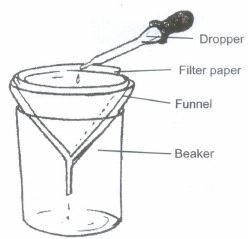
Keep pouring water till it starts dipping. Subtract the amount of water left in the measuring cylinder from the amount you started with. This is the amount of water retained by soil.
Record it in this manner:
Weight of soil = 50 mg
Initial volume of water = U mL
Final volume of water = V mL
Volume absorbed by the soil = (U- V) mL
Weight of water absorbed by the soil = (U - V) gm
because weight of 1 mL of water = 1 gm
Percentage of water absorbed = \(\frac { U-V }{ 50 } \times 100\)
Repeat this activity with different samples of soil. You observe that different soils have different absorbing capacity of water.
33.
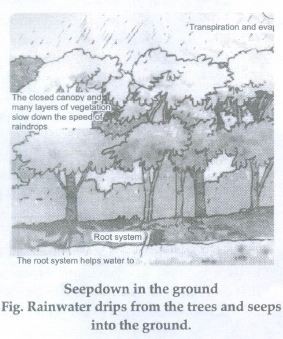
The forest acts as a natural absorber of rain water and allows it to seep. It helps to maintain the water table throughout the year. Forests not only helps in controlling floods but also help to maintain the flow of water in the streams so that we get a steady supply of water. On the other hand, if trees are not present rain hits the ground directly and may flood the area around it. Heavy rain may also damage the soil. Roots of trees normally bind the soil together, but in their absence the soil is washed away or eroded.
34.
(i) Plane mirror:
The image formed by a plane mirror is always erect. It is virtual and is of the same size as the object. The image is at the same distance behind the mirror as the object is in front of it. In an image formed by a mirror, the left side of the object is seen on the right side in the image, and right side of the object appears to be on the left side in the image.
(ii) Concave mirror:
A concave mirror can form a real and inverted image. When the object is placed very close to the mirror, the image formed is virtual, erect and magnified.
(iii) Convex mirror:
Image formed by a convex mirror is erect, virtual and smaller in size than the object.
(iv) Concave lens:
A concave lens always forms erect, virtual and smaller in than the object.
(v) Convex lens:
A convex lens can form real and inverted image. When the object is placed very close to the lens, the image formed is virtual, erect and magnified. When used to see magnified objects, the convex lens is called a magnifying glass.
The image is virtual, erect and magnified.
35.
(a) Respiration is the process of breakdown of food to produce energy for performing various functions. It involves two major steps:
(i) Inhalation is the process of taking in of air which is rich in oxygen, inside our body.
(ii) Exhalation is the process of giving out of air which is rich in carbon dioxide from our body to the external environment.
(b) The number of times a person breathes, in a minute is called as breathing rate. An adult human being can inhale or exhale 15-18 times in a minute. It is the average breathing rate of an adult human being. Breathing rate is not constant always.
36.
()
Lighter
37.
()
Lateral inversion
38.
()
water , Food/Carbohydrates
39.
()
aquifer
40.
()
hair
41.
()
Light coloured clothes of cotton give us a feeling of coldness by reflecting heat.
42.
()
Jaundice and cholera.
43.
()
Water cycle.
44.
()
There are four chambers in human heart.
45.
()
Corrosion is the damage of metals due to air and moisture.
46.
()
Paper strip will start floating.
47.
()
Yes. By making small holes more rain water can be percolated.
48.
()
Convex lens converges (bends inside) the rays of light passing through it. So it is called as converging lens.
49.
()
Temperature, humidity, wind-speed.
50.
()
Stomata

7th Standard CBSE Syllabus & Materials
7th Standard CBSE
CBSE 7th Social Science Theme B - New Beginnings : Cities and States - New Sample Question Papers Study Material - QB365 Set A
NEW7th Standard CBSE
CBSE 7th Social Science Theme A - Climates of India - New Sample Question Papers Study Material - QB365 Set A
NEW7th Standard CBSE
CBSE 7th Social Science Theme A - Geographical Diversity of India - New Sample Question Papers Study Material - QB365 Set A
NEW7th Standard CBSE
CBSE 7th Science Earth, Moon and the Sun - New Sample Question Papers Study Material - QB365 Set A



NCERT Books

Syllabus

Exam Pattern

Sample Question Papers

Previous year Question Papers

Important Notes

MCQ Practice test

NCERT Exemplers

Case study Questions

Image Based Questions

Passage based Questions

HOT Questions

Value Based Questions

Model Questions Papers
NCERT ( Book Back ) Questions

Assertion and Reason
Important Questions And Answers

CBSE 7th Standard CBSE Subjects
CBSE Standards


