
 100% FREE ACCESS
7th Standard CBSE Syllabus & Materials
7th Standard CBSE
CBSE 7th Social Science Theme E - Understanding Market - New Sample Question Papers Study Material - QB365 Set A
NEW7th Standard CBSE
CBSE 7th Social Science Theme E - From Barter to Money - New Sample Question Papers Study Material - QB365 Set A
NEW7th Standard CBSE
CBSE 7th Social Science Theme D - The Constitution of India- An Introduction - New Sample Question Papers Study Material - QB365 Set A
NEW7th Standard CBSE
CBSE 7th Social Science Theme D - From the Rulers to the Ruled : Types of Governments - New Sample Question Papers Study Material - QB365 Set A
NEW7th Standard CBSE
CBSE 7th Social Science Theme B - The Age of Reorganisation - New Sample Question Papers Study Material - QB365 Set A
NEW7th Standard CBSE
CBSE 7th Social Science Theme B - The Rise of Empires - New Sample Question Papers Study Material - QB365 Set A

Published on: 31/10/2025
Download CBSE Class 7th Standard CBSE Science question papers, sample papers, important questions, and previous year solved papers in PDF format. Get free study materials, NCERT solutions, and exam preparation resources for Class 7th Standard CBSE Science
Questions + Answers key
Take MCQ Science Test
1.
Give the difference between weather and climate.
2.
Indicate the type of climate of the following areas
(a) Jammu and Kashmir
(b) Kerala
(c) Rajasthan
(d) North-East India
3.
How do elephant living in the tropical rainforest adapt itself?
4.
Following are some of the characteristics of animals
(a) Diets heavy on fruits
(b) White fur
(c) Need to migrate
(d) Loud voice
(e) Sticky pads on feet
(f) Layer of fat under skin
(g) Wide and large paws
(h) Bright colours
(i) Strong tails
(j) Long and large beak
For each characteristics indicate whether it is adaptation for tropical rainforests or polar regions. Do you think that some of these characteristics can be adopted for both regions?
5.
Which of the two changes frequently, weather or climate?
6.
When are the maximum and minimum temperatures likely to occur during the day?
7.
When the sun's heat reaches to the lowest level, it is called
maximum temperature
minimum temperature
average temperature
None of the above
8.
Humidity in climate is due to
rainfall
amount of water vapour in the air
snowfall
wind
9.
Which option best describes a tropical region?
Hot and humid
Moderate temperature, heavy rainfall
Cold and humid
Hot and dry
10.
Which features adapt polar bears to live in extremely cold climate?
A white fur, fat below skin, keen sense of smell.
Thin skin, large eyes, a white fur.
A long tail, strong claws, white large paws
White body, paws for swimming, gills for respiration.
11.
A carnivore with stripes on its body moves very fast while catching its prey. It is likely to be found in
polar regions
deserts
oceans
tropical rainforests
12.
Name the primary sources of energy which cause changes in the weather.
13.
There are several elements of weather. The weather report carries the information about which of the elements of weather?
14.
Give one example of an animal that can live both in water and on land.
15.
Which is the most important factor in determining the climate of a place?
16.
A fish dies when taken out of water, whereas a wall lizard will die if kept under water. Mention the term used to describe such abilities that allow fish and lizard to survive in their respective habitats.
17.
During rainy season, what do we use to protect ourselves from rainwater?
18.
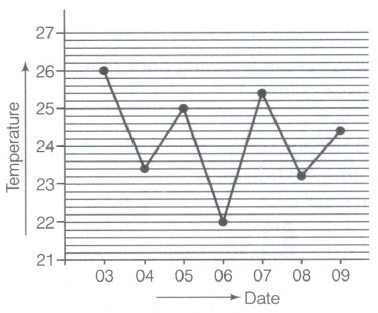
The following graph shows the change in temperature. Answer according to the reading of graph.
(a) Draw a table and fill the temperature change of each day.
(b) Which day show the highest temperature?
(c) Which day shows the minimum temperature?
19.
In a class, the teacher was explaining a concept from weather and climate chapter. Anand got confused and slowly asked his teacher to repeat again. She smiled and started again. In equatorial belt the climate is hot and wet. It has evergreen rainforest and variety of plants. Similarly the vegetation of tropical region also has variations. The forest located between two tropics is called tropical forest. Desert shows arid region and only xerophytes are observed. These plants show specific modification for their survival in this arid region.
(a) Which type of forest is formed in equatorial region?
(b) What are the variation in vegetation seen in tropical forest?
(c) Give some adaptations of plants that are formed in desert.
(d) Some places conifers are seen. What are these places?
(e) What values do we observe in the teacher and Anand?
20.
Rohan went to the desert of Rajasthan with his freinds. He saw an animal. It had a hump. Its feet had large soles. He wondered about this animal. He found that these were adaptations of that animal which helped it to survive in very hot and dry climate of the desert. Answer the following questions on the basis of the observations seen by Rohan.
(a) Name the animal Rohan observed in the desert of Rajasthan?
(b) What role does this hump has in this animal?
(c) Why do it has large soles?
(d) Can you give same more adaptations of this animal which help it to survive in desert?
(e) What values do you observe in Rohan?
1.
Difference between weather and climate
| Weather | Climate |
|---|---|
| It is a day to day condition of atmosphere at a place. | It is the average weather pattern taken over a long period of time (say 25 years). |
| It varies over a very short period of time (like hour to hour). | It does not vary in a short period of time. |
| It cannot affect the adaptation of an organism. | Climate affects the adaptions of an organism. |
2.
(a) Jammu and Kashmir: cold and moderately wet climate
(b) Kerala: very hot and wet climate
(c) Rajasthan: very hot and dry climate
(d) North-East India: wet climate
3.
Elephant living in the tropical rainforest has adapted to the conditions of rainforests in many remarkable ways. It uses its trunk as a nose because of which it has a strong sense of smell. The trunk also helps in picking up food. Its tusks are modified teeth. These can tear the bark of trees that elephant loves to eat. Large ears of the elephant help it to hear even very soft sound. They also help the elephant to keep cool in the hot and humid climate of the tropical rainforest.
4.
| Characteristics of animal | Adaptation for region |
|---|---|
| (a) Diets heavyon fruits | tropical rainforests |
| (b) Whitefur | polar regions |
| (c) Need to migrate | polar regions |
| (d) Loud voice | tropical rainforests |
| (e) Sticky pads on feet | tropical rainforests |
| (f) Layerof fat under skin | polar regions |
| (g) Wide and large paws | polar regions |
| (h) Bright colours | tropical rainforests |
| (i) Strong tails | tropical rainforests |
| (j) Long and large beak | tropical rainforests |
5.
Weather changes frequently in a very short period of time.
6.
The maximum temperature of the day occurs generally in the afternoon while the minimum temperature occurs generally in the early morning.
7.
(b)
minimum temperature
8.
(b)
amount of water vapour in the air
9.
(a)
Hot and humid
10.
(a)
A white fur, fat below skin, keen sense of smell.
11.
(d)
tropical rainforests
12.
The sun is the primary source of energy that causes Change in the weather.
13.
Daily weather reports carry information about the temperature, humidity and rainfall during the past 24 hrs.
14.
Those animals that can live both in water and on land are called amphibian, e.g. frog.
15.
The major factor which determines the climate of a place is latitude.
16.
Adaptation is the term used to describe such ability. Animals are adapted to survive in the conditions in which they live. So, fish dies when taken out of water while wall lizard dies if kept under water.
17.
We use umbrella or raincoat to protect ourselves from rainwater during rainy season.
18.
(a) Table showing the reading of temperature from the graph:
| Date | Maximum temperature |
|---|---|
| 03/11/14 | 26.0oC |
| 04/11/14 | 23.5oC |
| 05/11/11 | 25.0oC |
| 06/11/14 | 22.0oC |
| 07/11/14 | 25.5oC |
| 08/11/14 | 23.3oC |
| 09/11/14 | 24.4oC |
(b) The highest temperature is seen on 3rd November, 2014.
(c) The lowest temperature or minimum temperature was seen on 06th November, 2014.
19.
(a) Evergreen rainforest with the greatest variety of plants are seen in equational region.
(b) In tropical regions, vegetation varies from broad leaves evergreen trees to tropical deciduous trees to grassland.
(c) The plants in the arid of desert regions have modified leaves covered with hair or waxy coating and an extensive root system.
(d) Conifers are maintained and adapted to withst and snow fall and shortage ofwater in colder belt.
(e) Anand is observant and sincere boy. He is not afraid to ask question in the class.
20.
(a) Rohan observed a camel in the desert of Rajasthan.
(b) The hump stores fat which provides camel with food in times of food shortage.
(c) The feets of camel has large soles which help it to walk on soft sond.
(d) Camel can drink a very large quantity of water at a time which is stored in its stomach. It sweats very little which helps it to conserve water. Also it excretes very little water in the form of urine.
(e) Rohan is observant, curious and adventurer. He asks intelligent questions.

7th Standard CBSE Syllabus & Materials
7th Standard CBSE
CBSE 7th Social Science Theme B - New Beginnings : Cities and States - New Sample Question Papers Study Material - QB365 Set A
NEW7th Standard CBSE
CBSE 7th Social Science Theme A - Climates of India - New Sample Question Papers Study Material - QB365 Set A
NEW7th Standard CBSE
CBSE 7th Social Science Theme A - Geographical Diversity of India - New Sample Question Papers Study Material - QB365 Set A
NEW7th Standard CBSE
CBSE 7th Science Earth, Moon and the Sun - New Sample Question Papers Study Material - QB365 Set A



NCERT Books

Syllabus

Exam Pattern

Sample Question Papers

Previous year Question Papers

Important Notes

MCQ Practice test

NCERT Exemplers

Case study Questions

Image Based Questions

Passage based Questions

HOT Questions

Value Based Questions

Model Questions Papers
NCERT ( Book Back ) Questions

Assertion and Reason
Important Questions And Answers

CBSE 7th Standard CBSE Subjects
CBSE Standards


