
 100% FREE ACCESS
7th Standard CBSE Syllabus & Materials
7th Standard CBSE
CBSE 7th Social Science Theme E - Understanding Market - New Sample Question Papers Study Material - QB365 Set A
NEW7th Standard CBSE
CBSE 7th Social Science Theme E - From Barter to Money - New Sample Question Papers Study Material - QB365 Set A
NEW7th Standard CBSE
CBSE 7th Social Science Theme D - The Constitution of India- An Introduction - New Sample Question Papers Study Material - QB365 Set A
NEW7th Standard CBSE
CBSE 7th Social Science Theme D - From the Rulers to the Ruled : Types of Governments - New Sample Question Papers Study Material - QB365 Set A
NEW7th Standard CBSE
CBSE 7th Social Science Theme B - The Age of Reorganisation - New Sample Question Papers Study Material - QB365 Set A
NEW7th Standard CBSE
CBSE 7th Social Science Theme B - The Rise of Empires - New Sample Question Papers Study Material - QB365 Set A

Published on: 31/10/2025
Download CBSE Class 7th Standard CBSE Science question papers, sample papers, important questions, and previous year solved papers in PDF format. Get free study materials, NCERT solutions, and exam preparation resources for Class 7th Standard CBSE Science
Questions + Answers key
Take MCQ Science Test
1.
Take an outline map of the world. Mark the polar regions and tropical regions.
2.
How does sun cause the changes in the weather?
3.
Write two common adaptive features of a polar bear which help in keeping it warm.
4.
Give the difference between weather and climate.
5.
Name two animals each that live in polar regions and tropical rainforests.
6.
Which of the two changes frequently, weather or climate?
7.
When are the maximum and minimum temperatures likely to occur during the day?
8.
Tropical forests have a hot and _____ climate.
9.
Rainfall is measured by ______
10.
The fur of polar bear has ______ layers.
11.
_______ is the amount of water vapour present in air at a certain temperature.
12.
_____________ are good swimmers.
13.
The ___________ of polar bear helps it to protect it from predators.
14.
____________ animals becomes active during night.
15.
Red-eyed frog lives on __________
16.
The seasonal journey taken by the animals to escape extreme climatic conditions is called ____________
17.
The average weather taken over a long time is called ____________
18.
Why is it difficult to predict the weather of a place while it is easy to predict its climate?
19.
Name two countries that show the tropical rainforests.
20.
When sun rays fall on the earth, what does it provide?
21.
Give one example of an animal that can live both in water and on land.
22.
Which is the most important factor in determining the climate of a place?
23.
A fish dies when taken out of water, whereas a wall lizard will die if kept under water. Mention the term used to describe such abilities that allow fish and lizard to survive in their respective habitats.
24.
During rainy season, what do we use to protect ourselves from rainwater?
25.
What is meant by migration of birds, how it is regulated?
26.
How elephant is adopted to the conditions of tropical rainforest?
1.
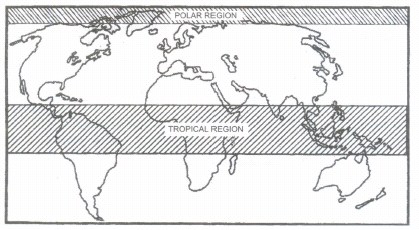
2.
Sun is a huge sphere of hot gases burning at a very high temperature. The distance of the sun from us is very much. Even then the energy sent out by the sun is very large in amount. So, sun is the primary source of energy that causes change in the weather. Energy absorbed and reflected by the Earth's surface, oceans and atmosphere play an important role in determining the weather at any place.
3.
Adaptive features of a polar bear that help in keeping it warm are as follows
(i) They have two thick layers of white fur.
(ii) They have layer of fat under their skin.
4.
Difference between weather and climate
| Weather | Climate |
|---|---|
| It is a day to day condition of atmosphere at a place. | It is the average weather pattern taken over a long period of time (say 25 years). |
| It varies over a very short period of time (like hour to hour). | It does not vary in a short period of time. |
| It cannot affect the adaptation of an organism. | Climate affects the adaptions of an organism. |
5.
Polar regions Polar bear/penguin/ reindeer/musk oxen.
Tropical rainforests Red-eyed frog /elephants lion-tailed macaque/ lion and tiger.
6.
Weather changes frequently in a very short period of time.
7.
The maximum temperature of the day occurs generally in the afternoon while the minimum temperature occurs generally in the early morning.
8.
()
humid
9.
()
rain gauge
10.
()
two
11.
()
humidity
12.
()
Penguins
13.
()
white fur
14.
()
Nocturnal
15.
()
trees
16.
()
migration
17.
()
climate
18.
Weather is a complex phenomenon which can vary over a short period of time and thus it is difficult to predict the weather of a place while it is easier to predict climate as it is the average weather pattern taken for a long time.
19.
Tropical rainforest is found in India and central America.
20.
Sun provides light as well as heat on the earth.
21.
Those animals that can live both in water and on land are called amphibian, e.g. frog.
22.
The major factor which determines the climate of a place is latitude.
23.
Adaptation is the term used to describe such ability. Animals are adapted to survive in the conditions in which they live. So, fish dies when taken out of water while wall lizard dies if kept under water.
24.
We use umbrella or raincoat to protect ourselves from rainwater during rainy season.
25.
To escape the harsh winter conditions of polar regions birds travel to warmer place in winter. This movement of birds is termed migration. During migration the birds fly high where wind flow is helpful and the cold conditions allow them to disperse the heat generated by their flight muscles. How these birds travel to the same place year after year is still a mystery. These birds have built in sense of direction and they know which direction to travel. Many birds are guided by sun during day and by stars during night. Some ornithologists suggest that the birds may use magnetic field of the earth to find the direction.
26.
(i) It has a big trunk which is used for two purposes-as a nose and for picking up food.
(ii) Its tusk can tear bark of trees. The elephant thus does not face problem as far as availability of food is concerned.
(iii) It has large ears which can hear small sounds. The large ears also help the elephant to remain cool in the hot and humid climate of the rainforest.

7th Standard CBSE Syllabus & Materials
7th Standard CBSE
CBSE 7th Social Science Theme B - New Beginnings : Cities and States - New Sample Question Papers Study Material - QB365 Set A
NEW7th Standard CBSE
CBSE 7th Social Science Theme A - Climates of India - New Sample Question Papers Study Material - QB365 Set A
NEW7th Standard CBSE
CBSE 7th Social Science Theme A - Geographical Diversity of India - New Sample Question Papers Study Material - QB365 Set A
NEW7th Standard CBSE
CBSE 7th Science Earth, Moon and the Sun - New Sample Question Papers Study Material - QB365 Set A



NCERT Books

Syllabus

Exam Pattern

Sample Question Papers

Previous year Question Papers

Important Notes

MCQ Practice test

NCERT Exemplers

Case study Questions

Image Based Questions

Passage based Questions

HOT Questions

Value Based Questions

Model Questions Papers
NCERT ( Book Back ) Questions

Assertion and Reason
Important Questions And Answers

CBSE 7th Standard CBSE Subjects
CBSE Standards


