
 100% FREE ACCESS
7th Standard CBSE Syllabus & Materials
7th Standard CBSE
CBSE 7th Social Science Theme E - Understanding Market - New Sample Question Papers Study Material - QB365 Set A
NEW7th Standard CBSE
CBSE 7th Social Science Theme E - From Barter to Money - New Sample Question Papers Study Material - QB365 Set A
NEW7th Standard CBSE
CBSE 7th Social Science Theme D - The Constitution of India- An Introduction - New Sample Question Papers Study Material - QB365 Set A
NEW7th Standard CBSE
CBSE 7th Social Science Theme D - From the Rulers to the Ruled : Types of Governments - New Sample Question Papers Study Material - QB365 Set A
NEW7th Standard CBSE
CBSE 7th Social Science Theme B - The Age of Reorganisation - New Sample Question Papers Study Material - QB365 Set A
NEW7th Standard CBSE
CBSE 7th Social Science Theme B - The Rise of Empires - New Sample Question Papers Study Material - QB365 Set A

Published on: 31/10/2025
Download CBSE Class 7th Standard CBSE Science question papers, sample papers, important questions, and previous year solved papers in PDF format. Get free study materials, NCERT solutions, and exam preparation resources for Class 7th Standard CBSE Science
Questions + Answers key
Take MCQ Science Test
1.
Briefly explain what are cyclones and how are they formed.
2.
Name some effective safety measures against cyclone?
3.
Explain thunderstorm and how are they produced.
4.
Give three precautions that should be taken to protect oneself from the thunderstorm.
5.
How will you help your neighbours in case cyclone approaches your village/town?
6.
Explain why holes are made in hanging banners and hoardings.
7.
Suggest two methods to find out wind direction at a given place.
8.
The warning of cyclone can be issued
48 h in advance
12 h in advance
6 h in advance
24 h in advance
9.
Orissa was hit by a cyclone with wind speed of 200 km/h on which date
18Oct, 1998
18 Oct, 1999
18 Oct, 2001
18 Oct, 2000
10.
Following are precautions, one must take in case a storm is accompanied by lightning.
(i) Do not take shelter under tree.
(ii) Do not take shelter under an umbrella with a metallic end.
(iii) Do not take shelter in open garages, storage sheds, etc.
(iv) Do not take shelter in a bus in the open. Which one of these is not correct?
(i)
(ii)
(iii)
(iv)
11.
Which of the statements given below is correct?
In winter, the winds blow from the land to the ocean.
In summer, the winds blow from the land towards the ocean.
A cyclone is formed at a very high pressure system with very high speed winds revolving around it.
The coastline of India is not vulnerable to cyclones.
12.
Which one of the following places is unlikely to be affected by a cyclone?
Chennai
Mangaluru (Mangalore)
Amritsar
Puri
13.
Monsoon winds are helpful. Do you agree?
14.
Enlist the other names of cyclone.
15.
To expel hot air out of the kitchen, A has an exhaust fan fitted on the window of her kitchen and B has a similar exhaust fan fitted on the wall near the ceiling of her kitchen. Which of the exhaust fan will expel the hot air more effectively? Explain why.
16.
Briefly describe the effect of heat on air pressure.
17.
Name the ocean which is mainly responsible to bring rain bearing monsoon winds to Kerala coast in June every year.
18.
Discuss the major cause of winds.
19.
Why is Chandigarh unlikely to be affected by a cyclone?
20.
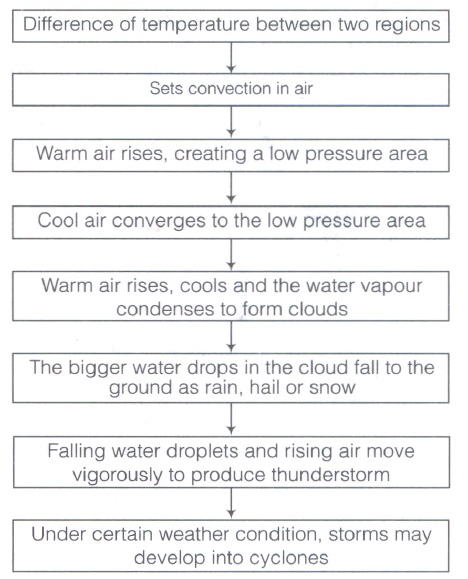
The phenomenon of cloud formation, rain, storm and cyclone are inter linked. Do you agree? If yes, give a flow chart that explain this relation.
21.
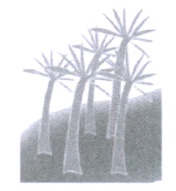
The picture in figure shows tree line along the sea coast on an island near the equator. As shown, the tree tops are permanently bent in one direction. Are the trees bend towards the sea or away from it? Explain.
1.
High speed winds and air pressure difference can cause cyclones.They are formed when water vapour changes back to liquid by the release of heat. This heat warms air around and it rises to move up and more air rushes to the vacant place. Thus, a cycle is formed which have low pressure and very high speed of air.
2.
These are produced by the dark clouds which form at fairly low altitude in the atmosphere.
3.
The swift movement of the falling water along with the rising warm air producing sound, lightning, heavy rain and strong wind is called thunderstorm.
4.
The following three precautions must be taken to protect oneself from the lightning of thunderstorm
(i) Do not take shelter under an isolated tree.
(ii) Do not lie on the ground
(iii) Do not take shelter under an umbrella with a metallic end.
5.
I will help my neighbours in case cyclone approaches my village/town by the following ways:
(i) I will help in shifting their household articles, domestic animals, etc., to safer place. (ii) I will provide phone numbers of all emergency services like police, fire brigade and medical centres.
(iii) I will give them safety advice like avoid driving on roads through standing water, not to touch wet switches, etc.
6.
Holes are made in hanging banners and hoardings to allow air to pass through them as a result of which there will be less pressure of air on the banners or hoardings. Unless it is done, these may be uprooted or distorted due to the pressure of the air.
7.
Two methods to find out wind direction at a given place are
(i) An instrument called anemometer can be used to find the direction and speed of the wind.
(ii) Hold a strip of paper outside. The direction in which the paper is blowing is the direction in which the wind blows.
8.
(d)
24 h in advance
9.
(b)
18 Oct, 1999
10.
(d)
(iv)
11.
(a)
In winter, the winds blow from the land to the ocean.
12.
(c)
Amritsar
13.
The monsoon winds carry water and it rains. Clouds bring rain and give us happiness. Farmers in our country depend mainly on rains for their harvests. So, monsoon winds are helpful.
14.
Hurricane and typhoon are the other names of cyclone.
15.
B's exhaust fan will expel the hot air more effectively because hot air rises up and her fan is at greater height than A's.
16.
The heat causes air to expand and occupies more space. It becomes lighter. That's why, warm air is lighter than the cold air.
17.
An Indian ocean is mainly responsible to bring rain bearing monsoon winds to Kerala coast in June every year.
18.
Wind currents are generated due to uneven heating on the earth. It may be between equator and pole and between land and water.
19.
Chandigarh is unlikely to be affected by a cyclone because it is not near to the sea or an ocean.
20.
Yes, the following flow chart explains the phenomenon leading to the formation of cloud, rain, storm and cyclone.
21.
In the given figure, the tree line along the sea coast on an island near the equator shows that tree tops are permanently bent in one direction. The reason behind this movement of tree is that during the day time the wind blows from sea to land because land gets warmer more quickly than sea.
This makes the air of land, warm and lighter which is raised up in the sky. Therefore, the top of the bent trees shows the moving direction of wind from sea to land.

7th Standard CBSE Syllabus & Materials
7th Standard CBSE
CBSE 7th Social Science Theme B - New Beginnings : Cities and States - New Sample Question Papers Study Material - QB365 Set A
NEW7th Standard CBSE
CBSE 7th Social Science Theme A - Climates of India - New Sample Question Papers Study Material - QB365 Set A
NEW7th Standard CBSE
CBSE 7th Social Science Theme A - Geographical Diversity of India - New Sample Question Papers Study Material - QB365 Set A
NEW7th Standard CBSE
CBSE 7th Science Earth, Moon and the Sun - New Sample Question Papers Study Material - QB365 Set A



NCERT Books

Syllabus

Exam Pattern

Sample Question Papers

Previous year Question Papers

Important Notes

MCQ Practice test

NCERT Exemplers

Case study Questions

Image Based Questions

Passage based Questions

HOT Questions

Value Based Questions

Model Questions Papers
NCERT ( Book Back ) Questions

Assertion and Reason
Important Questions And Answers

CBSE 7th Standard CBSE Subjects
CBSE Standards


