
 100% FREE ACCESS
7th Standard CBSE Syllabus & Materials
7th Standard CBSE
CBSE 7th Social Science Theme E - Understanding Market - New Sample Question Papers Study Material - QB365 Set A
NEW7th Standard CBSE
CBSE 7th Social Science Theme E - From Barter to Money - New Sample Question Papers Study Material - QB365 Set A
NEW7th Standard CBSE
CBSE 7th Social Science Theme D - The Constitution of India- An Introduction - New Sample Question Papers Study Material - QB365 Set A
NEW7th Standard CBSE
CBSE 7th Social Science Theme D - From the Rulers to the Ruled : Types of Governments - New Sample Question Papers Study Material - QB365 Set A
NEW7th Standard CBSE
CBSE 7th Social Science Theme B - The Age of Reorganisation - New Sample Question Papers Study Material - QB365 Set A
NEW7th Standard CBSE
CBSE 7th Social Science Theme B - The Rise of Empires - New Sample Question Papers Study Material - QB365 Set A

Published on: 31/10/2025
Download CBSE Class 7th Standard CBSE Science question papers, sample papers, important questions, and previous year solved papers in PDF format. Get free study materials, NCERT solutions, and exam preparation resources for Class 7th Standard CBSE Science
Questions + Answers key
Take MCQ Science Test
1.
Briefly explain what are cyclones and how are they formed.
2.
Describe the following terms briefly.
Trade winds
3.
Name some effective safety measures against cyclone?
4.
Explain why holes are made in hanging banners and hoardings.
5.
State two experiences that made you think that air exerts pressure.
6.
The main cause of wind movement is uneven ___________
7.
Factors like ___________,__________,_________and ___________ contribute to the development of cyclones.
8.
Air __________ on heating and ___________ on cooling.
9.
Air moves from a region of ___________ pressure to a region of __________ pressure.
10.
Wind is ___________ air.
11.
The word monsoon is derived from the word
mausam
monsoon
museum
storm
12.
Formation of thunderstorm requires
moisture
rapidly rising warm air
sea breeze
All of the above
13.
Wind is caused due to
uneven heating of equator and poles
difference in humidity
even heating of land and water
None of the above
14.
Orissa was hit by a cyclone with wind speed of 200 km/h on which date
18Oct, 1998
18 Oct, 1999
18 Oct, 2001
18 Oct, 2000
15.
Which of the statements given below is correct?
In winter, the winds blow from the land to the ocean.
In summer, the winds blow from the land towards the ocean.
A cyclone is formed at a very high pressure system with very high speed winds revolving around it.
The coastline of India is not vulnerable to cyclones.
16.
Monsoon winds are helpful. Do you agree?
17.
Name the instrument which is used to measure the speed of wind.
18.
Enlist the other names of cyclone.
19.
Briefly describe the effect of heat on air pressure.
20.
Discuss the major cause of winds.
21.
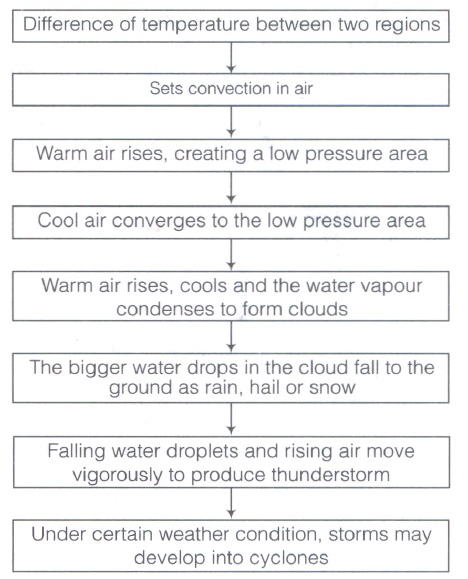
The phenomenon of cloud formation, rain, storm and cyclone are inter linked. Do you agree? If yes, give a flow chart that explain this relation.
22.
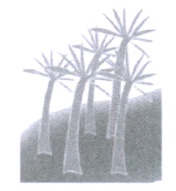
The picture in figure shows tree line along the sea coast on an island near the equator. As shown, the tree tops are permanently bent in one direction. Are the trees bend towards the sea or away from it? Explain.
23.
Warm air is lighter than cool air.
24.
A very high pressure system with very high speed wind surroundings, it forms a cyclone.
25.
The wind speed during cyclone is 150-250 km/h.
26.
Cyclone appears a dark funnel-shaped structure.
27.
Cyclone develops in the polar region.
1.
High speed winds and air pressure difference can cause cyclones.They are formed when water vapour changes back to liquid by the release of heat. This heat warms air around and it rises to move up and more air rushes to the vacant place. Thus, a cycle is formed which have low pressure and very high speed of air.
2.
The permanent wind that blows towards the equator from North to South are called trade winds.
3.
These are produced by the dark clouds which form at fairly low altitude in the atmosphere.
4.
Holes are made in hanging banners and hoardings to allow air to pass through them as a result of which there will be less pressure of air on the banners or hoardings. Unless it is done, these may be uprooted or distorted due to the pressure of the air.
5.
Two experiences that made us think that air exerts pressure are
(i) Cycling against the direction of the wind, it is difficult to ride. It shows that the air exerts pressure.
(ii) While rowing a sailboat in the direction of the wind, it is always easier to row and while rowing a sailboat against the direction of the wind, it is very difficult to row. It also shows that the air exerts pressure.
6.
()
heating
7.
()
Wind speed, wind direction, temperature, humidity
8.
()
expands, contracts
9.
()
high, low
10.
()
moving
11.
(a)
mausam
12.
13.
(a)
uneven heating of equator and poles
14.
(b)
18 Oct, 1999
15.
(a)
In winter, the winds blow from the land to the ocean.
16.
The monsoon winds carry water and it rains. Clouds bring rain and give us happiness. Farmers in our country depend mainly on rains for their harvests. So, monsoon winds are helpful.
17.
Anemometer is used to measure the speed of wind.
18.
Hurricane and typhoon are the other names of cyclone.
19.
The heat causes air to expand and occupies more space. It becomes lighter. That's why, warm air is lighter than the cold air.
20.
Wind currents are generated due to uneven heating on the earth. It may be between equator and pole and between land and water.
21.
Yes, the following flow chart explains the phenomenon leading to the formation of cloud, rain, storm and cyclone.
22.
In the given figure, the tree line along the sea coast on an island near the equator shows that tree tops are permanently bent in one direction. The reason behind this movement of tree is that during the day time the wind blows from sea to land because land gets warmer more quickly than sea.
This makes the air of land, warm and lighter which is raised up in the sky. Therefore, the top of the bent trees shows the moving direction of wind from sea to land.
23.
(a)
24.
(b)
25.
(a)
26.
(b)
27.
(b)

7th Standard CBSE Syllabus & Materials
7th Standard CBSE
CBSE 7th Social Science Theme B - New Beginnings : Cities and States - New Sample Question Papers Study Material - QB365 Set A
NEW7th Standard CBSE
CBSE 7th Social Science Theme A - Climates of India - New Sample Question Papers Study Material - QB365 Set A
NEW7th Standard CBSE
CBSE 7th Social Science Theme A - Geographical Diversity of India - New Sample Question Papers Study Material - QB365 Set A
NEW7th Standard CBSE
CBSE 7th Science Earth, Moon and the Sun - New Sample Question Papers Study Material - QB365 Set A



NCERT Books

Syllabus

Exam Pattern

Sample Question Papers

Previous year Question Papers

Important Notes

MCQ Practice test

NCERT Exemplers

Case study Questions

Image Based Questions

Passage based Questions

HOT Questions

Value Based Questions

Model Questions Papers
NCERT ( Book Back ) Questions

Assertion and Reason
Important Questions And Answers

CBSE 7th Standard CBSE Subjects
CBSE Standards


