
 100% FREE ACCESS
7th Standard CBSE Syllabus & Materials
7th Standard CBSE
CBSE 7th Social Science Theme E - Understanding Market - New Sample Question Papers Study Material - QB365 Set A
NEW7th Standard CBSE
CBSE 7th Social Science Theme E - From Barter to Money - New Sample Question Papers Study Material - QB365 Set A
NEW7th Standard CBSE
CBSE 7th Social Science Theme D - The Constitution of India- An Introduction - New Sample Question Papers Study Material - QB365 Set A
NEW7th Standard CBSE
CBSE 7th Social Science Theme D - From the Rulers to the Ruled : Types of Governments - New Sample Question Papers Study Material - QB365 Set A
NEW7th Standard CBSE
CBSE 7th Social Science Theme B - The Age of Reorganisation - New Sample Question Papers Study Material - QB365 Set A
NEW7th Standard CBSE
CBSE 7th Social Science Theme B - The Rise of Empires - New Sample Question Papers Study Material - QB365 Set A

Published on: 26/11/2019
Nutrition in Animals
Download CBSE Class 7th Standard CBSE Science question papers, sample papers, important questions, and previous year solved papers in PDF format. Get free study materials, NCERT solutions, and exam preparation resources for Class 7th Standard CBSE Science
Questions + Answers key
Take MCQ Science Test
1.
Read carefully the terms given below. Which of the following set is the correct combination of organs that do not carry out any digestive functions?
Oesophagus, Large Intestine, Rectum
Buccal cavity, Oesophagus, Rectum
Buccal cavity, Oesophagus, Large Intestine
Small Intestine, Large Intestine, Rectum
2.
The Bile juice is stored in :
Gall bladder
Liver
Pancreas
Small intestine
3.
Which one of the following is not secreted by the walls of stomach?
hydrochloric acid
Mucous
Digestive juice
Bile juice
4.
The simplest form of protein is
fatty acids
glucose
glycerol
amino acids
5.
Water from the undigested food is absorbed mainly in the
stomach
foodpipe
small intestine
large intestine
6.
What happens when we do not clean our teeth after eating food.
7.
What do you mean by salivary digestion?
8.
What do you mean by tooth decay? Explain its process.
9.
Name the various components of food and their simpler forms.
10.
Why do we get instant energy from glucose?
11.
What is a food pipe? Write its functions.
12.
What do you understand by rumen?
13.
Do you know the functions of the tongue?
14.
The long structure of small intestine is accommodated in small space within our body. Comment.
15.
Name the secretions of stomach which digest food.
16.
How do ruminants digest the cellulose?
17.
Explain the human digestive system with the help of labelled diagram.
18.
Define oral rehydration solution and when it is given to the patient? How can you prepare ORS at home?
19.
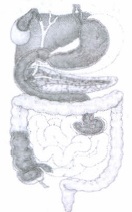
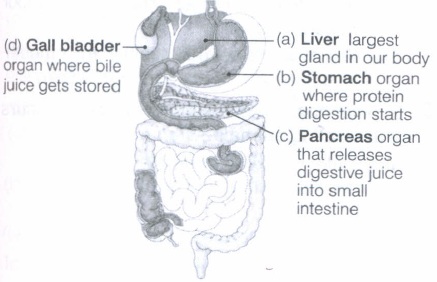
Label the following parts of above figure and name them.
(a) The largest gland in our body.
(b) The organ where protein digestion starts.
(c) The organ that releases digestive juice into the small intestine.
(d) The organ where bile juice gets stored.
1.
(a)
Oesophagus, Large Intestine, Rectum
2.
(a)
Gall bladder
3.
(b)
Mucous
4.
(d)
amino acids
5.
Large intestine absorbs the water from undigested food.
6.
If we do not clean our teeth and mouth after eating, many harmful bacteria start to live in it. These bacteria breakdown the sugars present from the leftover food and release acids. The acids gradually damage the teeth. This is called tooth decay. It causes tooth loss in many cases.
7.
The food enters into the buccal cavity through mouth. It is chewed by the teeth and mixed with saliva. Saliva contains an enzyme called ptyalin (salivary amylase) which converts complex carbohydrates like starch into sugar. That is why the bread taste becomes sweet after chewing. This type of digestion is called salivary digestion.
8.
If we do not clean our teeth and mouth after eating, many harmful bacteria start to live in it. These bacteria breakdown the sugars present from the leftover food and release acids. The acids gradually damage the teeth. This is called tooth decay. It causes tooth loss in many cases.
9.
The various components of food and their simpler forms are
| Components of food | Simpler form |
| Carbohydrate | Glucose |
| Fats | Fatty acids and glycerol |
| Proteins | Amino acids |
| Vitamins | Vitamins |
| Minerals and water | Minerals and water |
10.
Glucose is a simple sugar or carbohydrate which is broken down in the presence of oxygen into CO2 and H2O and releases instant energy. Glucose is easily absorbed by the blood, hence provides instant energy to the body.
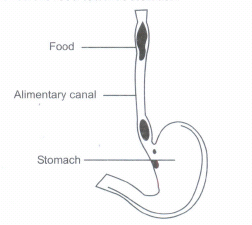
11.
A long tube along the neck and the chest is called a food pipe or oesophagus. The swallowed food passes into the food pipe. Food is pushed down by the movement of the wall of the food pipe. It pushed the food towards stomach.
12.
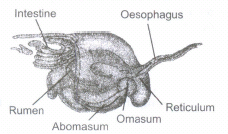
The grass eating animals quickly swallow the grass and store it in a separate part of the stomach. This part is called rumen.
13.
We use our tongue for talking and taste. Besides, it mixes saliva with the food during chewing and aids in swallowing food. We also taste food with our tongue. It has taste buds that detect different tastes of food.
14.
The small intestine is about 7.5 metre long It is accommodated in a coiled form inside our body.
15.
The inner lining of stomach secretes mucous hydrochloric acid and digestive juices.
16.
The food of ruminants like grass is rich in cellulose (a type of carbohydrate). Ruminants have a large sac-like structure between the small intestine and large intestine. The cellulose of the food is digested here by the action of certain bacteria which are not present in humans. In this way ruminants can digest the cellulose but many animals including human can not digest cellulose.
17.
When the ingest food in our mouth, salivary glands of the mouth secrete saliva which moistens the food. It also converts the starch into sugar. The tongue helps in chewing by moving the food in various directions. Saliva contains enzyme called salivary amylase which converts starch into sugar.
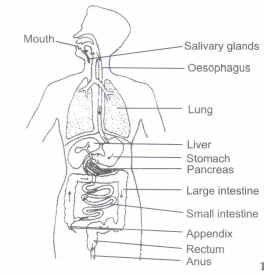
From mouth, food goes into food pipe called oesophagus. As food enters into the food pipe, muscles of its wall starts contraction and relaxation movement. This movement is called peristaltic movement that pushes the food into the stomach. The peristaltic movement occurs throughout the alimentary canal. The oesophagus leads the food to a saclike structure called stomach. The food is churned and partly digested in the stomach. The semi-solid food passes from the stomach to much coiled tube-like structure called the small intestine. The small intestine serves two purposes-digestion and absorption of the digested food. It is about 20 feet long. The inner surface of the small intestine has a large number of finger-like projections called villi. The villi increase the surface area for the absorption of digested food. The absorbed food enters into the blood stream and carried away to various parts of the body for assimilation. The undigested food moves from the small intestine to the large intestine where mainly absorption of water from the undigestion takes place. From the large intestine, the undigested food passes to the rectum which pushes it out of the body through the opening called the anus as faeces.
18.
Oral rehydration solution is the solution of sugar and salt in a particular ratio in the clean water. When a person passes out watery stools frequently, the disease is called diarrhoea. In this condition there is a loss of water and salt from the body of a person.
This is called dehydration which may be fatal if not cured at proper time. In order to prevent dehydration, the person or patient should be given ORS. ORS makes up the loss of water and salts in the body and sugar provides energy which helps in the recovery of disease. It should be given to a patient suffering from diarrhoea at a regular interval.
At home the ORS can be prepared by dissolving a teaspoonful of sugar and pinch of salt in a glass of clean water. The water used for preparing ORS should be first boiled and then cooled so that all the microorganisms or harmful bacteria may be killed.
19.

7th Standard CBSE Syllabus & Materials
7th Standard CBSE
CBSE 7th Social Science Theme B - New Beginnings : Cities and States - New Sample Question Papers Study Material - QB365 Set A
NEW7th Standard CBSE
CBSE 7th Social Science Theme A - Climates of India - New Sample Question Papers Study Material - QB365 Set A
NEW7th Standard CBSE
CBSE 7th Social Science Theme A - Geographical Diversity of India - New Sample Question Papers Study Material - QB365 Set A
NEW7th Standard CBSE
CBSE 7th Science Earth, Moon and the Sun - New Sample Question Papers Study Material - QB365 Set A



CBSE 7th Standard CBSE Subjects
CBSE Standards




