
 100% FREE ACCESS
7th Standard CBSE Syllabus & Materials
7th Standard CBSE
CBSE 7th Social Science Theme E - Understanding Market - New Sample Question Papers Study Material - QB365 Set A
NEW7th Standard CBSE
CBSE 7th Social Science Theme E - From Barter to Money - New Sample Question Papers Study Material - QB365 Set A
NEW7th Standard CBSE
CBSE 7th Social Science Theme D - The Constitution of India- An Introduction - New Sample Question Papers Study Material - QB365 Set A
NEW7th Standard CBSE
CBSE 7th Social Science Theme D - From the Rulers to the Ruled : Types of Governments - New Sample Question Papers Study Material - QB365 Set A
NEW7th Standard CBSE
CBSE 7th Social Science Theme B - The Age of Reorganisation - New Sample Question Papers Study Material - QB365 Set A
NEW7th Standard CBSE
CBSE 7th Social Science Theme B - The Rise of Empires - New Sample Question Papers Study Material - QB365 Set A

Published on: 24/09/2019
Winds, Storms and Cyclones
Download CBSE Class 7th Standard CBSE Science question papers, sample papers, important questions, and previous year solved papers in PDF format. Get free study materials, NCERT solutions, and exam preparation resources for Class 7th Standard CBSE Science
Questions + Answers key
Take MCQ Science Test
1.
What is an anemometer? Explain with the help of a diagram.
2.
Explain that how uneven heating between equator and the poles generates wind current.
3.
What is thunderstorm? How does it develop?
4.
Briefly explain what are cyclones and how are they formed.
5.
A flat in Mumbai with a balcony facing the sea has some clothes hung on a clothes line in the balcony. Towards which direction, the clothes will be blown in the afternoon? Explain it.
6.
How are the pressure difference created in nature?
7.
Rohan was very happy that'there was his birthday. He was decorating the room by blowing balloons. He was wondered that most of his balloons burstd. He rushed to his father and asked the reason. His father smiled and explained.
What are the values shown by Rohan?
8.
Monsoon brings rain. Explain the formation of monsoon.
9.
The advanced technologies issue the alerts and warnings of unexpected storm. Comment.
10.
When strong/high speed wind blows, an umbrella held upright at times gets upturned. Explain the reason.
11.
Mention an example when the cyclone hit a part of India and how much destruction was caused due to it.
12.
How will you help your neighbours in case cyclone approaches your village/town?
13.
Explain why holes are made in hanging banners and hoardings.
14.
State two experiences that made you think that air exerts pressure.
15.
Suggest two methods to find out wind direction at a given place.
1.
The device which is used to measure wind speed is called anemometer. Since wind speed plays an important role in the formation of storms, an anemometer becomes useful to predict the cyclones or storms in cyclone prone areas.
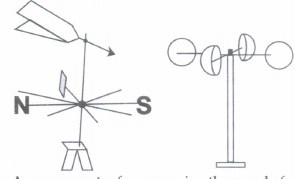
2.
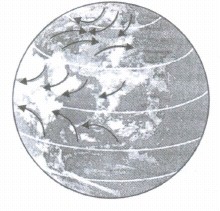
The regions closer to equator get maximum heat from the sun. This makes the air warm which rises up and the air from the regions in the 0-30 degrees latitude belt on either side of the equator moves in. These winds below from the north and the south towards the equators. At the poles, the air is colder than at latitudes about 60 degree. The warm air at these latitudes rises up and the cold wind from the poles rushes in. In this way, wind circulation is set up from poles to the warmer latitudes.
The wind flow pattern because of uneven heating on the earth:
3.
Thunderstorm develops in hot humid tropical areas. The rising temperatures produce strong upward rising winds. These winds carry water droplets upwards where they freeze and fall down again.
The swift movement of the falling water droplets along with the rising air crete lightning and sound. This event is called thunderstorm.
4.
High speed winds and air pressure difference can cause cyclones.They are formed when water vapour changes back to liquid by the release of heat. This heat warms air around and it rises to move up and more air rushes to the vacant place. Thus, a cycle is formed which have low pressure and very high speed of air.
5.
As during the afternoon, the land becomes hot which ultimately creates hot air above it and we know that hot air rises up and there is low pressure created. Thus, winds from sea start blowing towards the land and the clothes will be blown towards the house because sea breeze blowing towards the land.
6.
Pressure difference is created in the nature by the heat of the sun. When it falls on the earth surface, the surface of the earth gets heated and air above it also gets warm and becomes light weight and moves upward. Thus, the pressure difference is created.
7.
Curiosity to learn and scientific attitude.
8.
During summer, when the land gets warmed and temperature of land becomes higher than that of water in ocean. The air above the land gets heated and rises. Therefore, the cold wind flows from the ocean towards the land. These are monsoon winds which bring water and cause rain.
9.
The technologies that include satellites and radars issue the information of expected storm in advance in the form of cyclone warnings. It is issued in two stages, i.e. a cyclone alert or cyclone watch is issued 48 h in advance of any expected storm and cyclone warning is issued 24 h in advance. The message is broadcasted every hour or half hour when a cyclone is nearest the coast.
10.
High speed wind passing over the umbrella creates low pressure above the umbrella with respect to below of it. Therefore, the umbrella upturns.
11.
Orissa (a part of India) was hit by cyclone in 18th October 1999. The wind speed was 200 km/h and smashed 45000 houses making 700000 people homeless. Another cyclone hit the Orissa again an 29th October with the wind speed of 260 km/h. Thousands of people lost their lives and property worth crores of rupees was destroyed.
12.
I will help my neighbours in case cyclone approaches my village/town by the following ways:
(i) I will help in shifting their household articles, domestic animals, etc., to safer place. (ii) I will provide phone numbers of all emergency services like police, fire brigade and medical centres.
(iii) I will give them safety advice like avoid driving on roads through standing water, not to touch wet switches, etc.
13.
Holes are made in hanging banners and hoardings to allow air to pass through them as a result of which there will be less pressure of air on the banners or hoardings. Unless it is done, these may be uprooted or distorted due to the pressure of the air.
14.
Two experiences that made us think that air exerts pressure are
(i) Cycling against the direction of the wind, it is difficult to ride. It shows that the air exerts pressure.
(ii) While rowing a sailboat in the direction of the wind, it is always easier to row and while rowing a sailboat against the direction of the wind, it is very difficult to row. It also shows that the air exerts pressure.
15.
Two methods to find out wind direction at a given place are
(i) An instrument called anemometer can be used to find the direction and speed of the wind.
(ii) Hold a strip of paper outside. The direction in which the paper is blowing is the direction in which the wind blows.

7th Standard CBSE Syllabus & Materials
7th Standard CBSE
CBSE 7th Social Science Theme B - New Beginnings : Cities and States - New Sample Question Papers Study Material - QB365 Set A
NEW7th Standard CBSE
CBSE 7th Social Science Theme A - Climates of India - New Sample Question Papers Study Material - QB365 Set A
NEW7th Standard CBSE
CBSE 7th Social Science Theme A - Geographical Diversity of India - New Sample Question Papers Study Material - QB365 Set A
NEW7th Standard CBSE
CBSE 7th Science Earth, Moon and the Sun - New Sample Question Papers Study Material - QB365 Set A



CBSE 7th Standard CBSE Subjects
CBSE Standards




