
 100% FREE ACCESS
7th Standard CBSE Syllabus & Materials
7th Standard CBSE
CBSE 7th Social Science Theme E - Understanding Market - New Sample Question Papers Study Material - QB365 Set A
NEW7th Standard CBSE
CBSE 7th Social Science Theme E - From Barter to Money - New Sample Question Papers Study Material - QB365 Set A
NEW7th Standard CBSE
CBSE 7th Social Science Theme D - The Constitution of India- An Introduction - New Sample Question Papers Study Material - QB365 Set A
NEW7th Standard CBSE
CBSE 7th Social Science Theme D - From the Rulers to the Ruled : Types of Governments - New Sample Question Papers Study Material - QB365 Set A
NEW7th Standard CBSE
CBSE 7th Social Science Theme B - The Age of Reorganisation - New Sample Question Papers Study Material - QB365 Set A
NEW7th Standard CBSE
CBSE 7th Social Science Theme B - The Rise of Empires - New Sample Question Papers Study Material - QB365 Set A

Published on: 11/09/2019
How The State Government Works
Download CBSE Class 7th Standard CBSE Social Science question papers, sample papers, important questions, and previous year solved papers in PDF format. Get free study materials, NCERT solutions, and exam preparation resources for Class 7th Standard CBSE Social Science
Questions + Answers key
Take MCQ Social Science Test
1.
Discuss the procedure for government formation in a state.
2.
Use the terms 'constituency' and 'represent' to explain who an MLA is and how is the person elected?
3.
Find out with the help of your teacher, the work done by the government departments mentioned and fill in the table.
4.
At times, the ruling party may not be single party but a group of parties working together. This is called a coalition. Discuss with your teacher.
5.
What action do you think can be taken in the above situation and who do you think should take this action? Discuss.
6.
Laws for the entire country are made by
Legislative Assembly
Parliament
Governor
Chief Minister
7.
MLA stands for
Member of Long Assembly
Member of Legislative Assembly
Member of Law Assembly
None of the above
8.
Head of the State is known as
MLA
Chief Minister
Governor
Minister
9.
Political party that has attained majority is known as
Opposition party
Ruling party
Coalition party
Majority party
10.
To attain majority, political party is required to win
less than half the number of constituencies
more than half the number of constituencies
hundred per cent constituencies
None of the above
11.
Observe the following picture as answer the questions that follow
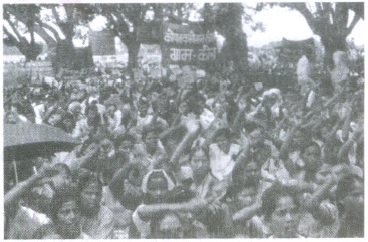
What do you infer from the above picture?
12.
What did the Chief Minister and the Health Minister do in the next week of the assembly session?
13.
Explain with the example of Himachal Pradesh, the working ota State Legislative Assembly.
14.
Some MLAs have dual responsibility one as an MLA and other as the ___________
15.
MLAs belonging to the ______ elect their leader as Chief Minister.
16.
A state is divided into different area known as _________
17.
___________ is the other name for Legislative Assembly.
18.
An MLA is a Member of Legislative Assembly.
19.
Chief Minister is the head of the Government.
20.
MLAs together are responsible for the working of government.
21.
Himachal Pradesh is divided into 70 constituencies.
22.
There are only two levels of government.
23.
Do you think the above debate would have been useful in some ways? How? Discuss
24.
By whom are the MLAs elected?
25.
What is the objective of organising public meetings?
26.
How is the Governor of a state appointed?
27.
State the meaning of Legislative Assembly.
28.
Define constituency.
1.
The following procedure is followed to form a government in a state
(i) General elections are contested to elect representatives from various constituencies.
(ii) A political party attaining more than half of the total seats is said to be in majority and this party forms the government.
(iii) MLAs belonging to ruling party elect their leader who then becomes Chief Minister.
(iv) The Chief Minister then selects other people as ministers.
(v) And finally, the Governor appoints them.
2.
The full form of MLA is Member of the Legislative Assembly is elected by the people and hence, this way they 'represent' people.
A person is elected as an MLA in the following manner
3.
| Name of Department | Examples of their work |
|---|---|
| School Education | Construction of new schools. Appointing adequate number of teachers. Providing good infrastructure facilities in schools. |
| Public Works Department |
Provision of clean drinking water and electricity. Construction of roads. Construction of government buildings and staff quarters. |
| Agriculture | Provision of good quality seeds and fertilisers. Provision of adequate irrigation facilities. Providing loans and subsidies to farmers. |
4.
Coalition A coalition is a pact or treaty among different parties in which they cooperate and join together to attain majority and form the government. In a parliamentary system, Coalition Government is made up of coalition of parties.
5.
In the above situation, Health Minister should take the required action like improving health services and clean drinking water should be supplied to people, etc.
6.
(b)
Parliament
7.
(b)
Member of Legislative Assembly
8.
(c)
Governor
9.
(b)
Ruling party
10.
(b)
more than half the number of constituencies
11.
From the above picture, it is inferred that people have gathered to raise their opinion for
some issue and protest the government. This type of public action is allowed in democratic government.
12.
In the week after the assembly session, the Chief Minister and the Minister for health visited Patalpuram district.
They do the following in the district
13.
Himachal Pradesh is divided into 68 assembly constituencies. From each constituency, people elect one representative who then becomes a member of Legislative Assembly. From 68 constituencies, a party needs more than 34 MLAs in order to gain majority. In 2003, Indian National Congress had majority with 43 MLAs and became the ruling party. The MLAs other than Indian National Congress became opposition and it was Bharatiya Janata Party who had the second largest number of MLAs. Shri Virbhadra Singh was selected as the majority leader and became Chief Minister of Himachal Pradesh.
14.
()
minister
15.
()
ruling party
16.
()
constituencies
17.
()
Vidhan Sabha
18.
(a)
19.
(a)
20.
(a)
21.
(b)
22.
(b)
23.
()
Yes. The above debate would be useful as it puts forth the problems of different constituencies which could force the Government to take immediate action.
24.
()
Members of the Legislative Assembly are elected by the people.
25.
()
Public meetings are organised in order to protest and demand for the rights of the people.
26.
()
It is the duty of Central Government to appoint the Governor of the various states
27.
()
Legislative Assembly is a place where all MLAs from ruling as well as opposition party meet to debate and discuss various issues.
28.
()
A particular area from which all the voters living there, choose their representatives is known as constituency.

7th Standard CBSE Syllabus & Materials
7th Standard CBSE
CBSE 7th Social Science Theme B - New Beginnings : Cities and States - New Sample Question Papers Study Material - QB365 Set A
NEW7th Standard CBSE
CBSE 7th Social Science Theme A - Climates of India - New Sample Question Papers Study Material - QB365 Set A
NEW7th Standard CBSE
CBSE 7th Social Science Theme A - Geographical Diversity of India - New Sample Question Papers Study Material - QB365 Set A
NEW7th Standard CBSE
CBSE 7th Science Earth, Moon and the Sun - New Sample Question Papers Study Material - QB365 Set A



CBSE 7th Standard CBSE Subjects
CBSE Standards




