
 100% FREE ACCESS
7th Standard CBSE Syllabus & Materials
7th Standard CBSE
CBSE 7th Social Science Theme E - Understanding Market - New Sample Question Papers Study Material - QB365 Set A
NEW7th Standard CBSE
CBSE 7th Social Science Theme E - From Barter to Money - New Sample Question Papers Study Material - QB365 Set A
NEW7th Standard CBSE
CBSE 7th Social Science Theme D - The Constitution of India- An Introduction - New Sample Question Papers Study Material - QB365 Set A
NEW7th Standard CBSE
CBSE 7th Social Science Theme D - From the Rulers to the Ruled : Types of Governments - New Sample Question Papers Study Material - QB365 Set A
NEW7th Standard CBSE
CBSE 7th Social Science Theme B - The Age of Reorganisation - New Sample Question Papers Study Material - QB365 Set A
NEW7th Standard CBSE
CBSE 7th Social Science Theme B - The Rise of Empires - New Sample Question Papers Study Material - QB365 Set A

Published on: 10/09/2019
Human Environment-Settlement, Transport and Communication
Download CBSE Class 7th Standard CBSE Social Science question papers, sample papers, important questions, and previous year solved papers in PDF format. Get free study materials, NCERT solutions, and exam preparation resources for Class 7th Standard CBSE Social Science
Questions + Answers key
Take MCQ Social Science Test
1.
Write a short note on waterways.
2.
Write a short note on airways.
3.
What do you understand by site? Mention the natural conditions for selection of an ideal site?
4.
Mention any two merits of railways.
5.
Find out the names of some newspapers and TV news channels in English, Hindi and a regional language.
6.
One can communicate with large number of people through
newspaper
radio
television
All of these
7.
Sea routes and oceanic routes are mostly used for transporting.
Merchandise
Eatables
Woollen clothes
None of these
8.
They are the cheapest modes of transport.
Airways
Roadways
Waterways
Railways
9.
Yaks are found in
Tibet
China
Bhutan
Myanmar
10.
Which is not a means of communication?
Telephone
Books
Table
11.
Explain all the major means of transport.
12.
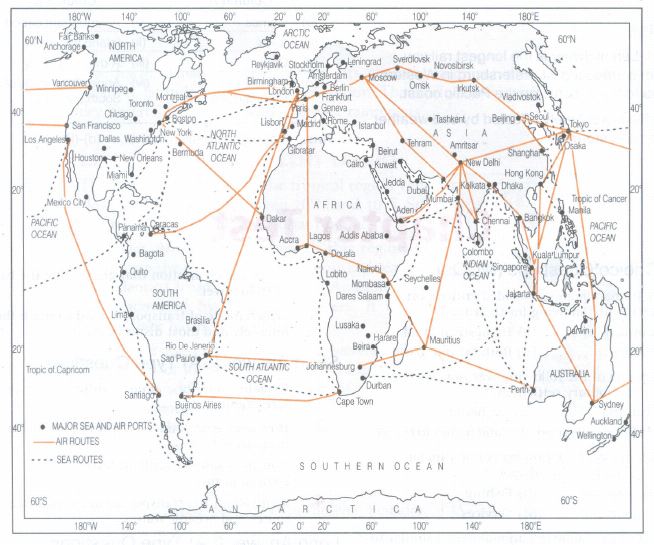
From the given below map, find out important sea ports and airports.
13.
________ means of transport thus saves time and energy.
14.
Invention of the______made transport easier.
15.
_______ is the means by which people and goods move.
16.
Thick mud walled houses with______are very common in areas of hot climate.
17.
A______is a closely built area of dwellings, wherever flat land is available.
18.
The train from Xining to Lhasa runs at an altitude of 4000 m above sea level and the highest point is 5072m.
19.
The Golden Quadrilateral connects Delhi, Mumbai, Chennai and Bhubaneshwar.
20.
The latest development in India is the construction of expressways.
21.
Subways are the parallel roads to the main roads.
22.
Manali-Leh highway is the longest railway system connecting St. Petersburg in Western Russia to Vladivostok on the Pacific coast.
23.
Name the latest development of expressways in India.
24.
Name any two important ports of the world.
25.
What kind of materials is used to build houses in rural areas?
26.
Where are scattered settlement found?
27.
What are the reasons behind evolution of settlements near the river valleys?
1.
Waterways are the cheapest for carrying heavy and bulky goods over long distances. They are mainly of two types - inland waterways and sea routes. Navigable rivers and lakes are used as inland waterways. For example, the Ganga-Brahmaputra river system, the Great Lakes in North America and the river Nile in Africa. Sea routes and oceanic routes are mostly used for transporting merchandise and goods from one country to another. These routes are connected with the ports.
2.
This is the fastest way of transport developed in the early 20th century. It is also the most expensive due to high cost of fuels. Air traffic is adversely affected by bad weather like fog and storms. It is the only mode of transport to reach the most remote and distant areas especially where there are no roads and railways.
3.
The place where a building or a settlement develops is called its site. The natural conditions for selection of an ideal site are
(i) favourable climate
(ii) availability of water
(iii) suitable land
(iv) fertile soil
4.
The two merits of railways are
1. Carry people over long distances quickly and cheaply.
2. Carry heavy goods in bulk.
5.
Names of Newspapers:
1. Hindusran Times (Eng.)
2. DainikJagaran (Hindi)
3. Nav Bharat Times (Hindi)
4. Dinathanrhi (Tamil)
5. Maryam Manorma (Malayalam)
T V News Channels:
1. D.D. News
2. Aaj Tak
3.Z News
4.NDTV
5.Sun TV (Tamil)
6.Asianet (Malayalam)
6.
(d)
All of these
7.
(a)
Merchandise
8.
(c)
Waterways
9.
(a)
Tibet
10.
(c)
Table
11.
Transport is the means by which people and goods move. In the early days, it took a great deal of time, to travel long distances. The four major means of transport are
(i) Roadways The most commonly used means of transport especially for short distances are roads. They can be metalled (pucca) and unmetalled (kutcha). The plains have a dense network of roads. Roads have also been built in terrains like deserts, forests and even high mountains.
(ii) Railways The railways carry heavy goods and people over long distances quickly and cheaply. The invention of the steam engine and the Industrial Revolution helped in speedy development of rail transport. Diesel and electric engines have largely replaced the steam engines.
(iii) Waterways They are the cheapest for carrying heavy and bulky goods over long distances. They are mainly of two types - inland waterways and sea routes. Navigable rivers and lakes are used as inland waterways. For example, the Ganga-Brahmaputra river system, the Great Lakes in North America and the river Nile in Africa. Sea routes and oceanic routes are mostly used for transporting merchandise and goods from one country to another. These routes are connected with the ports.
(iv) Airways This is the fastest way of transport developed in the early 20th century. It is also the most expensive due to high cost of fuels. Air traffic is adversely affected by bad weather like fog and storms. It is the only mode of transport to reach the most remote and distant areas especially where there are no roads and railways.
12.
Important sea ports are - Los Angles, Quito, Lima, Santiago, Rio de Janerio, Panama, Miami, Houston, New Orleans,Dakar,Boston, Douala, Lobito, Cape Town,Perth, Colombo, Chennai, Kolkata, Mumbai, Jakarta, Bangkok, Dhaka, Tokyo,Seoul, Shanghai, Dubai, etc.
Important Airports are - Vancouver, Mexico city, Nairobi, Paris, Moscow, Beijing, New Delhi, Hong Kong, Sydney, NewYork,tehram, Mauritius, Singapore, London, Buenos Airies, etc.
13.
()
Modern
14.
()
Wheel
15.
()
Transport
16.
()
thatched roofs
17.
()
compact settlement
18.
(a)
19.
(b)
20.
(a)
21.
(b)
22.
(b)
23.
()
The latest development of expressways in India is Golden Quadrilateral that connects Delhi, Mumbai, Chennai and Kolkata.
24.
()
Singapore and Mumbai are two important ports of the world.
25.
()
In rural areas, people build houses from stones, mud, clay, straw, etc.
26.
()
Scattered settlements are found in hilly tracts, thick forests and regions of extreme climate.
27.
()
Settlement grew near the river valleys because of availability of water and fertile land.

7th Standard CBSE Syllabus & Materials
7th Standard CBSE
CBSE 7th Social Science Theme B - New Beginnings : Cities and States - New Sample Question Papers Study Material - QB365 Set A
NEW7th Standard CBSE
CBSE 7th Social Science Theme A - Climates of India - New Sample Question Papers Study Material - QB365 Set A
NEW7th Standard CBSE
CBSE 7th Social Science Theme A - Geographical Diversity of India - New Sample Question Papers Study Material - QB365 Set A
NEW7th Standard CBSE
CBSE 7th Science Earth, Moon and the Sun - New Sample Question Papers Study Material - QB365 Set A



CBSE 7th Standard CBSE Subjects
CBSE Standards




