
 100% FREE ACCESS
7th Standard CBSE Syllabus & Materials
7th Standard CBSE
CBSE 7th Social Science Theme E - Understanding Market - New Sample Question Papers Study Material - QB365 Set A
NEW7th Standard CBSE
CBSE 7th Social Science Theme E - From Barter to Money - New Sample Question Papers Study Material - QB365 Set A
NEW7th Standard CBSE
CBSE 7th Social Science Theme D - The Constitution of India- An Introduction - New Sample Question Papers Study Material - QB365 Set A
NEW7th Standard CBSE
CBSE 7th Social Science Theme D - From the Rulers to the Ruled : Types of Governments - New Sample Question Papers Study Material - QB365 Set A
NEW7th Standard CBSE
CBSE 7th Social Science Theme B - The Age of Reorganisation - New Sample Question Papers Study Material - QB365 Set A
NEW7th Standard CBSE
CBSE 7th Social Science Theme B - The Rise of Empires - New Sample Question Papers Study Material - QB365 Set A

Published on: 27/09/2019
Our Changing Earth
Download CBSE Class 7th Standard CBSE Social Science question papers, sample papers, important questions, and previous year solved papers in PDF format. Get free study materials, NCERT solutions, and exam preparation resources for Class 7th Standard CBSE Social Science
Questions + Answers key
Take MCQ Social Science Test
1.
Write a note on the work of Sea waves.
2.
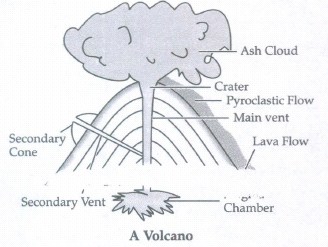
Draw a labelled diagram of a volcano.
3.
Differentiate between endogenic forces and exogenic forces.
4.
How an ox-bow lake is formed?
5.
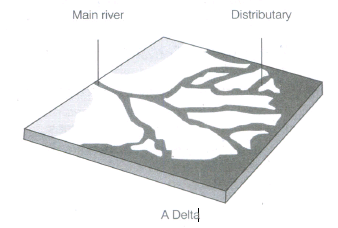
With the help of diagram define delta and distributaries with diagram.
6.
What do you understand by earthquake? How can it be measured?
7.
Briefly explains the work of ice.
8.
What are sand dunes?
9.
What is erosion?
10.
Why do the plates move?
11.
How are beaches formed?
12.
What are sand dunes?
13.
How are flood plains formed?
14.
What is erosion?
15.
What are exogenic and endogenic forces?
1.
Work of Sea Waves:
(i) Erosion and deposition of the sea wave forms coastal landform.
(ii) They are called sea caves. As cavities become bigger and bigger only the roof of the caves remain. This leads to formation of Sea arches.
(iii) Continuous erosion breaks the roof and only walls are left. These walls like features are called stacks.
(iv) The steep rocky coast rising almost vertically above Sea water is called sea cliff.
(v) The sea waves deposit sediments along the shores. This lead to the formation of Sea beaches.
2.
3.
Endogenic forces act in the interior of the Earth.
Exogenic forces act on the surface of the Earth.
4.
Due to continuous erosion and deposition along the sides of the meander, the ends of the meander loop come closer and closer. The meander loop cuts-off from the river in due course of time and forms a cut-off lake called an ox-bow lake.
5.
(i) Deltas are form by the deposition of sediment carried by a river as the flow leaves its mouth.
(ii) Distributaries are the streams which distribute the rivers water into different stream.
6.
Earthquakes are the vibration of the Earth's surface caused by the movements of lithospheric plates. An earthquake is measured with a machine called a seismograph. The magnitude of the earthquake is measured on the Richter scale.
7.
Glaciers are 'rivers' of ice which too erode the landscape by bulldozing soils and stones to expose the solid rock below. Glaciers carve out deep hollows. As the ice melts they get filled up with water and become beautiful lakes in the mountains. The material carried by the glacier such as big and small rocks, sand and silt gets deposited. These deposits form glacial moraines.
8.
Sand dunes are those hill-like structures which are formed by the deposition of blowing wind in deserts.
9.
Erosion is the wearing away of the landscape by different agents like water, wind and ice.
10.
The plates are moving because they are floating on the molten magma inside the Earth.
11.
Beaches are formed by the deposition of sediments along the seashores through the sea waves.
12.
Sand dunes are those hill-like structures which are formed by the deposition of blowing wind in deserts.
13.
Floodplains are formed by the deposition of fine soil and other materials through floods.
14.
Erosion is the wearing away of the landscape by different agents like water, wind and ice.
15.
Endogenic forces are those forces which act in the interior of the Earth; Exogenic forces that work on the surface of the Earth.

7th Standard CBSE Syllabus & Materials
7th Standard CBSE
CBSE 7th Social Science Theme B - New Beginnings : Cities and States - New Sample Question Papers Study Material - QB365 Set A
NEW7th Standard CBSE
CBSE 7th Social Science Theme A - Climates of India - New Sample Question Papers Study Material - QB365 Set A
NEW7th Standard CBSE
CBSE 7th Social Science Theme A - Geographical Diversity of India - New Sample Question Papers Study Material - QB365 Set A
NEW7th Standard CBSE
CBSE 7th Science Earth, Moon and the Sun - New Sample Question Papers Study Material - QB365 Set A



CBSE 7th Standard CBSE Subjects
CBSE Standards




