
 100% FREE ACCESS
7th Standard CBSE Syllabus & Materials
7th Standard CBSE
CBSE 7th Social Science Theme E - Understanding Market - New Sample Question Papers Study Material - QB365 Set A
NEW7th Standard CBSE
CBSE 7th Social Science Theme E - From Barter to Money - New Sample Question Papers Study Material - QB365 Set A
NEW7th Standard CBSE
CBSE 7th Social Science Theme D - The Constitution of India- An Introduction - New Sample Question Papers Study Material - QB365 Set A
NEW7th Standard CBSE
CBSE 7th Social Science Theme D - From the Rulers to the Ruled : Types of Governments - New Sample Question Papers Study Material - QB365 Set A
NEW7th Standard CBSE
CBSE 7th Social Science Theme B - The Age of Reorganisation - New Sample Question Papers Study Material - QB365 Set A
NEW7th Standard CBSE
CBSE 7th Social Science Theme B - The Rise of Empires - New Sample Question Papers Study Material - QB365 Set A

Published on: 09/09/2019
Water
Download CBSE Class 7th Standard CBSE Social Science question papers, sample papers, important questions, and previous year solved papers in PDF format. Get free study materials, NCERT solutions, and exam preparation resources for Class 7th Standard CBSE Social Science
Questions + Answers key
Take MCQ Social Science Test
1.
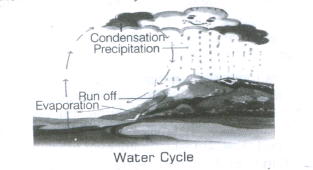
Explain water cycle with a neat and labelled diagram.
2.
Briefly explain the importance of water
3.
Give brief note on Tsunami.
4.
How are high tides important?
5.
What are ocean currents?
6.
World Water Day is celebrated on
22nd April
22nd March
22nd February
22nd January
7.
During low tides
Water recedes from the shore
Water covers much of the shore
Water disappears for a while
Both (a) and (b)
8.
The cold current originates near the
Equator
Tropic of cancer
Tropic of capricorn
Poles
9.
These are the best fishing grounds of the world.
Seas around Japan
Seas around the Eastern coast of North America
Both (a) and (b)
None of the above
10.
The process by which water continually changes its form and circulates between oceans, atmosphere and land
water cycle
tides
ocean currents
11.
Discuss the different types of ocean currents and their causes.
12.
The average salinity of______________ is 35 parts per thousand
13.
The__________________ and the seas contain salty water.
14.
Our Earth is like a_______________
15.
Dead Sea in Israel has salinity of_______________ of water.
16.
Salinity is the amount of salt in grams present ____________in of water.
17.
22nd March is celebrated as World Water Day when the need to conserve water is reinforced in different ways.
18.
When the water on the surface of the ocean rises and falls alternately, they are called tides
19.
Dead Sea in Israel has salinity of 45 grams per litre of water
20.
Salinity is the amount of salt in grams present in 1000 grams of water
21.
Our Earth is like an aquarium.
22.
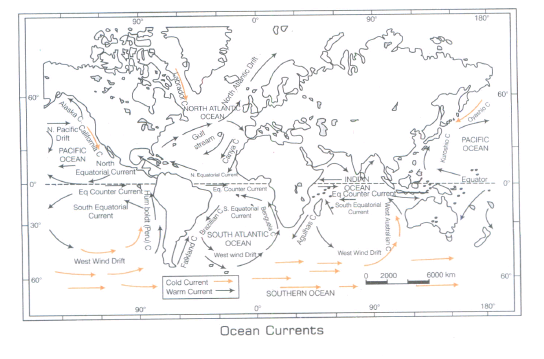
Show on the world map.
Warm Currents
(a) North Pacific Drift (b) Gulf Stream (c) North Atlantic Drift (d) Equator Counter Current (e) South Equatorial Current
Cold Currents
(a) Peru Current (b) West Wind Drift (c) West Australian Current (d) Oyashio Current (e) Labrador Current
23.
Why do swimmers float in Dead Sea?
24.
What happened to the Indira Point during the Tsunami of 2004?
25.
Name one warm current and one cold current.
26.
How are tides caused?
27.
What happens during low tide?
1.
The Sun's heat causes evaporation of water vapour. When the water vapour cools down, it condenses and forms clouds. From there, it may fallon the land or sea in the form of rain, snow or sleet. The process by which water continually changes its form and circulates between oceans, atmosphere and land is known as the water cycle.
2.
Water is life-line of human beings. Its scarcity may create numerous problems but its absence would definitely lead to non-existence of all the living beings on the Earth. It is a precious resource of the nature. We drink water whenever we feel thirsty. We use water in numerous activities such as washing clothes, cleaning house floors, watering garden etc. Industries also need water for their functioning. Thus, water is very essential for human beings and must be conserve.
3.
Tsunami is a Japanese word that means 'Harbour waves' as the harbours get destroyed whenever there is tsunami. An earthquake, a volcanic eruption or underwater landslides can shift large amounts of ocean water. As a result, a huge tidal wave called tsunami, that may be as high as 15 m, is formed.
The largest tsunami ever measured was 150 m high. These waves travel at a speed of more than 700 km per hour. The tsunami of 2004 caused widespread damage in the coastal areas of India. The Indira Point in the Andaman and Nicobar Islands got submerged after the tsunami.
4.
High tides are important for various reasons
(i) They raise the water level close to the shores. This helps the ships to arrive at the harbour more easily.
(ii) The high tides also help in fishing.
(iii) Many more fish come closer to the shore during the high tide. This enables fishermen to get a plentiful catch.
(iv) The rise and fall of water due to tides is being used to generate electricity in some places.
5.
Ocean currents are streams of water flowing constantly on the ocean surface in definite directions which may be warm or cold.
6.
(b)
22nd March
7.
(a)
Water recedes from the shore
8.
(d)
Poles
9.
(c)
Both (a) and (b)
10.
(a)
water cycle
11.
i) Ocean currents are streams of water flowing constantly on the ocean surface in definite directions. The ocean currents may be warm or cold. Generally, the warm ocean currents originate near the equator and move towards the poles. The cold currents carry water from polar or higher latitudes to tropical or lower latitudes. The Labrador Ocean current is a cold current while the Gulf Stream is a warm current.
ii) The ocean current influence the temperature conditions of the area. Warm currents bring about warm temperature over land surface. The areas where the warm and cold currents meet provide the best fishing grounds of the world.
iii) Seas around Japan and the Eastern coast of North America are such examples. The areas where a warm and cold current meet also experience foggy weather making it difficult for navigation.
12.
()
the oceans
13.
()
ocean bodies
14.
()
terrarium
15.
()
45 grams per litre
16.
()
1000 grams
17.
(a)
18.
(b)
19.
(a)
20.
(a)
21.
(b)
22.
23.
()
Salt contain in Dead Sea has more density than swimmers that's why swimmers float in Dead Sea.
24.
()
The Indira Point got submerged during the Tsunami of 2004.
25.
()
i) Warm current The Gulf of Stream
ii) Cold current The Labrador Ocean current
26.
()
The strong gravitational pull exerted by the Sun and the Moon on the Earth's surface causes the tides.
27.
()
During low tide water falls to its lowest level and recedes from the shore.

7th Standard CBSE Syllabus & Materials
7th Standard CBSE
CBSE 7th Social Science Theme B - New Beginnings : Cities and States - New Sample Question Papers Study Material - QB365 Set A
NEW7th Standard CBSE
CBSE 7th Social Science Theme A - Climates of India - New Sample Question Papers Study Material - QB365 Set A
NEW7th Standard CBSE
CBSE 7th Social Science Theme A - Geographical Diversity of India - New Sample Question Papers Study Material - QB365 Set A
NEW7th Standard CBSE
CBSE 7th Science Earth, Moon and the Sun - New Sample Question Papers Study Material - QB365 Set A



CBSE 7th Standard CBSE Subjects
CBSE Standards




