100% FREE ACCESS
10th Standard CBSE Syllabus & Materials
10th Standard CBSE
CBSE 10th Social Science ECO - Globalisation and the Indian Economy - New Model Questions Papers Study Material - QB365 Set A
NEW10th Standard CBSE
CBSE 10th Social Science ECO - Money and Credit - New Model Questions Papers Study Material - QB365 Set A
NEW10th Standard CBSE
CBSE 10th Social Science ECO - Sectors of the Indian Economy - New Model Questions Papers Study Material - QB365 Set A
NEW10th Standard CBSE
CBSE 10th Social Science ECO - Development - New Model Questions Papers Study Material - QB365 Set A
NEW10th Standard CBSE
CBSE 10th Social Science PS - Outcomes of Democracy - New Model Questions Papers Study Material - QB365 Set A
NEW10th Standard CBSE
CBSE 10th Social Science PS - Gender, Religion and Caste - New Model Questions Papers Study Material - QB365 Set A

Published on: 15/09/2018
Model Question Paper
Download CBSE Class 10th Standard CBSE Science question papers, sample papers, important questions, and previous year solved papers in PDF format. Get free study materials, NCERT solutions, and exam preparation resources for Class 10th Standard CBSE Science
Questions + Answers key
Take MCQ Science Test
1.
Which one is a chemical change-rusting of iron or melting of iron?
2.
What is meant by a chemical reaction?
3.
Out of 60 W and 40 W lamps, which one has a higher electrical resistance when in use?
4.
What is a voltmeter?
5.
What does an electric current mean?
6.
What is the role of a catalyst in a chemical
7.
Classify the following reactions into slow and fast reaction:
(i) Reaction between an acid and a base
(ii) Rusting of iron
8.
Balance the following chemical equation:
Fe(s) + H2O(g) \(\rightarrow\) Fe3O4(s) + H2(g)
9.
A metal X available in the form of ribbon burns in air with a dazzling white light once heated to its ignition temperature. It leaves a white powder Y which dissolves in water. The solution so formed turns red litmus blue. Identify X and Y and write a balanced chemical equation of the reaction.
(a) Identify 'X' and 'Y'.
(b) Write a balanced chemical equation for this reaction.
10.
Why should a magnesium ribbon be cleaned before burning in air?
11.
Write the steps for balancing the chemical equation for the formation of ammonia by the combination of nitrogen and hydrogen.
12.
Give the differences between series and parallel connections of resistors.
13.
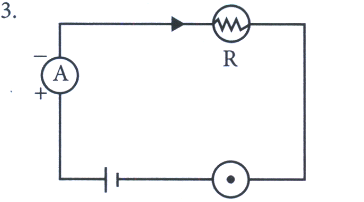
Differentiate between ammeter and voltmeter.
14.
(a) Distinguish between the terms "overloading and short circuiting" as used in domestic circuits.
(b) Why are the coils of electric toasters made of an alloy rather than a pure metal?
15.
Two lamps, one related 60W at 220 W at 220V and the other 40 W at 220 V, are connected in parallel to the electric supply at 220V.
(a) Draw a circuit diagram to show the connections.
(b) Calculate the current drawn from the electric supply.
(c) Calculate the total energy consumed by the two lamps together when they operate for one hour.
16.
What is a balanced chemical equation? Why should chemical equations be balanced?
17.
Write the balanced equation for the following chemical reactions.
(i) Hydrogen + Chlorine \(\rightarrow\) Hydrogen chloride
(ii) Barium chloride + Aluminium sulphate \(\rightarrow\) Barium sulphate + Aluminium chloride
(iii) Sodium + Water \(\rightarrow\) Sodium hydroxide + Hydrogen
18.
Electrical resistivity of a given metallic wire depends upon
its length
its thickness
its shape
nature of the material
19.
1 kilowatt hour (kWh) is equal to
3.6 \(\times\)106J
3.6 \(\times\)108J
3.6 \(\times\)102J
3.6 \(\times\)105J
20.
Chemically rust is
only ferric oxide
hydrated ferrous oxide
hydrated ferric oxide
none of these
21.
A dilute ferrous sulphate solution was gradually added to the beaker containing acidified permanganate solution. The light purple colour of the solution fades and finally disappears. Which of the following is the correct explanation for the observation?
KMnO4 is an oxidising agent, it oxidises FeSO4
FeSO4 acts as an oxidising agent and oxidises KMnO4
The colour disappears due to dilution; no reaction is involved
KMnO4 is an unstable compound and decomposes in presence of FeSO4 to a colourless compound.
22.
Which of the following are exothermic processes?
(i) Reaction of water with quicklime
(ii) Dilution of an acid
(iii) Evaporation of water
(iv) Sublimation of camphor(crystals)
(i) and (ii)
(ii) and (iii)
(i) and (iv)
(iii) and (iv)
23.
Which of the statements about the reaction below are incorrect?
2PbO(s) + C(s) \(\rightarrow\) 2Pb(s) + CO2(g)
(a) Lead is getting reduced
(b) Carbon dioxide is getting oxidized
(c) Carbon is getting oxidized
(d) Lead oxide is getting reduced.
(a) and (b)
(a) and (c)
(a), (b) and (c)
All of these
24.
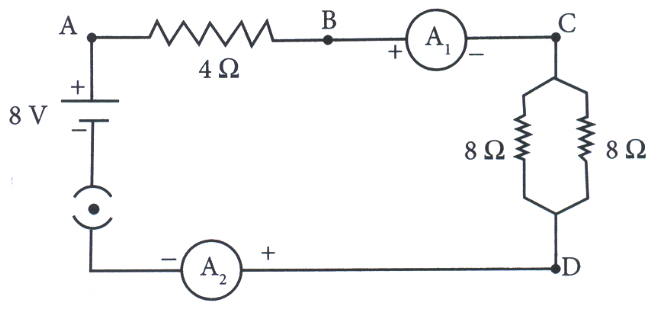
Find out the following in the electric circuit given in Figure
(a) Effective resistance of two 8 \(\Omega\) resistors in the combination
(b)Current flowing through 4 \(\Omega\) resistor
(c) Potential difference across 8 \(\Omega\) resistance
(d) Power dissipated in 4 \(\Omega\) resistor
(e) Difference in ammeter readings, if any.
25.
What happens when zinc granules are treated with dilute solution of H2SO4, HCl, HNO3, NaCl and NaOH, also write the chemical equations if reaction occurs.
26.
Give the characteristic tests for the following gases:
(a) CO2
(b) SO2
(c) O2
(d) H2
1.
Physical change:
A temporary change, in which no new substance is formed and the chemical composition of the original substance remains the same, even though some of its physical properties like color, state, shape, size, etc. may change. For example, the melting of ice.
Melting of iron is a physical change because when the iron is heated it changes from one state to other but the chemical properties remain the same.
Chemical change:
A permanent change in which new substances are formed whose chemical and physical properties are completely different from that those of the original substance. For example, the burning of fuel.
During rusting of iron the new substance i.e rust (red-brown solid) is formed when iron comes in contact with air and water.
Thus rusting of iron is a chemical change.
2.
A process in which two or more substances react to form some other new substances with new set of properties is called a chemical reaction.
3.
Electric power, p = \( \frac{V^{2}}{R}\), where R
V = Potential difference across the circuit
For 40 W bulb, 40 =\(\frac{V^{2}}{R_{1}0}\), where
R40 = Resistance offered by the 40 W bulb
For 60 W bulb, 60 =\(\frac{V^{2}}{R_{6}0}\) , where
R40 = Resistance offered by the 60 W bulb
Therefore, \(R_{10}=\frac{V^{2}}{40}\) and \(R_{60}=\frac{V^{2}}{60}\) (as the voltage difference remains the same)
Therefore, R40 > R60
So, the 40 W bulb has a higher electrical resistance when in use.
4.
A measuring instrument used to measure potential difference between two points in an electric circuit.
5.
The flow of electric charge is known as electric current. Electric current is carried by moving electrons through a conductor. Electric current flows in opposite direction to the movement of electrons.
6.
A catalyst changes the rate of reaction without taking part in the reaction itself.
7.
i. Neutralization reaction
ii. Oxidation reaction
8.
3Fe(s) + 4H2O(g) →→ Fe3O4(s) + 4H2(g)
9.
(a) When magnesium is heated in oxygen of air, it leaves white powder of magnesium oxide which dissolves in water. The magnesium oxide being alkaline in nature turns red litmus to blue. Also, the metal in ribbon form is Magnesium [Mg]. Thus 'X' is identified ad magnesium and 'Y' is identified as magnesium oxide.
(b)The chemical reaction is:
2Mg(s)+O2(g)\(\rightarrow\)2MgO
10.
Magnesium ribbon reacts with oxygen present in air to form a protective and inert layer of magnesium oxide on its surface. This layer is unreactive and prevents the ribbon from burning. Hence, it needs to be cleaned with sand paper before burning in air.
11.
N2 + H2 \(\rightarrow \) NH3 (Unbalanced equation).
(i) Examine the number of atoms of different elements present in the unbalanced equation.
(ii) In the above reaction, left hand N2 and H2 of both the sides are unbalanced.
(iii) To balance hydrogen, H2 is multiplied by 3 on side. It makes 6H-atoms on the left hand side.
(iv) Now to balance hydrogen atoms on the right hand side, NH3 should be multiplied by 2. It makes 6H-atoms on this side.
(v) Now to balance nitrogen atoms, they are counted separately for both the sides and we will find that, nitrogen atoms are 2 on both the sides.
(vi) Balanced chemical equation will be :
N2 + H2 \(\rightarrow \) NH3.
12.
| Series connection | Parallel connection |
| 1. The potential difference (V) across the combination of resistors connected in series is equal to the sum of all the individual potential differnece. | The potential difference across all resistors in parallel connection remains constant. |
|
2. Current (I) remains the same. |
Current (I) will be different for different resistor.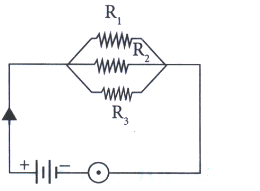 |
| 3. The resistance will be the sum of all the resistors in the circuit. Rs = R1 + R2 + R3. |
Total resistance will be given as \(\frac { 1 }{ { R }_{ p } } =\frac { 1 }{ { R }_{ 1 } } +\frac { 1 }{ { R }_{ 2 } } +\frac { 1 }{ { R }_{ 3 } } \) |
| 4. Equivalent resistance is high. | Equivalent resistance is less than each resistor. |
13.
| Ammeter | Voltmeter |
| 1. Ammeter is an instrument used to measure current in a circuit. | Voltmeter is used to measure potential difference between two points. |
| 2. It is connected in series in a circuit. | It is connected in parallel in a circuit. |
 |
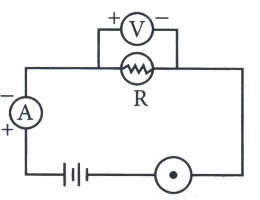 |
14.
(a) Short circuiting is the term used for defining the situation in which the neutral and live wires of an electric circuit come in direct contact. When too many electrical appliances are connected to a single socket, the appliances drawn much more current or power that the permissible limit from the main supply. This situation is termed as overloading.
(b) Resistivity of an alloy is much higher than its constituent metals Moreover, alloys do not oxidise as easily as the constituent metals at high temperature. Because of these reasons, coils of electric testers are made of an alloy rather than a pure meta.
15.
(a)
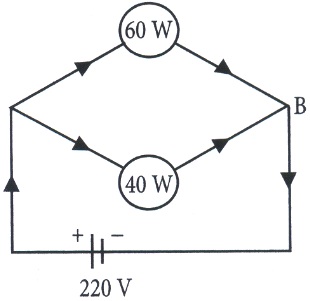
(b) Electric current flowing through a bulb = \(\frac { Power\quad of\quad the\quad bulb }{ Voltage\quad across\quad the\quad bulb } \)
\(i.e.,\quad I=\frac { P }{ V } \)
Therefore, \({ I }_{ 60 }=\frac { 60W }{ 220V } =\frac { 3 }{ 11 } A\quad and\quad { I }_{ 40 }=\frac { 40W }{ 220V } =\frac { 2 }{ 11 } A\)
Therefore, total current flowing through the circuit \(={ I }_{ 60 }+{ I }_{ 40 }=\frac { 3 }{ 11 } +\frac { 2 }{ 11 } =\frac { 5 }{ 11 } A=0.45A\)
(c) Total energy consumed = Power \(\times \) Time
That is, E = P \(\times \) T
= (40W+60W)\(\times \)1h
= 100 Wh
= 0.1 kWh
16.
A chemical change is represented by a chemical equation. When the number of atoms of different elements on reactant and product side are equal, then the chemical equation is called a balanced chemical equation.
It is important to balance a chemical equation because
(i) to validate the law of conservation of mass which states that the mass of reactants should be equal to the mass of the products. The total mass of a system is thus conserved.
This law holds true only if number of atoms of reactants reacting together is equal to number of product atoms formed.
(ii) a balanced chemical equation tells us about the physical state of the reactants and products whether they are solid (s), liquid (l) or gas (g) or aqueous(aq).
(iii) it tells us about heat changes that can take place in a chemical reaction. \(\Delta\) is the symbol of heat. Hence, it is endothermic or exothermic can be deduced from a balanced chemical equations.
17.
(i) H2 + Cl2 \(\rightarrow\) 2HCI
(ii) 3BaCl2 + Al2(SO4)3 \(\rightarrow\) 3BaSO4 \(\downarrow\)+ 2AlCl3
(iii) 2Na + 2H2O \(\rightarrow\) 2NaOH + H2
18.
(d)
nature of the material
19.
(d)
3.6 \(\times\)105J
20.
(c)
hydrated ferric oxide
21.
(a)
KMnO4 is an oxidising agent, it oxidises FeSO4
22.
(a)
(i) and (ii)
23.
(a)
(a) and (b)
24.
(a) Since two \(8\Omega \) resistors are in parallel, their effective resistance (\({ R }_{ P }\)) is given by,
\(\frac { 1 }{ { R }_{ P } } =\frac { 1 }{ 8 } +\frac { 1 }{ 8 } +\frac { 1 }{ 4 } \) or \({ R }_{ P }=4\Omega \)
(b) Total resistance in the circuit
\(R=4\Omega +{ R }_{ P }=4\Omega +4\Omega =84\Omega \)
Current through the electric circuit
\(I=\frac { V }{ R } =\frac { 8V }{ 8\Omega } =1A\)
(c) The potential difference \(4\Omega \) resistor V
I \(=IR=1\times 4=4V\)
(d) Power dissipated in \(4\Omega \) resistor P=\({ (I) }^{ 2 }\)
\(R={ (1) }^{ 2 }(4)=4W\)
(e) There is no difference in the readings of ammeters \({ A }_{ 1 }\) and \({ A }_{ 2 }\) as same current flows through all elements in a series circuit.
25.
Hydrogen gas and zinc sulphate are formed when zinc granules are treated with sulphuric acid
\(\underset{Zinc }{Zn(s)}+\underset{Sulphuric\ acid}{H2SO4(l)} \rightarrow\underset{Zinc\ sulphate}{ZnSO_4(aq)}+\underset{Hydrogen}{H_2(g)}\)
Zinc chloride and hydrogen gas are formed, when zinc granules are treated with hydrochloric acid.
\(\underset{Zinc}{Zn(s)} + \underset{Hydrochloric\ acid}{2HCI(l)}\rightarrow \underset{Zinc}{ZnCI2(s)} +\underset{Water}{ H_2(g)}\)
Similarly, hydrogen gas and zinc nitrate are formed when zinc granules are treated with nitric acid.
\(\underset{Zinc}{Zn(s)} + \underset{Nitricic\ acid}{2HNO_3(l)}\rightarrow \underset{Zinc\ nitrate}{Zn(NO_3)_2(s)} +\underset{Hydrogen}{ H_2}\)
Since, zinc is less reactive than sodium, thus no reaction takes place when zinc granules are treated with sodium chloride.
Sodium zinc ate and hydrogen gas are formed when zinc granules are treated with sodium hydroxide and water.
\(Zn + 2H_2O + 2NaOH\rightarrow Na_2Zn(OH) _4 + H_2\)
26.
(a) Carbon dioxide turns lime water milky as it forms calcium carbonate with lime water. This is the characteristics test for carbon dioxide.
Ca(OH)2 + CO2 --> CaCO3 + H2O
(b) The smell of sulphur dioxide gas is like burning of sulphur, which is the characteristics test for sulphur dioxide. Sulphur dioxide turns moist litmus paper from blue to red.
(c) When a burnt candle or match stick is brought near the oxygen gas, it starts burning brightly. This is the characteristic test for oxygen gas.
(d) When a burnt candle or match stick is brought near the hydrogen gas, it burns with pop sound, which is the characteristic test for hydrogen gas.

10th Standard CBSE Syllabus & Materials
10th Standard CBSE
CBSE 10th Social Science PS - Federalism - New Model Questions Papers Study Material - QB365 Set A
NEW10th Standard CBSE
CBSE 10th Social Science PS - Power Sharing - New Model Questions Papers Study Material - QB365 Set A
NEW10th Standard CBSE
CBSE 10th Social Science GEO - Manufacturing Industries - New Model Questions Papers Study Material - QB365 Set A
NEW10th Standard CBSE
CBSE 10th Social Science GEO - Minerals and Energy Resources - New Model Questions Papers Study Material - QB365 Set A



CBSE 10th Standard CBSE Subjects
CBSE Standards