
 100% FREE ACCESS
10th Standard CBSE Syllabus & Materials
10th Standard CBSE
CBSE 10th Social Science ECO - Globalisation and the Indian Economy - New Model Questions Papers Study Material - QB365 Set A
NEW10th Standard CBSE
CBSE 10th Social Science ECO - Money and Credit - New Model Questions Papers Study Material - QB365 Set A
NEW10th Standard CBSE
CBSE 10th Social Science ECO - Sectors of the Indian Economy - New Model Questions Papers Study Material - QB365 Set A
NEW10th Standard CBSE
CBSE 10th Social Science ECO - Development - New Model Questions Papers Study Material - QB365 Set A
NEW10th Standard CBSE
CBSE 10th Social Science PS - Outcomes of Democracy - New Model Questions Papers Study Material - QB365 Set A
NEW10th Standard CBSE
CBSE 10th Social Science PS - Gender, Religion and Caste - New Model Questions Papers Study Material - QB365 Set A

Published on: 01/08/2018
Based on the chapter How do Organisms Reproduce, some of the important questions are prepared in this question paper. Teacher please subscribes and gets the plenty of question paper based on chapter wise and also predefined blueprint. For subscription, please Click Here.
Download CBSE Class 10th Standard CBSE Science question papers, sample papers, important questions, and previous year solved papers in PDF format. Get free study materials, NCERT solutions, and exam preparation resources for Class 10th Standard CBSE Science
Questions + Answers key
Take MCQ Science Test
1.
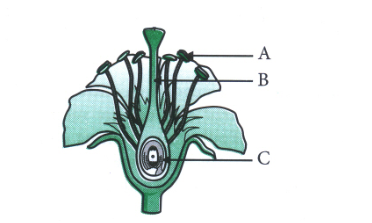
Name the parts A, B and C shown in the following diagram and state one function of each.
2.
Write two examples each of sexually transmitted disease caused by (i)virus, (ii) bacteria. Explain how the transmission of such diseases be prevented?
3.
List the parts of human male reproductive system which contribute fluid to the semen. State two advantages semen offers to the sperms.
4.
Explain the following methods of contraception giving one example of each:
(i)Barrier method
(ii)Hormonal imbalance method
(iii)Surgical method
5.
List any two differences between pollination and fertilisation.
6.
(i)What is fertilisation? Distinguish between external fertilisation and internal fertilisation
(ii)What is the site of fertilisation in human beings?
7.
Name the life process of an organisms that helps in the growth of its population.
8.
List the function of human female reproductive system.
9.
State the method used for growing rose plants.
10.
What is the effect of DNA copying which is not perfect accurate on the reproduction process?
11.
What happen when a mature program filament attains considerable length?
12.
Give two reasons among the progeny formed by sexual reproduction.
13.
When a human female reaches a certain stage then vaginal bleeding occurs for few days after regular time intervals.
(a)Give the scientific and common term for this process.
(b)What is said to have attained at this stage in hum, an females?
(c)How much time is this process repeated?
14.
What is the role of the seminal vesicles and the prostate gland?
15.
What is the importance of DNA copying in reproduction?
16.
In human males, the testes lie in the scrotum because it helps in the
process of mating
formation of sperm
easy transfer of gametes
all the above
17.
In human females, an event that reflects onset of reproductive phase is
growth of body
changes in hair pattern
change in voice
menstruation
18.
Which of the following statement are true for flowers?
(i)Flowers are always bisexual
(ii)They are the sexual reproductive organs
(iii)They are produced in all groups of plants
(iv)After fertilisation they give rise to fruits
(i) and (iv)
(ii) and (iii)
(i) and (iii)
(ii) and (iv)
19.
Vegetative propagation refers to formation of new plants from
stem, roots and flowers
stem, roots, and flower
stem, flowers and fruits
stem, leaves and flowers
20.
InRhizopus, tubular thread-like structures bearing sporangia at their tips are called
filaments
hyphae
rhizoids
roots
21.
In Spirogyra, asexual reproduction takes place by
breaking up of filaments into smaller bits
division of a cell into two cells
division of a cell into many cells
formation of Young cells from older cells
22.
Characters that are transmitted from parents to offspring during reproduction show
only similarities with parents
only variations with parents
both similarities and variations with parents
neither similarities nor variations
23.
In this list of organisms given below, those that reproduce by the asexual method are
(i)banana
(ii)dog
(iii)yeast
(iv)amoeba
(ii) and (iv)
(i), (iii) and (iv)
(i) and (iv)
(ii), (iii) and (iv)
24.
Asexual reproduction takes place through budding in
amoeba
yeast
plasmodium
leishmania
25.
Describe in brief the role of (i)testis (ii)seminal vesicle, (iii)vas deferens, (iv)ureter and (v) prostate gland in human male reproductive system.
26.
List six specific characteristics of sexual reproduction.
1.
A\(\rightarrow \) Anther. It produces pollen grains which are the male gametes.
B\(\rightarrow \) Style. It provides the path through which the pollen tube grows and reaches the ovary.
C\(\rightarrow \) Ovary. It contains ovules and each ovule has an egg cell / female gamete. It develops into fruit after fertilization.
2.
Sexually transmitted diseases caused by
(i) Virus:
(a) AIDS (Acquired Immune Deficiency Syndrome)
(b) Genital warts
(ii) Bacteria:
(a) Gonorrhoea
(b) Syphilis
Transmission of such diseases can be prevented by the following ways:
a) Screening tests for blood donors
b) Mutually faithful monogamous relationships
c) Educating people in high risk groups
d) Using condoms etc.
3.
Prostate glands and seminal vesicles add fluid in the vas deferens. This makes transportation of sperms easier and also provides nutrition to the sperms.
4.
(i) Barrier Method: In this method, physical devices such as condoms, diaphragm and cervical caps are used. These devices prevent the entry of sperm in the female
genital tract during copulation, thus acting' as a barrier between them. '
(ii) Hormonal Imbalance Method: In this method, specific drugs are used by females,which are of two types: oral pills and vaginal pills. Oral pills contain hormones
which stop the ovaries from releasing ovum into the fallopian tube. These pills are also called oral contraceptives (OCs) which act by changing the hormonal balance of the body so that eggs are not released and fertilisation cannot occur. The use of Intrauterine Contraceptive Devices (IUCDs) prevents implantation in the uterus. This device is copper- T placed safely inside the uterus by a doctor or nurse.
(iii) Surgical Method: In this method, a small portion of vas deferens in male and the fallopian tube in 'female is surgically removed or tied. It is called 'vasectomy' in males and 'tubectomy' in females. In this case, if the vas deferens in male is blocked, sperm transfer will be prevented and if the fallopian tube in the female is blocked, the egg will not be able to reach !he uterus, thus fertilisation will not take place
5.
| Pollination | Fertilisation |
| 1. It is the transfer of pollen grains from another to the stigma of a flower | 1. It is the fusion of male and female gametes. |
| 2. Pollination precedes fertilisation. | 2. Fertilisation occurs only after pollination when the pollen grains has germinated and sent the male gametes to ovule. |
| 3. Pollination carries the male gamete producing pollen grains to the female sex organ. | 3. Fertilisation brings about fusion of gametes. |
6.
| External Fertilisation | Internal Fertilisation |
| l. The fusion of male gamete (sperm) and female gamete (ovum) occurs the body. | l. The fusion of gametes occurs inside outside the body. |
| 2. Both individuals discharge their gametes outside the body. | 2. Only the male discharges sperms into female genital tract. |
| 3. Development occurs outside the body. | 3. Development occurs inside the body. |
| 4. Example: Frog | 4. Examples : Human, Birds, Cattle,etc. |
(ii) The site of fertilisation in human beings is in the fallopian tube of female reproductive system.
7.
Reproduction is the process that helps in the growth of population of an organism.
8.
Two functions of ovary:
To produce female gamete ovum
To secrete female hormones estrogen and progestrone.
9.
Artificial method of vegetative propagation like cutting are used to grow rose plants.
10.
DNA copying is not perfect accurate and the resultant errors are a source of variations in populations of organisms.
11.
When a mature spirogyra filament attains considerable length, it breaks up into smaller fragments or pieces, and each fragment grows into a new filament or individual
12.
The first and foremost reason for the appearance of variations among the progeny formed by sexual reproduction is, gene pool of the progeny is contributed by two different individuals. The second reason is that variations also happen during DNA replication before cell division.
13.
(a)Menstruation and Periods.
(b)Puberty
(c)28 days
14.
Secretions from seminal vesicles and prostate gland provide nutrition to the sperms. This makes transportation of sperms easier by providing them a fluid medium.
15.
The importance of DNA copying during reproduction are:
(i) It is responsible for the transmission of parental characteristics to the offsprings.
(ii) During DNA copying in reproduction, the changes occur due to the inheritance of traits from both the parents. This lead to certain genetic variations, which are useful for the evolution of species over a period of time.
16.
(b)
formation of sperm
17.
(d)
menstruation
18.
(d)
(ii) and (iv)
19.
(b)
stem, roots, and flower
20.
(b)
hyphae
21.
(a)
breaking up of filaments into smaller bits
22.
(c)
both similarities and variations with parents
23.
(b)
(i), (iii) and (iv)
24.
(b)
yeast
25.
1. Testis: Testes are oval shaped primary reproductive organs in men. The function of testes is to produce sperms and male sex hormone testosterone. The scrotum provides optimal temperature for the formation of sperms.
2. Seminal vesicle: Seminal vesicles are a pair of thin walled muscular elongated which secrete fluid for nourishment of sperms.
3. Vas deferens: The sperms are carried by a long tube called vas deferens to organs called seminal vesicles where the sperms get nourishment and stored.
4. Ureter: It is the tube that carries urine from kidney to the urinary bladder. In humans, there are two ureters, one attached to each kidney.
5. Prostate glands: Prostate glands produce a fluid which is released in the urethra along with secretion of seminal vesicles for nourishment and transportation of sperms.
26.
Characteristics of sexual reproduction are:
1. In sexual reproduction, two parents are involved (male and female).
2. The new organism produced is genetically different from both parents.
3. During gamete formation meiosis occurs. After fertilisation all divisions are mitotic.
4. Sexual reproduction helps in evolution.
5. Fertilisation of gametes leads to zygote formation. This zygote grows and develops to form a new organism.
6. Humans, fish, dogs, hens, cats, cows, horses, deer, rabbit, lions and tigers all reproduce by the method of sexual reproduction. Most of the flowering plants also reproduce by sexual reproduction.

10th Standard CBSE Syllabus & Materials
10th Standard CBSE
CBSE 10th Social Science PS - Federalism - New Model Questions Papers Study Material - QB365 Set A
NEW10th Standard CBSE
CBSE 10th Social Science PS - Power Sharing - New Model Questions Papers Study Material - QB365 Set A
NEW10th Standard CBSE
CBSE 10th Social Science GEO - Manufacturing Industries - New Model Questions Papers Study Material - QB365 Set A
NEW10th Standard CBSE
CBSE 10th Social Science GEO - Minerals and Energy Resources - New Model Questions Papers Study Material - QB365 Set A



CBSE 10th Standard CBSE Subjects
CBSE Standards





