
 100% FREE ACCESS
11th Standard CBSE Syllabus & Materials
11th Standard CBSE
CBSE 11th Economics PART-A - Presentation of Data - New Sample Question Papers Study Material - QB365 Set A
NEW11th Standard CBSE
CBSE 11th Economics PART-A - Organisation of Data - New Sample Question Papers Study Material - QB365 Set A
NEW11th Standard CBSE
CBSE 11th Economics PART-A - Collection of Data - New Sample Question Papers Study Material - QB365 Set A
NEW11th Standard CBSE
CBSE 11th Economics PART-A - Introduction to Economics and Statistics - New Sample Question Papers Study Material - QB365 Set A
NEW11th Standard CBSE
CBSE 11th Business Studies International Trade Sample Question Papers Study Material - QB365 Set A
NEW11th Standard CBSE
CBSE 11th Business Studies Evolution and Fundamentals of Business Sample Question Papers Study Material - QB365 Set A

Published on: 15/02/2019
Biological Classification Important Questions
Download CBSE Class 11th Standard CBSE Biology question papers, sample papers, important questions, and previous year solved papers in PDF format. Get free study materials, NCERT solutions, and exam preparation resources for Class 11th Standard CBSE Biology
Questions + Answers key
Take MCQ Biology Test
1.
Write short notes on Bacteria
2.
Suppose you accidentally find an old preserved permanent slide without a label. In your effort to identify it, you place the slide under microscope and observe the following features
(i) Unicellular
(ii) Well-defined nucleus
(iii) Biflagellate, one flagellum lying longitudinally and other transversely.
What would you identify it as? Can you name the kingdom it belongs to?
3.
Diatoms are called as pearls of ocean. Why ? What is diatomaceous earth ?
4.
Polluted water bodies have usually high abundance of plants like Nostoc and Oscillatoria. Give reason.
5.
Gamete formation and fusion are absent in bacteria. How do then bacteria undergo sexual reproduction ?
6.
What is the nature of cell wall in diatoms ?
7.
Name the organisms living in salty areas.
8.
Mention any two cellular structures absent in kingdom-Animalia of four Kingdom classification system of organisms that are present in kingdom-Protista.
9.
Why two kingdom classification continued to be used for a long time?
10.
Neurospora, an Ascomycetes fungus has been used as a biological tool to understand the mechanism of plant genetics much in the same way as Drosophila has been used to study animal genetics. What makes Neurospora as a genetic tool?
11.
Which are the main groups of kingdom-Animalia?
12.
Are chemosynthetic bacteria autotrophic or heterotrophic?
13.
What is the difference between bacteria and protozoa?
14.
Cyanobateria and heterophic bacteria have been clubbed together in Eubacteria of Kindom-Monera as per the five kindom classification even though the two are vastly different from each other , Is this grouping of the tow types of taxa in the same kingdom justify ? If so, Why?
15.
There is a myth that immediately after heavy rains in forest, mushrooms appear in large number and make a very large ring or circle, which may be several metres in diameter. These are called 'fairy rings'. Can you explain the myth of fairy rings in biological terms?
16.
At a stage of their cycle, Ascomycetes fungi produce the fruiting bodies like apothecium, perithecium and cleistothecium. How are these three types of fruiting bodies different from each other?
17.
What is the need of a classification system in biology? How did different classification systems develop over a period of time?
18.
Describe various classes of fungi.Give details of their key characteristics.
19.
(i) Why does the interior of bacterial cell appear simple and granular?
(ii) Which components make cell envelope of bacterial cell?
(iii) What gives gummy or sticky trait to bacterial cells and if it is not essential for survival, what are its functions?
20.
What is three domain system? Who introduced it? Name these domains and their salient features.
21.
Naked cytoplasm, multinucleated and saprophytic are the characteristics of ______.
22.
Which is the most acceptable system of biological classification?
Two Kingdom Classification
Three Kingdom Classification
Five Kingdom Classification
Six Kingdom Classification
23.
Which of the following organisms is a good indicator of pollution in an environment?
Bacteria
Fungi
Algae
Lichens
1.
Bacteria are unicellular.Among bacteria there are certain species which are believed to be on earth since life began on earth.Bacteria can be beneficial and harmful to humans.Nutrition is heterotrophic and autotrophic.
2.
Dinoflagellates are unicellular, motile, photosynthetic protists. They have a well defined nucleus and possess two different flagella one transverse and the other is longitudinal. They belong to kingdom-Protista.
3.
Pearl of ocean : Diatoms have a shinning silicified two valved covering or frustule. Because of their distinctive cell walls these are sometimes called the pearls of ocean.
Diatomaceous earth : It is pile of siliceous skeletons of diatoms which accumulates at the bottom of sea or oceans, being resistant to decay.
4.
Some cyanobacteria or blue-green algae like Nostoc and Oscillatoria can tolerate adverse conditions including pollutants very well, as compared to other aquatic plants. This is due to the presence of mucilage covering, resistant proteins and the absence of sap vacuoles. They release large quantity of spores, which are dispersed by air.
5.
It occurs by conjugation. It involves transfer of genetic material from one bacterium to another through cell to cell contact.
6.
Cell wall in diatoms is made up of cellulose and pectin compounds. It is two-valved layer called frustule.
7.
Halophiles live in habitats having high salinity and high light intensity. Examples are Halobacterium and Halococcus.
8.
Cell wall and chloroplasts are absent in cells of members of Kingdom-Animalia.
9.
Classification of organisms into plants and animals was easily done and was easy to understand.
10.
Neurospora (pink bread mould) is often called Drosophila of plant kingdom. It is haploid in nature which helps in immediate expression of every mutation. Beadle and Tatum used it as an experimental tool to find out that genes express their effect through synthesis of specific enzymes.
11.
Sponges, coelenterates, helminthes, annelids, arthropods, molluscs, Echinodermata, amphibian, reptiles, aves, and mammals.
12.
Chemosynthetic bacteria are autotrophs because they are able to synthesise their food from inorganic raw material with the help of energy obtained from chemical reaction.
13.
Cell wall is present in bacteria, while cell wall is absent in protozoa.Some bacteria can be autotrophs,while all protozoans are heterotrophs.
14.
Although the two are vastly different from each other . THey still bear some common characters , on the basis of which they are introduced in Eubacteria of kingdom-Monera.
These character are follows
(i) Both the group do nait possess well defined nucleus,
(ii) Nucleus lacks nucleous and nuclear membrane.
(iii) DNA (genetic material) lies freely in the cytoplasm
(iv)They possess 70 S type of ribosomes
15.
The fairy rings form as the mycelium of the mushroom fungus spreads in the soil from a central point. It grows peripherally, so that the younger hyphae will appear that cause young fungal hyphae to form compact masses that grow into mushrooms. This is the reason, the mushrooms appear growing in a circle or ring
16.
The fruiting bodies of Ascomycetes are called ascocarps. A fertile layer called hymenium bears asci. These fruiting bodies are different from each other in following ways
(i) Cleistothecium : Closed ascocarp, i.e., ascocarp with no opening.
(ii) Perithecium : Flask-shaped ascocarp with an apical pore called ostiole.
(iii) Apothecium : Cup-shaped open ascocarp.
17.
There are millions of species on this planet.The largest phylum Arthropoda alone comprises of millions of species. To study all of them properly we need some system for categorizing them, based on some common characteristics.
Apart from that think of the differences in language and you will find different names for the same species in different languages.In the absence of a system of nomenclature it would have been difficult to share scientific knowledge among the scientists of different nations.
To make things easier and systematic the need for classification was felt.Earlier attempts by people like Aristotle segregated living beings into plants and animals.This was good point to start with, but there are certain living beings which do not fit in either of plants or animals.So a three kingdom classification was devised.The three kingdom classification was used for some time.But as none of the scientific theory is permanent so further discoveries led to creation of a five kingdom classification.The five kingdom classification is the most accepted system of classification.
18.
Division of Kingdom Fungi :
The morphology of the mycelium, mode of spore formation and fruiting bodies form the basis for the division of the kingdom into various classes.
a) Phycomycetes :
Habit and Habitat : Members of phycomycetes are found in aquatic habitats and on decaying wood in moist and damp places or as obligate parasites on plants.
Mycelium : The mycelium is aseptate and coenocytic.
Reproduction : Asexual reproduction takes place by zoospores (motile) or by aplanospores (non-motile).
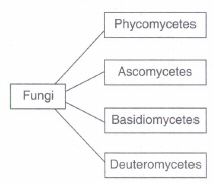
b) Ascomycetes :
Habit and Habitat : Commonly known as sac-fungi,the ascomycetes are unicellular, e.g.yeast (Sacharomyces) or multicellular, e.g.Penicillium.They are saprophytic, decomposers, parasitic or coprophilous (growing on dung).
Mycelium : Mycelium is branched and septate.
Reproduction : The asexual spores are conidia, produced exogenously on the special mycelium called conidiophores.
c) Basidiomycetes :
Habit and Habitat : Commonly known forms of basidiomycetes are mushrooms, bracket fungi or puffballs. They grow in soil, on logs and tree stumps and in living plant bodies as parasites, e.g., rusts and smuts.
Mycelium : The mycelium is branched and septate.
Reproduction : The asexual spores are generally not found, but vegetative reproduction by fragmentation is common.
d) Deuteromycetes :
Habit and Habitat : Some members are saprophytes or parasites while a large number of them are decomposers of litter and help in mineral cycling. Some examples are Alternaria, Colletotrichum and Trichoderma.
Reproduction : The deuteromycetes reproduce only by asexual spores known as conidia. The mycelium is septate and branched.
19.
(i) The interior of bacterial cell seems simple and granular because the membrane bound organelles are not present in it.
(ii) Mucilage, cell wall and plasma membrane are together called cell envelope.
(iii) Mucilage or glycocalyx gives gummy or sticky trait to cells.
Though it is not essential for bacterial survival, glycocalyx has several functions such as
(a) Protection from desiccation and toxins.
(b) Preventing host phagocytes to get attached to the bacterium.
(c) Holdings cells together.
(d) Storing chemicals for virulence.
20.
Three Domains system or six Kingdom classification is a biological classification system in which living organisms were divided based on cellular characteristics. Carl Woese in 1990 introduced it.
The three domains are
(i) Archaea It contains prokaryotic organisms, which have a monolayer core of lipids in the cell membrane and distinct nucleotides in their 16 RNA.
(ii) Bacteria It contains typical prokaryotes, which lack membrane covered cell organelles but do not have a type of microchambers for separating various activities.
(iii) Eukarya This domain contains eukaryotic organisms, originated by endosymbiotic association between some archaebacteria and eubacteria. It have four kingdoms-Protista, Plantae, and Animalia.
21.
Slime moulds are saprophytic protists that possess all these characteristics.
22.
(c)
Five Kingdom Classification
23.
(d)
Lichens

11th Standard CBSE Syllabus & Materials
11th Standard CBSE
CBSE 11th Business Studies Forms of Business Organisation Sample Question Papers Study Material - QB365 Set A
NEW11th Standard CBSE
CBSE 11th Business Studies Business, Trade and Commerce Sample Question Papers Study Material - QB365 Set A
NEW11th Standard CBSE
CBSE 11th Physics Waves Sample Question Papers Study Material - QB365 Set A
NEW11th Standard CBSE
CBSE 11th Physics Kinetic Theory Sample Question Papers Study Material - QB365 Set A



CBSE 11th Standard CBSE Subjects
CBSE Standards









