
 100% FREE ACCESS
7th Standard CBSE Syllabus & Materials
7th Standard CBSE
CBSE 7th Social Science Theme E - Understanding Market - New Sample Question Papers Study Material - QB365 Set A
NEW7th Standard CBSE
CBSE 7th Social Science Theme E - From Barter to Money - New Sample Question Papers Study Material - QB365 Set A
NEW7th Standard CBSE
CBSE 7th Social Science Theme D - The Constitution of India- An Introduction - New Sample Question Papers Study Material - QB365 Set A
NEW7th Standard CBSE
CBSE 7th Social Science Theme D - From the Rulers to the Ruled : Types of Governments - New Sample Question Papers Study Material - QB365 Set A
NEW7th Standard CBSE
CBSE 7th Social Science Theme B - The Age of Reorganisation - New Sample Question Papers Study Material - QB365 Set A
NEW7th Standard CBSE
CBSE 7th Social Science Theme B - The Rise of Empires - New Sample Question Papers Study Material - QB365 Set A

Published on: 05/03/2019
New Kings And Kingdoms important Questions
Download CBSE Class 7th Standard CBSE Social Science question papers, sample papers, important questions, and previous year solved papers in PDF format. Get free study materials, NCERT solutions, and exam preparation resources for Class 7th Standard CBSE Social Science
Questions + Answers key
Take MCQ Social Science Test
1.
Which district provided the details of the way in which sabha was organised? What was the system of election of committee members for sabha?
2.
What was the uses of money collected from taxes?
3.
You are present in an election for a sabha. Describe what you see and hear.
4.
Read the following information and answer the question that follows
This is part of the Tamil section of a land grant given by the Cholas :
We have demarcated the boundaries of the land by making earthen embankments, as well as by planting thorny bushes. This is what the land contains: fruit-bearing trees, water, land, gardens and orchards, trees, wells, open spaces, pastureland, a village, anthills, platforms, canals, ditches, rivers silt-laden land, tanks, granaries, fish ponds, beehives and deep lakes.
He who receives the land can collect taxes from it. He can collect the taxes imposed by judicial officers as fines, the tax on betel-leaves, that on woven cloth, as well as on vehicles. He can build large rooms with upper stories made of baked bricks, he can get large and small wells dug, he can plant trees and thorny bushes, if necessary, he can get canals constructed for irrigation. He should ensure that water is not wasted and that embankments are built. List all the possible sources of irrigation mentioned in the inscription and discuss how these might have been used.
5.
Do you think women participated in there assemblies? In your view are lotteries useful in choosing members of committees?
6.
Who defeated Muhammad Ghori?
7.
What was the use of embankments in the delta region?
8.
Describe the lives of ordinary men and women during the Chola empire.
9.
Explain 'Tripartite Struggle'.
10.
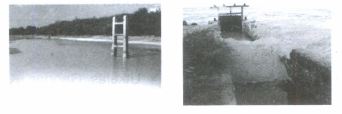
Interpret and compare the two above figures and answer the question Gates are opened and closed during which situation?
11.
Interpret and compare the two above figures and answer the question At which area these sluice gate were made?
12.
What were the achievements of Nagabhatta?
13.
______ contain details that may not be literally true.
14.
Vetti was one kind of ____________ taken in the form of forced labour.
15.
Kitab-al Hind, written by AI-Biruni still remains an important source for Historians.
16.
al-Baruni
17.
Rashtrakutas
18.
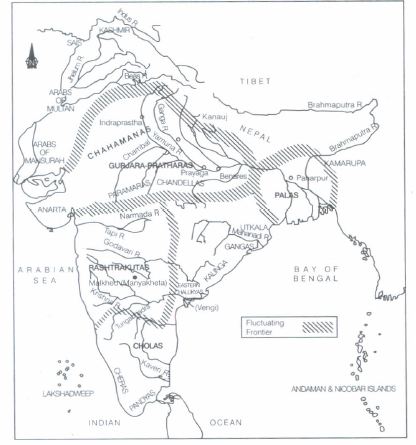
Can you identify the present day states over which they exercised control?
(i) Gurjara-Pratiharas - Madhya Pradesh and Uttar Pradesh
(ii) Rashtrakutas - Maharashtra
(iii) Palas - Bengal
(iv) Cholas - Andhra Pradesh
(v) Chahamanas - Delhi, Rajasthan
19.
In which language was the Prashasti found in Gwalior, written:
Sanskrit
Hindi
English
Urdu
20.
Which dynasty ruled China for about 300 years?
Tang
Shang
Xian
Qin
21.
Sultan Mahmud of Ghazni came from
Afghanistan
Arab
Persia
China
1.
Inscriptions from Uttaramerur in Chingleput district, Tamil Nadu, provided details of the way in which sabha was organized. The sabha had separate committees to look after irrigation work, gardens, temples, etc. Names of the eligible candidates were written on small tickets of palm leaf. The tickets were put into an earthenware pot. A young boy was asked to take out the tickets one by one for each committee.
2.
(i) This money is used to finance the king's establishment.
(ii) For the construction of temples and forts.
(iii) Also used to fight wars, which were in turn expected to lead to the acquisition in the form of plunder and access to land as well as trade route.
3.
What I saw in the process of election for a sabha, I am trying to express in words. A group of elite and wise people gathered in the sabha hall of temple. The senior most member was the president of sabha. And next one was the secretary. He announced the proposed names of people to be nominated in the sabha and asked existing members if they have any objection. As the majority of existing members supported the names of proposed persons they were elected as the members of sabha. For the election of committee the names of proposed members were written on palm leaves and kept in an earthenware pot. Then a young boy picked up few leaves, the name of members written on those leaves were announced as the elected members for committee.
4.
The possible sources of irrigation mentioned in this inscription are wells, canals, ditches, tanks, deep lakes and embankments canals a reconstructed for irrigation. Embankments are built, so that extra water of the river cannot make flood. Seasonal water can be stored in tanks, deep lakes etc. Later this water can be used for irrigation.
Taxpayers can construct canals which are used for irrigation in different fields. Fertile soils were deposited on the banks of the canals and there were no misuse of water through the dedicated lines of water carriage. Canals were made on the lands of the peasants who used to pay taxes out of the produce.
5.
No women did not participate in these assemblies. Only the man who had landed property and house and was well versed in administrative matters could become the member. He should have knowledge of the Vedas and should be between 35 and 70 years of age.
The system of lottery is not correct to choose the right candidate, as it is totally based on individual's luck, not on his qualifications and capacities.
6.
()
Prithviraj Chauhan defeated Muhammad Ghori in 1191 in first battle of Tarain but later on in 1192, he was defeated in second battle of Tarain by Ghori.
7.
()
Embankments had to be built in the delta region to prevent flooding.
8.
Chola empire the Periyapuranam, a twelfth-century Tamil work, tells us about the lives of ordinary men and women in the following way:
(i) On the outskirts of Adanur was a small hamlet of Pulaiyas, a name used for a social group considered "outcastes" by Brahmanas and Vellala
(ii) The hamlet was studded with small huts under old thatches and inhabited by agrarian labourers who were engaged in menial occupations.
(iii) The thresholds of the huts were covered with strips of leather, little chickens moved about in groups, dark children who wore bracelets of black iron were playing around were carrying little puppies. In the shade of the marudu (Arjuna) trees, a female labourer put her baby to sleep on a sheet of leather, there were mango trees from whose branches drums were hanging; and under the coconut palms, in little hollows on the ground, tiny-headed bitches lay after whelping. The red-crested cocks crowed before dawn calling the brawny Pulaiyar (plural) to their day's work; and by day, under the shade of the Kanji tree spread the voice of the wavy-haired Pulaiya women singing as they were husking paddy
9.
All the ruling dynasties were based in a specific region. At the same time they tried to control the other areas. One particularly prized area was the city of Kanauj in the Ganga valley. For centuries, rulers belonging to the Curjara-Pratihara, Rashtrakuta and Pala dynasties fought for control over Kanauj. As there were three 'parties' in this long drawn conflict. Historians often describe it as the "tripartite struggle". Rulers also tried to demonstrate their power and resources by building large temples. When they attacked one another's kingdom; they often chose to target temples, which were sometimes extremely rich.
10.
Gates were opened to irrigate land and closed to store water for future use.
11.
They all were made by Cholas in Tamil Nadu.
12.
Many rulers described their achievements in Prashastis. One prashasti, written in Sanskrit was found in Gwalior (Madhya Pradesh) spoke highly about the success of Nagabhatta, a Pratihara King. It follows like this.
The king of Andhra, Saindhava (Sind), Vidarbha (Maharashtra) Kalinga (part of Orissa) fell before him even as he was a prince.
He won a victory over Chakrayudha (the ruler of Kanauj). He defeated king of Vanga (Part of Bengal), Anarta (part of Gujarat), Malava (part of Madhya Pradesh), Kirata (forest peoples), Turushka (Turks), VatsaMatsya (both from North India).
13.
()
Prashastis
14.
()
Tax
15.
(a)
16.
()
Pratihara King
17.
()
Western Deccan
18.
19.
(a)
Sanskrit
20.
(a)
Tang
21.
(a)
Afghanistan

7th Standard CBSE Syllabus & Materials
7th Standard CBSE
CBSE 7th Social Science Theme B - New Beginnings : Cities and States - New Sample Question Papers Study Material - QB365 Set A
NEW7th Standard CBSE
CBSE 7th Social Science Theme A - Climates of India - New Sample Question Papers Study Material - QB365 Set A
NEW7th Standard CBSE
CBSE 7th Social Science Theme A - Geographical Diversity of India - New Sample Question Papers Study Material - QB365 Set A
NEW7th Standard CBSE
CBSE 7th Science Earth, Moon and the Sun - New Sample Question Papers Study Material - QB365 Set A



CBSE 7th Standard CBSE Subjects
CBSE Standards




