
 100% FREE ACCESS
7th Standard CBSE Syllabus & Materials
7th Standard CBSE
CBSE 7th Social Science Theme E - Understanding Market - New Sample Question Papers Study Material - QB365 Set A
NEW7th Standard CBSE
CBSE 7th Social Science Theme E - From Barter to Money - New Sample Question Papers Study Material - QB365 Set A
NEW7th Standard CBSE
CBSE 7th Social Science Theme D - The Constitution of India- An Introduction - New Sample Question Papers Study Material - QB365 Set A
NEW7th Standard CBSE
CBSE 7th Social Science Theme D - From the Rulers to the Ruled : Types of Governments - New Sample Question Papers Study Material - QB365 Set A
NEW7th Standard CBSE
CBSE 7th Social Science Theme B - The Age of Reorganisation - New Sample Question Papers Study Material - QB365 Set A
NEW7th Standard CBSE
CBSE 7th Social Science Theme B - The Rise of Empires - New Sample Question Papers Study Material - QB365 Set A

Published on: 05/03/2019
The Delhi Sultans Important Questions
Download CBSE Class 7th Standard CBSE Social Science question papers, sample papers, important questions, and previous year solved papers in PDF format. Get free study materials, NCERT solutions, and exam preparation resources for Class 7th Standard CBSE Social Science
Questions + Answers key
Take MCQ Social Science Test
1.
Describe the Delhi Sultanate during the 15th and 16th century
2.
Give a brief account of Raziyya
3.
How did the authorities of muqtis ended?
4.
Write a short note on Sher Shah Suri.
5.
Why did the Delhi Sultans build mosques all over the subcontinent?
6.
How did the Mongols Persuade the Delhi Sultans to mobilise a big army?
7.
Do you think the 'Circle of Justice' is an appropriate term to describe the relationship between the king and his subjects?
8.
Read the following extract and answer the question that follows
Chieftains and their Fortifications
Ibn Battuta, a 14th-century traveller from Morocco, Africa, explained that chieftains sometimes fortified themselves in mountains, in rocky, uneven and rugged places as well as in bamboo groves. In India the bamboo is not hollow, it is big. Its several parts are so intertwined that even fire cannot affect them and they are on the whole very strong. The chieftains live in these forests which serve them as ramparts, inside which are their cattle and their crops. There is also water for them within, that is, rainwater which collects there. Hence, they cannot be subdued except by powerful armies, who entering these forests, cut down the bamboos with specially prepared instruments. Describe the ways in which the chieftains arranged for their defense.
9.
How did the Khaljis and Tughluqs help the people of humble birth? How did it lead to instability in the Sultanate?
10.
Which ruler first established his or her capital at Delhi?
11.
Who was the successor of Muhammad-bin- Tughluq?
Ibn Battuta
Ghiyasuddin Tughluq
Firoz Shah Tughluq
None of these
12.
Alauddin constructed a new Garrison town for his soldiers. The name of this town was
Siri
Daulatabad
Jahanpanah
Firuzabad
13.
Raziyya Sultan ruled during
1206-1201 AD
1236-1240 AD
1210-1236 AD
1266-1287 AD
14.
When did Raziyya Sultan sat on the throne?
1235
1236
1237
1238
15.
Special slaves were called by which name?
16.
Why was Muhammad-bin-Iughluq known as "Man of ideas but a failure as an administrator"?
17.
What were the administrative measures taken by Alauddin Khalji to check the prices and supply of goods for his large standing army?
18.
Compare figures 1, 2, 3 and 4. What similarities and differences do you notice amongst the mosques?
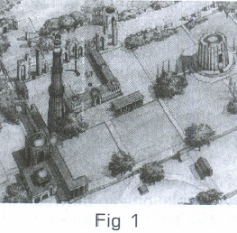
Quwwat aI-Islam mosque and minaret, built during the last decade of the 12th century. This was the congregational mosque of the first city built by the Delhi Sultans described in the chronicles as Delhi-i-Kuhna (the old city). The mosque was enlarged by IItutmish and Alauddin Khalji. The minar was built by two Sultans. Qutbuddin Aybak and IItutmish.
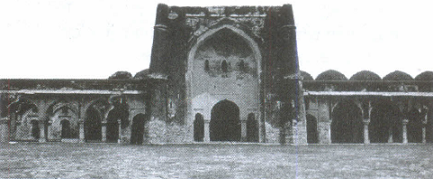
Begumpuri mosque built in the reign of Muhammad Tughluq was the main mosque of Jahanpanah the 'Sanctuary of the World' his new capital in Delhi.
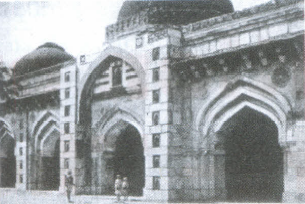
Moth ki Masjid, built in the reign of Sikandar Lodi by his minister.
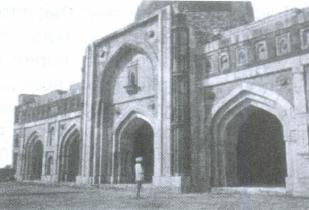
19.
What is called a masjid? Explain the contribution of Delhi Sultans in building different masjids.
20.
Emperor __________ followed the administration model of Sher Shah Suri when he consolidated the Mughal Empire.
21.
Soldiers were paid salaries in cash in the reign of Alauddin Khalji
22.
Internal frontier was aimed at military expeditions into Southern India.
23.
Early Turkish ruler
24.
Khizr Khan
25.
On an outline map of India, identify the provinces of Delhi Sultanate during Muhammad Tughlaq's reign and write their names near their locations
1.
The Delhi Sultanate during the fifteenth and sixteenth century.
(i) After the Tughluqs, the Sayyid and Lodi dynasties ruled from Delhi and Agra until 1526.
(ii) Bythen, [aunpur, Bengal, Malwa, Gujarat, Rajasthan and the entire South India had independent rulers. They had established flourishing states and prosperous capitals.
(iii)This was also the period which saw the emergence of new ruling groups like the Afghans and the Rajputs.
(iv) Some of the states established in this period were small but very powerful and extremely well administered.
2.
In a brief, Sultan Iltutmish's daughter, Raziyya, became the Sultan in 1236. The chronicler of the age named Minhaj-i Siraj said that she was more able and qualified than all her brothers.
(i) Her brothers were not comfortable having her as ruler.
(ii) The nobles were also not happy at her attempts to rule independently.
(iii) She was removed from the throne in 1240.
3.
(i) Delhi Sultans brought the hinterland of the cities under their control.
(ii) They forced the landed chieftains, the Samantas and rich landlords to accept their authority.
(iii) Under Alauddin Khalji the state brought the assessment and collection of land revenue under its own control.
- The rights of the local chieftains to levy taxes were cancelled.
- They were also forced to pay taxes.
-The Sultan's administrators measured the land and maintained careful accounts.
- Several of the old chieftains and landlords served the Sultanate as revenue collectors and assessors.
4.
Sher Shah Suri (1540-1545) started his career as the Manager of a small territory for his uncle in Bihar and eventually challenged and defeated the Mughal emperor Humayun (1530-1540,1555,1556).
(i)Sher Shah Suri captured Delhi and established his own dynasty.
(ii) The Suri dynasty ruled for only fifteen years (1540- 1555)but it introduced an administration that had borrowed elements from Alauddin Khalji and made them more efficient.
(iii) Sher Shah's administration became the model for Akbar to some extent.
5.
Delhi Sultans built various mosques in different cities. They wanted to project themselves as protectors of Islam and Muslims. Mosques helped in creating a sense of community sharing, common belief and code of conduct. It was important as the Muslims came from variety of backgrounds.
6.
(i) The Mongols under Genghis Khan invaded Transoxiana in north-east Iran in 1291.
(ii) Delhi Sultan faced their onslaught soon after.
(iii) Mongol attacks on the Delhi Sultanate increased significantly during the reign of Alauddin Khalji and during the initial years of Muhammad-bin-Tughluq's rule.
(iv) This forced the two rulers to mobilise a large standing army in Delhi which posed a huge administrative challenge
7.
'Circle of Justice' is an appropriate term to describe the relationship between the king and his subjects, because they were dependent on each other for their requirements.
8.
The chieftains arranged multiple forms of defense system against the attacking enemies. A chieftain when attacked used to fortified in mountains, in rocky valleys, uneven and rugged places and in bamboo groves also.
In India the bamboo is strong, even fire cannot affect them as they are intertwined. The chieftains live in these forests which served them as ramparts, inside which there were cattle and crops. They cannot be subdued except by powerful armies. Only specially prepared instruments could cut down the bamboos where the chieftains took shelter.
9.
The Khaljis and the Tughluq's raised people of humble birth who were often their clients, to high political positions. They were appointed as generals and governors. However, the slaves and clients were loyal to their masters and patrons but not to their heirs. Heirs were the new rulers, they neglected such appointed man of high posts. This led to conflict between old and new nobility.
10.
Tomara Rajputs were the first rulers who established their capital at Delhi.
11.
(c)
Firoz Shah Tughluq
12.
(a)
Siri
13.
(b)
1236-1240 AD
14.
(b)
1236
15.
()
Special slaves were purchased for military services and were called as Bandagan.
16.
Muhammad bin Tughluq was a learned man, a philosopher and student of science and math. His ideas about "token currency" and "central capital" were good but failed miserably as administrative measures:
After he defeated Mongol Army, he planned to raise large army to attack on Transoxiana. But his campaign into Kashmir was a disaster. He had to disband his large army as well as his plans to conquer Mongols.
He asked residents of Dehli-i-Kuhna to vacate the city for his soldiers and move to new capital Daulatabad in the south. It resulted in another failure and resentment among the citizens.
To feed his army, he levied additional taxes which coincided with famine in the area. It led to widespread rebellion in Ganga-Yamuna belt.
To control prices, he introduced a 'token currency'. People did not trust these new coins but they outsmarted the king and paid the taxes in new currency. This cheap currency could also be counterfeited easily. Finally, the 'token currency' had to be recalled.
17.
Alauddin Khalji executed the following administrative measures:
(i) He constructed a new garrison town known as Siri for his soldiers.
(ii) He fixed 50 per cent of the peasant's yield for the Ganga Yamuna lands.
(iii)The soldiers were paid salaries instead of iqtas. The soldiers would buy their supplies from merchants in Delhi.
(iv) The prices of the goods in Delhi were regulated. Merchants were asked to sell at prescribed rates.
(v) Prices were carefully surveyed by officers, and merchants who did not sell at the prescribed rates were punished.
18.
The mosques in Fig. 2, 3 and 4 show an evolution in the architectural tradition that culminates in Shah Jahan's mosque in Delhi. In Fig. 1 the earlier mosque is shown which is plain and rough. Only a centre hall mosque is there. Thereafter, in fig. 2, the mosque had many supporting masjids in the left and right side of the main hall.
Fig. 3 Moth ki Masjid, showed many soft skills, craftwork carved on the pillars, walls, Arabic calligraphy. The facade was decorated with Arabic calligraphy and vegetal motifs in the fig. 3 and 4. Craftsmen used corbelled arches, a technique commonly used in India. Different types of red sandstone marble were used to create such monuments. These all spoke highly about the art and culture that flourished during the Delhi Sultanate.
19.
A mosque is called a masjid in Arabic, literally, it is a place where a Muslim prostrates in reverence to Allah. In a congregational mosque, Muslim read their prayers. Members of the congregation choose the most respected, learned male as their leader or Imam for the rituals of prayer-Imam delivers the sermon (Khutba) during Friday prayer.
The Delhi Sultans build several mosques in cities all over the subcontinent.
They wanted to claim themselves as protectors of Islam and Muslims. Mosques also helped to create the senses of a community of believers who shared a common code of conduct and belief.
Quwwat al-islam was built by Qutbuddin Aybak and IItutmish. Muhammad Tughluq constructed Begumpuri mosque. Moth ki Masjid built by a minister of Sikandar Lodi, Mosque of Jamali Kamali was also built in the late 1520s.
20.
()
Akbar
21.
(a)
22.
(b)
23.
()
Shamsuddin lltutmish
24.
()
Sayyid Dynasty (1414-1451 )
25.
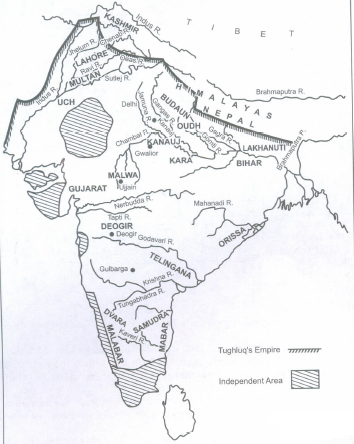

7th Standard CBSE Syllabus & Materials
7th Standard CBSE
CBSE 7th Social Science Theme B - New Beginnings : Cities and States - New Sample Question Papers Study Material - QB365 Set A
NEW7th Standard CBSE
CBSE 7th Social Science Theme A - Climates of India - New Sample Question Papers Study Material - QB365 Set A
NEW7th Standard CBSE
CBSE 7th Social Science Theme A - Geographical Diversity of India - New Sample Question Papers Study Material - QB365 Set A
NEW7th Standard CBSE
CBSE 7th Science Earth, Moon and the Sun - New Sample Question Papers Study Material - QB365 Set A



CBSE 7th Standard CBSE Subjects
CBSE Standards




