
 100% FREE ACCESS
7th Standard CBSE Syllabus & Materials
7th Standard CBSE
CBSE 7th Social Science Theme E - Understanding Market - New Sample Question Papers Study Material - QB365 Set A
NEW7th Standard CBSE
CBSE 7th Social Science Theme E - From Barter to Money - New Sample Question Papers Study Material - QB365 Set A
NEW7th Standard CBSE
CBSE 7th Social Science Theme D - The Constitution of India- An Introduction - New Sample Question Papers Study Material - QB365 Set A
NEW7th Standard CBSE
CBSE 7th Social Science Theme D - From the Rulers to the Ruled : Types of Governments - New Sample Question Papers Study Material - QB365 Set A
NEW7th Standard CBSE
CBSE 7th Social Science Theme B - The Age of Reorganisation - New Sample Question Papers Study Material - QB365 Set A
NEW7th Standard CBSE
CBSE 7th Social Science Theme B - The Rise of Empires - New Sample Question Papers Study Material - QB365 Set A

Published on: 31/12/2018
7th Grade Unit Test
Download CBSE Class 7th Standard CBSE Mathematics question papers, sample papers, important questions, and previous year solved papers in PDF format. Get free study materials, NCERT solutions, and exam preparation resources for Class 7th Standard CBSE Mathematics
Questions + Answers key
Take MCQ Mathematics Test
1.
Find \(\frac{1}{7}\) of \(\frac{3}{10}\)
2.
Expand by expressing powers of 10 in the exponential form. 56439
3.
Write the like terms in the expression
4x2 yz + 7xy2z - 14xyz + 7x2yz2 + 14xyx2 - 15xy2z+ 10zxy2 +13y2 xz
4.
Find \(\frac { 19 }{ 5 } +\left( \frac { -7 }{ 5 } \right) \)
5.
Find the value of \(\frac{12}{x}=\frac{16}{4}\)
6.
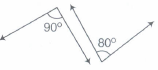
Check which of the following pairs of angles form a linear pair in the figure?
7.
Arrange the rational numbers \(\frac{-2}{5},\frac{9}{-10}\) and \(\frac{-5}{6}\).
8.
Evaluate the value of \([144 \times \frac{1}{2}\times \frac{1}{6}]\div \frac{1}{2}\)
9.
If A :B = 3 : 4 and B :C = 5 : 6. Find A : C.
10.
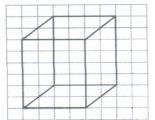
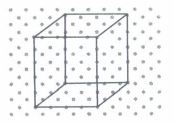
Give an oblique sketch for the following:
A cube with an edge 4 cm long.
11.
Read the bar graph (in the given figure), which shows the number of books sold by a bookstore during five consecutive years and answer the following questions.
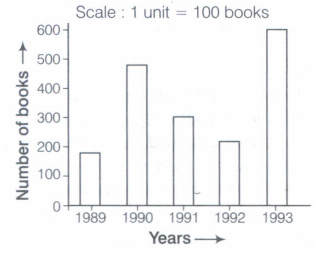
Can you explain how you would estimate the number of books sold in 1989?
12.
Multiplication is not commutative for integers.
13.
(25)6 = 211
14.
In oblique sketch of the solid,the measurements are kept proportional
15.
If ΔABC is an isosceles triangle, where AB = AC and D is mid-point of BC, then ΔABD ≌ ΔACD.
16.
if \(\frac { -6 }{ 7 } =\frac { x }{ 28 } ,\) then the value of x is \(\frac { -3 }{ 2 } \)
17.
At ______ % per annum simple interest Rs.100 will become Rs.300 in 16 years.
18.
132.11 \(\div\) 1000 =_________
19.
| Shape | Centre of rotation | Order of rotation | Angle of rotation |
|---|---|---|---|
| Semi-circle |
20.
If \(\frac{1}{6}-x=\frac{1}{6}\) then x = __________.
21.
___ \(\div\) 48 = -1
22.
Simplify \(\frac { { 5 }^{ -2 }\times { 3 }^{ -3 }\times (125)^{ 2/3 } }{ (27)^{ -2/3 }\times (32)^{ -1/5 } } \).
23.
Taking x\(=\frac { -4 }{ 9 } \), y\(=\frac { 5 }{ 12 } \),and z\(=\frac { 7 }{ 18 } \) , Find
x\(\div \)(y\(\div \)z)
24.
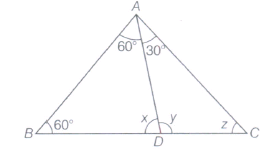
In the given figure, find the values of x, y and z.
25.
Arrange in descending order. 6.2, 2.4, 12.46, 12.34, 46.16, 46.21
26.
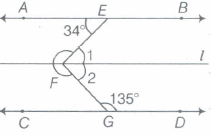
In the given figure, AB II CD. Find the reflex \(\angle\)EFG.
27.
The denominator of the rational number \(\frac{4}{7}\) is
7
4
3
11
28.
Simplify: p + (p - q) + q + (q - p)
p
q
p + q
p - q
29.
There are 100 voters. 50 of them votes yes. What per cent voted yes?
10%
25%
50%
5%
30.
On a number line, when we subtract a positive integer, we
move to the right
move to the left
do not move at all
none of these.
31.
If 'a' and 'b' are rational numbers and m is a whole number, then the value of am \(\div\) bm is:
(ab)m
(m)a-b
(m)a+b
(a/b)m
32.
If the length of a side of a triangle is 15cm. The difference of other two sides of this triangle must be:
equal to 15 cm
more than 15 cm
less than 15 cm
7.5 cm
33.
A fraction having its numerator as 1 is called a:
like fraction
improper fraction
unlike fraction
unit fraction
34.
Which of the following has the largest value?
\(\frac { 32 }{ 0.05 } \)
\(\frac { 0.320 }{ 50 } \)
\(\frac { 3.2 }{ 0.05 } \)
\(\frac { 3.2 }{ 50 } \)
35.
What is the sum of the measures of two supplementary angles?
90°
180°
360°
270°
36.
Total number of edges a cylinder has
0
1
2
3
37.
The figure given below represents a rectangular lawn with a circular flower bed. Find:
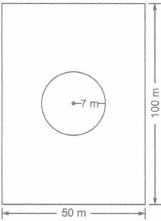
The area of the lawn excluding the flower bed.
38.
Find the value of the following expressions for a = 3 and b = 2:
a - b
39.
Write the reciprocal of:
-1
40.
How many lines of symmetry are there in a rhombus?
41.
Write as per cent. 5 / 20
42.
Find an angle which is \(\frac { 1 }{ 8 } \) the of its complement.
43.
What do we call a triangle whose each angle is 60°?
44.
What is the value of 1.35 x 100?
45.
Write it certain to happen, impossible, can happen but not certain for each of the following events.
The sun coming up from the east.
46.
What is the quotient, when an integer is divided by 1?
47.
Write each of the following in power notation:
\((a)\left(-{4\over 3}\right)\times\left(-{4\over 3}\right)\times\left(-{4\over 3}\right)\times\left(-{4\over 3}\right)\times\left(-{4\over 3}\right)\)
\((b)\left(-{8\over 3}\right)\times\left(-{8\over 3}\right)\times\left(-{8\over 3}\right)\times\left(-{8\over 3}\right)\times\left(-{8\over 3}\right)\times\)
48.
Divide 184 into two parts such that one third of one part may exceed one seventh of other part by 8.
1.
We have, \(\frac{1}{7}\)of\(\frac{3}{10}\)= \(\frac{1}{7}\times \frac{3}{10}=\frac{1\times 3}{7\times 10}=\frac{3}{70}\)
2.
We have, 56439
Expanded form of 56439 = = 5 x 10000 + 6 x 1000 + 4 x 100 + 3 x 10 + 9 x 1
= 5x10⁴ + 6x10³ + 4x10² + 3x101 + 9x100
Which is the required exponential form in powers of 10.
3.
The like terms are 7xy2z,- 15xy2z, 10zxy2,13y2xz
4.
\(\frac { 19 }{ 5 } +\left( \frac { -7 }{ 5 } \right) =\frac { 19+(-7) }{ 5 } =\frac { 19-7 }{ 5 } =\frac { 12 }{ 5 } \)
5.
3
6.
Sum of two angles = 90° + 80° = 170°,
which is less than 180°.
So, this pair is not a linear pair.
7.
The given rational numbers are: \(\frac{-2}{5},\frac{9}{-10}\) and \(\frac{-5}{6}\).
First let us express the given rational numbers with positive denominators.
\(\therefore\) \(\frac{-2}{5}=\frac{-2\times1}{5\times1}=\frac{-2}{5}\)
\(\frac{9}{-10}=\frac{9\times(-1)}{(-10)\times(-1)}=\frac{-9}{10}\)
\(\frac{-5}{6}=\frac{-5\times1}{6\times1}=\frac{-5}{6}\)
Since, LCM of 5, 10 and 6 is 30.
\(\therefore\)Making the denominators of the given rationals the same, we have
\(\frac{-2}{5}=\frac{-2}{5}\times \frac{6}{6}=\frac{-12}{30}\)
\(\frac{9}{-10}=\frac{-9}{10}\times \frac{3}{3}=\frac{-27}{30}\)
\(\frac{-5}{6}=\frac{-5}{6}\times \frac{5}{5}=\frac{-25}{30}\)
Since, (-27) <(-25) <(-12)
i.e. \(\frac{-27}{30}<\frac{-25}{30}<\frac{-12}{30}\)
Thus, \(\frac{9}{-10}<\frac{-5}{6}<\frac{-2}{5}\)
8.
24
9.
Given, A: B = 3: 4, B: C = 5: 6
i.e. \(\frac { A }{ B } =\frac { 2 }{ 3 } and\frac { B }{ C } =\frac { 5 }{ 6 } ⇒\frac { A }{ B } \times \frac { B }{ C } =\frac { 3 }{ 4 } \times \frac { 5 }{ 6 } =\frac { 5 }{ 8 } \)
\(\frac { A }{ C } =\frac { 5 }{ 8 }\)
10.
(i) Oblique sketch of the cube of edge 4 cm is as follows:
(ii) An isometric sketch of this cube is as follows:
11.
From the bar graph, it is clear that number of books in the years 1989 is 180 (approx.). We can see in the bar graph that the number of book sold in the year 1989 is little less than 200, but greater than 175.
12.
(b)
13.
(b)
14.
(b)
15.
(a)
16.
(b)
17.
()
12.5%
18.
()
0.13211
19.
()
A figure is said to have rotational symmetry, if it fits on to itself more than once during a full turn i.e. rotation through 360°.
The complete table is shown below:
| Shape | Centre of rotation | Order of rotation | Angle of rotation |
|---|---|---|---|
| Semi-circle | No | No | No |
20.
Given, \(\frac{1}{6}-x=\frac{1}{6}\Rightarrow \frac{1-6x}{6}=\frac{1}{6}\)
1 - 6x = 1 \(\Rightarrow\) 6x = 1 - 1 \(\Rightarrow\) 6x = 0 \(\Rightarrow\) x = 0
So, if \(\frac{1}{6}-x=\frac{1}{6}\) then x = 0.
21.
()
We have, (-48) \(\div\) 48 = -48/48 = -1 [ \(\because\) (-a) \(\div\)a = -1 ]
22.
\(\frac { { 5 }^{ -2 }\times { 3 }^{ -3 }\times (125)^{ 2/3 } }{ (27)^{ -2/3 }\times (32)^{ -1/5 } } \)
∵ 125 = (5)3 = 5 x 5 x 5
So, (125)2/3 =(5)3 x 2/3 =52 and 27=(3)3
∴ (27)-2/3 = {(3)3}-2/3 =\({ (3 })^{ 3\times \frac { -2 }{ 3 } }\) =(3)2
32 = 2 x 2 x 2 x 2 x 2 = (2)5
So, (32)-1/5 = {(2)5}-1/5 = \({ (2) }^{ 5\times \frac { (-1) }{ 5 } }\)=(2)-1
Now \(\frac { { 5 }^{ -2 }\times { 3 }^{ -3 }\times { 5 }^{ 2 } }{ (3)^{ -2 }\times (2)^{ -1 } } \) \(\left[ \because a^{ -m }=\frac { 1 }{ { a }^{ m } } \right] \)
= 5-2 x 3-3 x 32 x 21 x 52
=5-2+2 x 3-3+2 x 21
am x an =am+n
=50 x 3-1 x 21 = 1 x \(\frac { 1 }{ 3 } \times 2=\frac { 2 }{ 3 } \).
23.
We have, x\(\div \)(y\(\div \)z)
=\(=\frac { -4 }{ 9 } \div \left( \frac { 5 }{ 12 } +\frac { 7 }{ 18 } \right) =\frac { -4 }{ 9 } \div \left( \frac { 5 }{ 12 } \times \frac { 18 }{ 7 } \right) \\ =\frac { -4 }{ 9 } \div \frac { 15 }{ 14 } =\frac { -4 }{ 9 } \times \frac { 14 }{ 15 } =\frac { -56 }{ 135 } \)
24.
In the given figure,\(\angle BAD=60°,\angle ABD=60°,\angle ADB=x,\angle DAC=30°,\angle ADC=Y\) and \(\angle ACD =z\)
We know that, the sum of all angles in a triangle is equal to 180.
So, \(\angle BAD+\angle ABD+\angle ADB=180°\)
\(\Rightarrow\) 60° + 60° + x = 180°
\(\Rightarrow\) 120° + x = 180°
\(\Rightarrow\) x = 180° - 120° \(\Rightarrow\) x = 60°
Now,\(\angle y=\angle BAD+\angle ADB\)
[since, exterior angle is equal to the sum of interior opposite angles]
\(\Rightarrow\angle y=60°+60°\)
\(\therefore \angle y=120°\)
\(\triangle ADC\) we know that, the sum of all angles in a triangle is equal to 180°.
So, \(\angle DAC+\angle ADC+\angle ACD=180°\)
\(\Rightarrow\) 30° + 120° + z = 180°
\(\Rightarrow\) 150° + z = 180°
\(\Rightarrow\) z = 180° - 1500
\(\Rightarrow\) z = 30°
Hence, x = 60°, Y = 120° and z = 30°
25.
46.21,46.16,12.46,12.34,6.2,2.4
26.
281°
27.
(a)
7
28.
(c)
p + q
29.
Required percentage =\({50\over 100}\times 100\%\)
=50%.
30.
(b)
move to the left
31.
(d)
(a/b)m
32.
(c)
less than 15 cm
33.
(d)
unit fraction
34.
(a)
\(\frac { 32 }{ 0.05 } \)
35.
(b)
180°
36.
(c)
2
37.
()
4846 m2
38.
()
1
39.
()
-1
40.
()
2
41.
()
20%
42.
()
10°
43.
()
Equilateral
44.
()
135
45.
()
is certain to happen
46.
()
The integer itself.
47.
\((a)\left(-{4\over 3}\right)\times\left(-{4\over 3}\right)\times\left(-{4\over 3}\right)\times\left(-{4\over 3}\right)\times\left(-{4\over 3}\right)\)
\(={(-4)\times(-4)\times(-4)\times(-4)\times(-4)\over 3\times3\times3\times3\times3}\)
\(={(-4)^5\over (3)^5}=\left(-4\over 3\right)^5\)
\((b)\left(-{8\over 3}\right)\times\left(-{8\over 3}\right)\times\left(-{8\over 3}\right)\times\left(-{8\over 3}\right)\times\left(-{8\over 3}\right)\)
\(={(-8)\times(-8)\times(-8)\times(-8)\times(-8)\over 3\times3\times3\times3\times3}\)
\(={(-8)^5\over (3)^5}=\left(-8\over 3\right)^5\)
48.
Let one part of 184 be x.
\(\therefore\) Other part be (184 - x)
Now, according to question,
\(\Rightarrow \quad \frac { 1 }{ 3 } x-\frac { 1 }{ 7 } (184-x)=8\)
\(\Rightarrow \quad \frac { x }{ 3 } +\frac { x }{ 7 } -\frac { 184 }{ 7 } =8\)
\(\Rightarrow \quad \frac { 7x+3x }{ 21 } =8+\frac { 184 }{ 7 } \)
\(\Rightarrow \quad \frac { 10x }{ 21 } =\frac { 56+184 }{ 7 } \)
\(\Rightarrow \quad \frac { 10x }{ 21 } =\frac { 240 }{ 7 } \)
\(\Rightarrow \quad x=\frac { 21\times 240 }{ 7\times 10 } \)
= 72
Hence, parts are 72 and 184 - 72 = 112.

7th Standard CBSE Syllabus & Materials
7th Standard CBSE
CBSE 7th Social Science Theme B - New Beginnings : Cities and States - New Sample Question Papers Study Material - QB365 Set A
NEW7th Standard CBSE
CBSE 7th Social Science Theme A - Climates of India - New Sample Question Papers Study Material - QB365 Set A
NEW7th Standard CBSE
CBSE 7th Social Science Theme A - Geographical Diversity of India - New Sample Question Papers Study Material - QB365 Set A
NEW7th Standard CBSE
CBSE 7th Science Earth, Moon and the Sun - New Sample Question Papers Study Material - QB365 Set A



CBSE 7th Standard CBSE Subjects
CBSE Standards




