
 100% FREE ACCESS
10th Standard CBSE Syllabus & Materials
10th Standard CBSE
CBSE 10th Social Science ECO - Globalisation and the Indian Economy - New Model Questions Papers Study Material - QB365 Set A
NEW10th Standard CBSE
CBSE 10th Social Science ECO - Money and Credit - New Model Questions Papers Study Material - QB365 Set A
NEW10th Standard CBSE
CBSE 10th Social Science ECO - Sectors of the Indian Economy - New Model Questions Papers Study Material - QB365 Set A
NEW10th Standard CBSE
CBSE 10th Social Science ECO - Development - New Model Questions Papers Study Material - QB365 Set A
NEW10th Standard CBSE
CBSE 10th Social Science PS - Outcomes of Democracy - New Model Questions Papers Study Material - QB365 Set A
NEW10th Standard CBSE
CBSE 10th Social Science PS - Gender, Religion and Caste - New Model Questions Papers Study Material - QB365 Set A

Published on: 03/10/2019
Coordinate Geometry
Download CBSE Class 10th Standard CBSE Maths question papers, sample papers, important questions, and previous year solved papers in PDF format. Get free study materials, NCERT solutions, and exam preparation resources for Class 10th Standard CBSE Maths
Questions + Answers key
Take MCQ Maths Test
1.
Find the coordinates of the point Q on the x-axis which lies on the perpendicular bisector of the line segment joining the points A(-5,-2) and B(4,-2). Name the type of triangle formed by the points Q, A and B.
2.
Find the area of the triangle ABC with A(1,-4) and the mid-points of sides through A being (2,-1) and (0,-1).
3.
Find the area of a square, if coordinates of its vertices are (1,2),(6,3), (5,8) and (0,7) taken in order.
4.
Find the value of k for which the points (-5,1), (1,k) and (4,-2) are collinear.
5.
Find the value of p for which the points (3,6), (7,p) and (-5,2) are collinear.
6.
In what ratio does the point (-4,6) divide the line segment joining the point A(-6,10) and B(3,-8)?
7.
Find the coordinates of the points P,Q and R which divide the line segment joining A(5,4) and B(11,6) into four equal parts.
8.
Find the coordinates of the points of trisection (i.e., points dividing in three equal parts) of the line segment joining the points A(2, -2) and B(-7, 4)
9.
Find the points of trisection of the line segment determined by (7,5) and (16,-1).
10.
If A(-5,7), B(-4,-5),C(-1,-6) and D(4,5) are the vertices of a quadrilateral, find the area of the quadrilateral ABCD.
1.
Let Q(x, 0) be any point on the x-axis which lies on the perpendicular bisector of the line segment joining the point A(-5, -2) and B(4, -2)
⇒ Q is equidistant from A and B
⇒ |AQ| = |BQ|
⇒ AQ2 = BQ2
⇒ (x+5)2+(0+2)2=(x-4)2+(0+2)2
⇒ x2+10x+25+4=x2-8x+16+4
⇒ 18x=-9
⇒ \(x=-{9\over 18}\)
⇒ \(x=-{1\over 2}\)
Thus, the required point Q on the x-axis is \(\left(-{1\over 2},0\right)\).Since Q lies on the perpendicular bisector of the line segment joining A and B ⇒ |AQ|=|BQ|.
Hence, triangle formed by the points Q, A and B is an isosecles triangle.
2.
Let the coordinates of B and C be (a,b) and (x,y) respectively
Then \(\left( \frac { 1+a }{ 2 } ,\frac { -4+b }{ 2 } \right) \) =(2.-1)
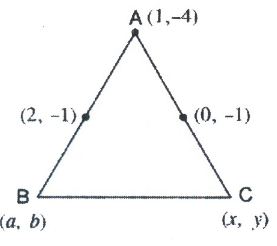
\(\Rightarrow \) \(\frac { 1+a }{ 2 } =2\quad and\quad \frac { -4+b }{ 2 } =-1\)
\(\Rightarrow \) 1+a=4 and -4+b=-2
\(\Rightarrow \) a=3 and b=2
Also \(\left( \frac { 1+x }{ 2 } ,\frac { -4+y }{ 2 } \right) \)=(0,-1)
\(\Rightarrow \) \(\frac { 1+x }{ 2 } =0\quad and\quad \frac { -4+y }{ 2 } =-1\)
\(\Rightarrow \) 1+x=0 and -4+y=-2
\(\Rightarrow \) x=-1 and y=2
Thus the coordinates of the vertices of ABC are A(1,-4),B(3,2) and C(-1,2)
Area of ABC =\(\frac { 1 }{ 2 } \) |1(2-2)+3(2+4)+(-1)(-4-2)|
= \(\frac { 1 }{ 2 } \)|0+18+6|
= \(\frac { 1 }{ 2 } \)(24)=12 sq.units
3.
26 sq.units
4.
k=-1
5.
p=8
6.
Let (– 4, 6) divide AB internally in the ratio m1 : m2.Using the section formula, we get
\((-4,6)=\left(\frac{3 m_{1}-6 m_{2}}{m_{1}+m_{2}}, \frac{-8 m_{1}+10 m_{2}}{m_{1}+m_{2}}\right)\)
Recall that if (x, y) = (a, b) then x = a and y = b.
So,\(-4=\frac{3 m_{1}-6 m_{2}}{m_{1}+m_{2}}\) and \(6=\frac{-8 m_{1}+10 m_{2}}{m_{1}+m_{2}}\)
Now, \(-4=\frac{3 m_{1}-6 m_{2}}{m_{1}+m_{2}}\) gives us
– 4m1 – 4m2 = 3m1 – 6m2
i.e., 7m1 = 2m2
i.e., m1 : m2 = 2 : 7
You should verify that the ratio satisfies the y-coordinate also.
Now,\(\frac{-8 m_{1}+10 m_{2}}{m_{1}+m_{2}}=\frac{-8 \frac{m_{1}}{m_{2}}+10}{\frac{m_{1}}{m_{2}}+1}\) ,(Dividing throughout by m2)
\(=\frac{-8 \times \frac{2}{7}+10}{\frac{2}{7}+1}=6\)
Therefore, the point (– 4, 6) divides the line segment joining the points A(– 6, 10) and B(3, – 8) in the ratio 2 : 7.
Alternatively : The ratio m1 : m2 can also be written as \(\frac{m_{1}}{m_{2}}: 1\) ,or k : 1. Let (– 4, 6) divide AB internally in the ratio k : 1. Using the section formula, we get
\((-4,6)=\left(\frac{3 k-6}{k+1}, \frac{-8 k+10}{k+1}\right)\)
So, \(-4=\frac{3 k-6}{k+1}\)
i.e., – 4k – 4 = 3k – 6
i.e., 7k = 2
i.e., k : 1 = 2 : 7
You can check for the y-coordinate also.
So, the point (– 4, 6) divides the line segment joining the points A(– 6, 10) and B(3, – 8) in the ratio 2 : 7.
7.
\(P({13\over 2},{9\over 2})\), Q(8,5), R\(({19\over 2}, {11\over2})\)
8.
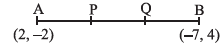
Let P and Q be the points of trisection of AB i.e., AP = PQ = QB
Therefore, P divides AB internally in the ratio 1 : 2. Therefore, the coordinates of P, by applying the section formula, are
\(\left(\frac{1(-7)+2(2)}{1+2}, \frac{1(4)+2(-2)}{1+2}\right), \)i.e., (–1, 0)
Now, Q also divides AB internally in the ratio 2 : 1. So, the coordinates of Q are
\(\left(\frac{2(-7)+1(2)}{2+1}, \frac{2(4)+1(-2)}{2+1}\right)\) ,i.e., (– 4, 2)
Therefore, the coordinates of the points of trisection of the line segment joining A and B are (–1, 0) and (– 4, 2).
9.
(10,3), (13,1)
10.
Given vertices of a quadrilateral ABCD are
A(-5, 7), B(-4, - 5), C(-l, - 6) and D(4, 5).
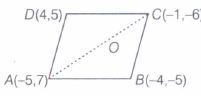
\(\therefore\) Area of quadrilateral ABCD
\(=\text { Area of } \Delta A B C+\text { Area ot } \triangle A C D\) ...(i)
Now, area of \(\triangle A B C\)
\(=\frac{1}{2}\left|x_{1}\left(y_{2}-y_{3}\right)+x_{2}\left(y_{3}-y_{1}\right)+x_{3}\left(y_{1}-y_{2}\right)\right|\)
\(=\frac{1}{2} \mid-5(-5+6)-4(-6-7)-1(7+5)\)
\(=\frac{1}{2}|-5 \times 1-4(-13)-1 \times 12|\)
\(=\frac{1}{2}|-5+52-12|=\frac{|35|}{2}=\frac{35}{2} \text { sq units }\)
and area of \(\Delta A C D=\frac{1}{2} \mid-5(-6-5)-1(5-7)+4(7+6) \mid\)
\(=\frac{1}{2}|-5 \times(-11)-1 \times(-2)+4 \times 13|\)
\(=\frac{1}{2}|55+2+52|=\frac{|109|}{2}=\frac{109}{2} \mathrm{sq} \text { units }\)
\(\therefore\) From Eq. (i) say,
Area of quadnlateral ABCD = \(\frac{35}{2}+\frac{109}{2}\)
\(=\frac{144}{2}=72 \mathrm{sq} \text { units }\)

10th Standard CBSE Syllabus & Materials
10th Standard CBSE
CBSE 10th Social Science PS - Federalism - New Model Questions Papers Study Material - QB365 Set A
NEW10th Standard CBSE
CBSE 10th Social Science PS - Power Sharing - New Model Questions Papers Study Material - QB365 Set A
NEW10th Standard CBSE
CBSE 10th Social Science GEO - Manufacturing Industries - New Model Questions Papers Study Material - QB365 Set A
NEW10th Standard CBSE
CBSE 10th Social Science GEO - Minerals and Energy Resources - New Model Questions Papers Study Material - QB365 Set A



CBSE 10th Standard CBSE Subjects
CBSE Standards





