
 100% FREE ACCESS
7th Standard CBSE Syllabus & Materials
7th Standard CBSE
CBSE 7th Social Science Theme E - Understanding Market - New Sample Question Papers Study Material - QB365 Set A
NEW7th Standard CBSE
CBSE 7th Social Science Theme E - From Barter to Money - New Sample Question Papers Study Material - QB365 Set A
NEW7th Standard CBSE
CBSE 7th Social Science Theme D - The Constitution of India- An Introduction - New Sample Question Papers Study Material - QB365 Set A
NEW7th Standard CBSE
CBSE 7th Social Science Theme D - From the Rulers to the Ruled : Types of Governments - New Sample Question Papers Study Material - QB365 Set A
NEW7th Standard CBSE
CBSE 7th Social Science Theme B - The Age of Reorganisation - New Sample Question Papers Study Material - QB365 Set A
NEW7th Standard CBSE
CBSE 7th Social Science Theme B - The Rise of Empires - New Sample Question Papers Study Material - QB365 Set A

Published on: 31/12/2018
Grade 7 Unit Test
Download CBSE Class 7th Standard CBSE Social Science question papers, sample papers, important questions, and previous year solved papers in PDF format. Get free study materials, NCERT solutions, and exam preparation resources for Class 7th Standard CBSE Social Science
Questions + Answers key
Take MCQ Social Science Test
1.
The endangered species of antelope is:
Robin
Chiru
Raven
Yak
2.
Which one of the following is a local wind?
Sea breeze
Trade wind
Monsoon wind
None of these
3.
TMS stands for
Tawa Matsya Sangh
Tilak Matsya Samooh
Talwar Matsya Sangh
None of the above
4.
Shopkeepers procure their goods from
factories
farms
wholesaler
All of these
5.
Which among the rivers is not a tributary of Ganga
Chambal
Ravi
Kosi
Gandak
6.
Electronic media includes
Newspapers
Magazines
Radio
All of the above
7.
Grasslands grow in the regions of
moderate rain
heavy rain
poor rain
None of these
8.
Who was Bir Narain?
Ruler of Punjab
Son of Rani Durgawati
Ruler of Multan
Ruler of Sind
9.
Sher Khan defeated the Mughal Emperor named
Humayun
Akbar
Babur
Jahangir
10.
From which region did AI-Idrisi belong?
Arab
France
Germany
Sri Lanka
11.
What do you mean by 'terrace farming'?
12.
Why is rainfall important?
13.
Why are companies required to show the same advertisements again and again?
14.
Where are RMPs mostly found?
15.
What were Hanafi and Shafi'i?
16.
In private health services, doctors do not prescribe unnecessary medicines, injections or saline bottles
17.
Mullah Abdul Ghaffur and Virji Vora owned number of ships.
18.
Shopping malls and complexes are found mostly in urban areas.
19.
Our Earth is like an aquarium.
20.
Forest-dwellers were sometimes pushed out of their lands with the spread of agricultural settlements.
21.
What is a chain of market? Do you think that everyone gains equally in the market?
22.
Answer the question based on the extracts given below.
The boys' school had no such courtyard and our playground was just a big space attached to the school. Every evening, once school was over, the boys watched as hundreds of school girls crowded the narrow streets. As these girls walked on the streets, they looked so purposeful.
This was unlike the boys who used the streets as a place to stand around idling, to play, to try out tricks with their bicycles. For the girls, the street was simply a place to get straight home. The girls always went in groups, perhaps because they also carried fears of being teased or attacked.
(a) 'The boys' school had no such courtyard". Which courtyard is being talked about?
(b) For what purpose did the boys use the street?
23.
Discuss the different layers of the atmosphere
24.
Discuss Article 15 of Indian Constitution
25.
How did the Indian craftspersons lose their independence?
26.
Interpret and compare the two above figures and answer the question Gates are opened and closed during which situation?
27.
Where do you think large farmers would sell their cotton? How is their situation different from Swapna?
28.
Read the following extract and answer the question that follows
Beyond the Rana's palace
This is a song composed by Mirabai:
Ranaji, I have left your norms of shame,
and false decorum of the princely life.
I have left your town.
And yet Rana why have you kept up enmity against me?
Rana you gave me a cup of poison.
I drank it laughing.
Rana I will not be destroyed by you.
And yet Rana why have you kept up?
enmity against me?
Why do you think Mirabai left the Rana's palace?
29.
Briefly explain the major features of tropical evergreen forests.
30.
You are an artisan standing on a tiny wooden platform held together by bamboo and rope fifty metres above the ground. You have to place an inscription under the first balcony of the Qutub Minar. How would you do this?
31.
What is the difference between the work that MLAs do in the assembly and the work done by government departments?
32.
What is the Mid-day Meal Programme? Can you list three benefits of the programme? How do you think this programme might help promote greater equality?
33.
What Minhaj-i-Siraj thought about Raziyya?
34.
At times media is prevented from publishing a story, this is called___________.
35.
The girls' schools was_______very different from the boys' schools
36.
___________released in the atmosphere creates greenhouse effect.
37.
Prithviraja III was a Chahamana ruler who defeated an Afghan ruler named ________
38.
If zat determined a mansabdar's rank and salary, sawar indicated his ____________
39.
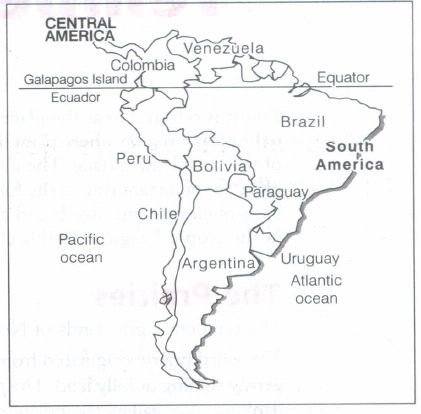
On the polltical map of South America, draw the equator. Mark the countries through which the equator passes.
40.
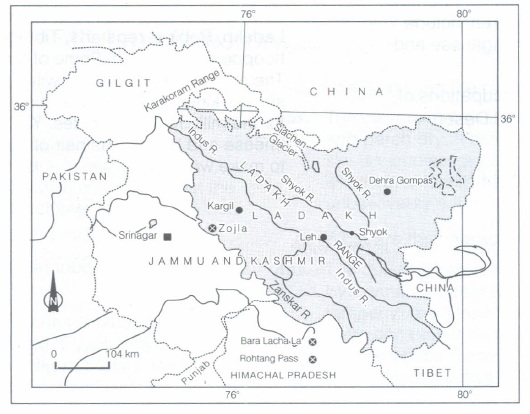
On the outline map of India, mark the Karakoram Hanqe, Zanskar Range, Ladakh and Zoji la Pass
41.
The rainforests are depleting.
42.
Limestone changes into marble
43.
Did you notice that the names by which languages are known have changed with time?
44.
Enlist the causes why media is not said to be independent?
45.
Enlist the major features of the tribal societies.
1.
(b)
Chiru
2.
3.
(a)
Tawa Matsya Sangh
4.
(d)
All of these
5.
(b)
Ravi
6.
(c)
Radio
7.
(a)
moderate rain
8.
(b)
Son of Rani Durgawati
9.
(a)
Humayun
10.
(a)
Arab
11.
()
Terraces are built on steep slopes to create flat surfaces on which crops are grown. This is called terrace farming
12.
()
Rainfall is very important for the survival of plants and animals. It brings fresh water to the earth's surface.
13.
()
Companies show the same advertisements again and again so that people remember them.
14.
()
RMPs stands for Registered Medical Practitioners and they are easily available in rural areas.
15.
()
These are the two schools of law of the medieval period of Islam.
16.
(b)
17.
(a)
18.
(a)
19.
(b)
20.
(a)
21.
There is a chain of market which links the producer to the buyer, but everyone does not benefit equally in the market.
The foreign business persons made huge profits. Compared to this, the garment exporters made moderate profits. Some people like small farmers (like Swapna), weavers, workers earn little. The profits made by the merchants or traders are somewhere in between. So everyone does not gain equally in the market. In democracy everybody has right to earn a fair wage for his work.
If people don't earn enough then they cannot think themselves as equal to others and cannot live with dignity.
The market offers people opportunities to work and earn fairly. But it is the people, who are rich powerful and have large establishments take away the maximum benefit. And the poor people, because of their dependence on the rich, are exploited in the market.
22.
(a) The boys' school and the girls' school were designed differently as boys school had no courtyard as the girls school had. Here, the courtyard is the playground or a big space attached to the school where boys and girls used to play.
(b) The boys used the streets as a place to stand around idling, to play, to tryout tricks with their bicycles, etc and not just for walking home, the way girls used it.
23.
The atmosphere is divided into five layers starting from the Earth's surface
(i) Troposphere Its average height is 13 km. The air we breathe exists here. Almost all the weather phenomena like rainfall, fog and hailstorm occur in this layer.
(ii) Stratosphere It lies above the troposphere which extends up to a height of 50 km. This layer is almost free from clouds and associated weather phenomenon, making conditions most ideal for flying aeroplanes. It contains a layer of ozone gas.
(iii) Mesosphere It lies above the stratosphere. It extends up to the height of 80 km. Meteorites burn up in this layer on entering from the space.
(iv) Thermosphere In thermosphere, temperature rises very rapidly with increasing height. Ionosphere is a part of this layer. It extends between 80-400 km. This layer helps in radio transmission. In fact, radio waves transmitted from the Earth are reflected back to the Earth by this layer.
(v) Exosphere This uppermost layer. This layer has very thin air. Light gases like helium and hydrogen float into the space from here.
24.
Article 15 talks about, prohibition of discrimination on grounds of religion, race, caste, sex or place of birth.
(i) The state shall not discriminate against any citizen on grounds only of religion, race, caste, sex place of birth or any of them.
(ii) No citizen shall, on grounds only of religion, race, caste, sex, place of birth or any of them, be subject to any disability, liability, restriction or condition with regard to
(a) access to shops public restaurants, hotels and places of public entertainment.
(b) the use of wells, tanks, bathing ghats, roads and places of public resort maintained wholly or partly out of state funds or dedicated to the use of general public.
25.
Initially, Indian crafts and textiles were in great demands in the European markets. As a result, the English began to make attempts to control the Indian craftspersons by appointing Indian traders as their agents. They introduced the system of advances under which the weavers had to weave cloth which was only and already promised to European agents. They no longer were able to sell their own cloth or weaving their own patterns. Thus, the Indian craftspersons lost their independence.
26.
Gates were opened to irrigate land and closed to store water for future use.
27.
Large farmers would sell their cotton in markets and that too at higher rates. Their situation is different from Swapna as
She is small farmer.
She has taken loan from the trader.
She promised to sell cotton to the trader
28.
One evening a marriage procession was passing by the side of Mirabai, the Rajput princes's fort. She was standing along with his grandfather, she saw the bride and asked her grandfather, who would marry me? Her grandfather without consciousness told that she will be married to Lord Krishna.
But, unfortunately, she got married to Bhojraj, ruler of Chittor without her wish.
Meera's brother-in-law and Rana gave her immense pain and sufferings to make her forget about Lord Krishna.
Out of love of Krishna, she left the fort and royal life. However, it is considered a myth by many others.
29.
The major features of tropical evergreen forests are as
(i) These are thick forests occur in the regions near the equator and close to the tropics.
(ii) These regions are hot and receive heavy rainfall throughout the year. As there is no particular dry season, the trees do not shed their leaves altogether.
30.
(i) I would first fix packings in the wall. Then chisels would be got through the inscription at its four corners.
(ii) Then the inscription would be fixed on the wall below the balcony.
31.
Differences between the work that MLAs do in the assembly and the work done by the government departments are
32.
Mid-day Meal Programme is an initiative taken by government in order to provide children of elementary schools with cooked lunch all over the country.
Three benefits of the programme are
More poor children have begun enrolling and regularly attending school.
It also helped in reducing the hunger of poor students who cannot concentrate on their studies because of empty stomachs.
The programme also helped In improving the attendance of the students.
This programme will also help in promoting equality as it will help in reducing caste prejudices as both lower and upper caste children will sit together to have their meals. In some places, Dalit women have been employed to cook the meals.
33.
Minhaj-i-Siraj thought that the Raziyya Sultan's rule went against the ideal social order created by God, in which women were supposed to be subordinate to men. Although he recognised that she was more able and qualified than all her brothers. But Siraj was not comfortable at having a queen as ruler. Thus, he suggested that in the register of God's creation, since her account did not fall under the column of men, it was not possible for her to gain from all of her excellent qualities.
34.
()
censorship.
35.
()
designed
36.
()
Carbon dioxide
37.
()
Sultan Muhammad Ghori
38.
()
number of horses maintained
39.
The equator is passes through Ecuador, Colombia, Peru and Brazil.
40.
The answer map isgiven below
41.
The rainforests are depleting because of developmental activities which destroy the biological diversity of rainforests through deforestation and hunting.
42.
Limestone is a sedimentary rock. It changes into marble which is a metamorphic rock under great heat and pressure.
43.
The names of languages which changed over time are as follows
Lahori : Punjabi
Telangani : Telugu
Gujari : Gujarati
Mabari : Tamil
Gauri : Bengali
Hindawi : Hindi
44.
The media is far from independent due to certain reasons:
(i) The government has a control over media:
Due to Censorship a news item, scenes from movies or songs are not shared with public.
During the Emergency 1975-1977 government censored the media.
Government censor the films but it really does not censor media coverage of news.
Despite the absence of censorship on news, most newspapers are unable to provide a balanced story.
(ii) This is due to the control of business houses over the media:
News are given based on the interest of the business houses.
Media needs money which it gets from advertisements.
It becomes difficult for them to report against those who give advertisements.
So media is not independent due to its business links.
(iii) Need for support for an issue:
Media tends to focus on particular aspect to make story interesting:
Also if they want public support, they focus on one side of the story.
45.
Major Features of the Tribal Societies:
(i) Members of each tribe were united by kinship bonds.
(ii) Many tribes obtained their livelihood from agriculture.
(iii) Others were hunter-gatherers or herders.
(iv) Some tribes were nomadic and moved from one place to another.
(v) A tribal group controlled land and pastures jointly, and divided these amongst households according to its own rules.
(vi) Many large tribes evolved in different parts of the subcontinent. They usually lived in forests, hills, deserts and places difficult to reach. Sometimes they clashed with the more powerful caste-based societies.
(vii) The tribes retained their freedom and preserved their separate culture.

7th Standard CBSE Syllabus & Materials
7th Standard CBSE
CBSE 7th Social Science Theme B - New Beginnings : Cities and States - New Sample Question Papers Study Material - QB365 Set A
NEW7th Standard CBSE
CBSE 7th Social Science Theme A - Climates of India - New Sample Question Papers Study Material - QB365 Set A
NEW7th Standard CBSE
CBSE 7th Social Science Theme A - Geographical Diversity of India - New Sample Question Papers Study Material - QB365 Set A
NEW7th Standard CBSE
CBSE 7th Science Earth, Moon and the Sun - New Sample Question Papers Study Material - QB365 Set A



CBSE 7th Standard CBSE Subjects
CBSE Standards




