
 100% FREE ACCESS
11th Standard CBSE Syllabus & Materials
11th Standard CBSE
CBSE 11th Economics PART-A - Presentation of Data - New Sample Question Papers Study Material - QB365 Set A
NEW11th Standard CBSE
CBSE 11th Economics PART-A - Organisation of Data - New Sample Question Papers Study Material - QB365 Set A
NEW11th Standard CBSE
CBSE 11th Economics PART-A - Collection of Data - New Sample Question Papers Study Material - QB365 Set A
NEW11th Standard CBSE
CBSE 11th Economics PART-A - Introduction to Economics and Statistics - New Sample Question Papers Study Material - QB365 Set A
NEW11th Standard CBSE
CBSE 11th Business Studies International Trade Sample Question Papers Study Material - QB365 Set A
NEW11th Standard CBSE
CBSE 11th Business Studies Evolution and Fundamentals of Business Sample Question Papers Study Material - QB365 Set A

Published on: 31/07/2018
Some of the important questions from the chapter Cell Cycle and Cell Division covered in this question paper. The questions are prepared from the book back and PTA question.
Students, subscribe and get plenty of question paper with answer key. For subscription please click here.
Download CBSE Class 11th Standard CBSE Biology question papers, sample papers, important questions, and previous year solved papers in PDF format. Get free study materials, NCERT solutions, and exam preparation resources for Class 11th Standard CBSE Biology
Questions + Answers key
Take MCQ Biology Test
1.
What is kinetochore?
2.
How would you analyse that the cell's entire energy is devoted to the process of division in the M-phase?
3.
Why is mitosis called equational division?
4.
Why do the chromosomes become short and thick in prophase?
5.
There occurs a process in which two divisions of nucleus take place. Identify the process and also write about its different phases.
6.
At the following stage of meiosis, the chromosomes appear to be beaded.Can you find out the stage?
7.
Meiosis is essential in sexually reproducing organisms.Why?
8.
If a tissue has 1024 cells at a given time, how many cycles of mitosis had the original parental single cell undergone?
9.
Distinguish cytokinesis from karyokinesis.
10.
Two key events take place during S-phase in animal cells, DNA replication and duplication of centriole. In which parts of the cell do these events occur?
11.
Mitosis cell division helps in regeneration process. How?
12.
What is the significance of meiosis?
13.
Does mitosis occur before or after the interphase?
14.
What is the average cell cycle span for a mammalian cell?
15.
Name a drug that has an inhibitory effect on cell cycle in mitotic stage.
16.
Why does a multicellular organism require two types of cell division? Which of the two, produces the greater number of cells? Describe prophase-I stage.
17.
Explain meiosis-II in an animal cell.
18.
Briefly describe the significance of cell division.
19.
The diagram below represents the changes in the number of chromosomes during several processes that occur in an animal cell.
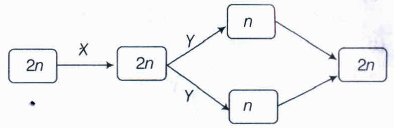
(i) Name the process of cell division occurring at X and Y.
(ii) State two differences in the behaviour of chromosomes between X and Y.
20.
Both unicellular and multicellular organisms undergo mitosis. What are the differences if any observed in the process between the two?
21.
Describe cell division. List various types of cell division. Also mention about the need of cell division?
22.
What is chiasmata? Mention its significance also.
23.
Name a cell that is found arrested in diplotene stage for months and years. Comment in 2-3 lines how it complete cell cycle?
1.
Kinetochores are disc-shaped structures on chromosomes, which help in the attachment of spindle fibres.
2.
Gene expression, protein synthesis, secretion, motility etc, do not happen during M-phase.
3.
Mitosis is called an equational division because it divides the mother cell into two daughter cell, which are identical to the original mother cell in every respect. In mitosis, the chromosomes of the mother cell are duplicated and distributed equally to the daughter cells and daughter cells have same number of chromosomes as matter cell has.
4.
It happens so because it is physically easier for short and compact chromosomes to move through the cytoplasm than the very long twisted interphase chromosomes.
5.
Karyokinesis is a series of uninterrupted changes before forming two daughter nuclei. Though karyokinesis is a continuous process, it has been divided into four phases. They are prophase metaphase, anaphase and telophase.
6.
Chromosomes seem to be beaded during leptotene(prophase-I) of meiosis.
7.
Meiosis is essential in sexually reproducing organisms because it keeps the chromosomes number constant.
8.
Calculation of number of mitosis
Mitosis of one cell produces 2 cells. Similarly, 2 cells undergoing mitosis give rise to 4 cells and so on.
This can be generalised as:
2n = number of daughter cells, where n = number of cycles of mitotic cell division.
Since the tissue has 1024 cells
⇒ 1024 = 210 cycles
Hence, the original parental single cell has undergone 10 cycles of mitosis to give rise to 1024 cells.
Ten cycles of mitosis.
9.
Cytokinesis is the division of cytoplasm, whereas karyokinesis is the division of nucleus of the cell.
10.
DNA replication occurs in the nucleus whereas centriole duplication takes place in the cytoplasm.
11.
Mitosis helps in regeneration by keeping all the somatic cells of an organism genetically similar, so that they are able to regenerate part or whole of the organism.
12.
significance of meiosis :
1. Meiosis is responsible for the formation of sex cells or gametes that are responsible for sexual reproduction.
2. It activates the genetic information for the development of sex cells and deactivates the sporophytic information.
3. It maintains the constant number of chromosomes by halving the same. This is important because the chromosome number doubles after fertilization.
4.In this process independent assortment of maternal and paternal chromosomes takes place. Thus the chromosomes and the traits controlled by them are reshuffled.
5. The genetic mutation occurs due to irregularities in cell division by meiosis. The mutations that are beneficial are carried on by natural selection.
6. Crossing over produces a new combination of traits and variations.
13.
Yes, mitosis can occur before or after the interphase, as dividing phase (meiosis or mitosis) and interphase is the only major phase of a cell cycle.
14.
The average cell cycle span for a mammalian cell is approximately 24 hours.
15.
Colchicine is a mitotic inhibitor, so it inhibits the M phase or mitotic phase.
16.
There are two distinct type of cell divisions taking place in multicellular organisms One is mitosis in somatic cells for growth and healing of wounds and the other is meiosis in reproductive cells for producing gametes having half the number of chromosomes. It is essential to maintain the characters of the species.
More number of cells are produced in meiosis. Each division of mitosis results in the formation of two cells while in meiosis four cells are formed.
17.
All these happen in the two haploid nuclei simultaneously.
(i) Prophase-II, takes short time. Spindle formation begins and the chromosomes become short. Two chromatids are joined to a single centromere. Nuclear membrane and nucleous disintegrate.
(ii) Metaphase-II At the equator, the chromosomes align at the equator and spindle is formed. The centromere of every chromosome is joined to the spindle fibre and centromere also divides.
(iii) Anaphase-II The daughter chromosomes are formed. Chromatids move towards their poles with the spindle fibres.
(iv) Telophase-II Reaching at the poles, chromosomes form nuclei which are haploid(n) daughter nuclei. Again nuclear membrane is constructed. Nucleous now becomes clearly visible.
Cytokinesis Occurs and four daughter cells are formed which are haploid (n). It may occur once or twice or only after the meiosis-II cell division.
18.
Cell division is significant in the following ways
(i) Cell multiplication Cell division is a means of cell multiplication or formation of new cells from pre-existing cells.
(ii) Continuity It maintains continuity of living matter generation after generation.
(iii) Multicellular organisms The body of a multicellular organism is formed of innumerable cells. They are formed by repeated divisions of a single cell or zygote. As the number of cells increases, many of them begin to differentiate, form tissues and organisms.
(iv) Cell size Cell division helps in maintenance of a particular cell size which is essential for efficiency and control of cell activities.
(v) Genetic similarity The common type of cell division or mitosis maintains genetic similarity of all the cells in an individual despite being different, i.e., structurally and functionally.
19.
(i) X-Miltosis
Y-Meiosis
(ii) (a) In X, there is no association of homologous chromosomes, but in Y, homologous chromosomes pair up together to form bivalents during prophase-I.
(b) In X, there is no crossing over as there is no formation of chiasmata, but in Y, crossing over occurs at the chiasmata whereby some genes are swapped between homologous chromosomes.
20.
Cell division id the first stage of growth in living organisms whereby cells divide to form new cells.
(i) In unicellular organisms, cell division is a process of asexual reproduction. It leads to an increase in the total number individuals.
(ii) In multicellular organism, the division of all cells, other than the reproductive cells is known as mitosis. It is a process of cell division related to growth and is accomplished by the cellular enlargement and differentiation.
21.
cell division, cell reproduction or cell multiplication is the process of formation of new daughter cells from the pre-existing cell or parent cell.
It is three types
(i) Amitosis
(ii) Mitosis
(iii) Meiosis.
A cell divides when it attains the size and the nucleocytoplasmic ratio disturbs. The DNA duplication also causes a cell to divide.
22.
Chiasmata is X-shaped structure of separated bivalents of recombined homologous chromosomes. Chiasmata formation is necessary for the separation of homologous chromosomes which have undergone the process of crossing over.
23.
The cells found arrested in diplotene stage for months and years are oocyte cells of vertebrates such as tailed and tailless amphibians, birds and insects.
The chromosomes of these cells transform into the Lampbrush form during the diplotene stage of meiotic prophase due to an active transcription of many genes. These chromosomes produce large amounts of RNA for the oocyte and most of the genes present in the DNA loops are being expressed actively.

11th Standard CBSE Syllabus & Materials
11th Standard CBSE
CBSE 11th Business Studies Forms of Business Organisation Sample Question Papers Study Material - QB365 Set A
NEW11th Standard CBSE
CBSE 11th Business Studies Business, Trade and Commerce Sample Question Papers Study Material - QB365 Set A
NEW11th Standard CBSE
CBSE 11th Physics Waves Sample Question Papers Study Material - QB365 Set A
NEW11th Standard CBSE
CBSE 11th Physics Kinetic Theory Sample Question Papers Study Material - QB365 Set A



CBSE 11th Standard CBSE Subjects
CBSE Standards









