
 100% FREE ACCESS
11th Standard CBSE Syllabus & Materials
11th Standard CBSE
CBSE 11th Economics PART-A - Presentation of Data - New Sample Question Papers Study Material - QB365 Set A
NEW11th Standard CBSE
CBSE 11th Economics PART-A - Organisation of Data - New Sample Question Papers Study Material - QB365 Set A
NEW11th Standard CBSE
CBSE 11th Economics PART-A - Collection of Data - New Sample Question Papers Study Material - QB365 Set A
NEW11th Standard CBSE
CBSE 11th Economics PART-A - Introduction to Economics and Statistics - New Sample Question Papers Study Material - QB365 Set A
NEW11th Standard CBSE
CBSE 11th Business Studies International Trade Sample Question Papers Study Material - QB365 Set A
NEW11th Standard CBSE
CBSE 11th Business Studies Evolution and Fundamentals of Business Sample Question Papers Study Material - QB365 Set A

Published on: 31/07/2018
In this question paper, some of the important one mark, two and five marks questions from the chapter The Unit of Life are covered. The questions are prepared from the book back and previous year questions.
Download CBSE Class 11th Standard CBSE Biology question papers, sample papers, important questions, and previous year solved papers in PDF format. Get free study materials, NCERT solutions, and exam preparation resources for Class 11th Standard CBSE Biology
Questions + Answers key
Take MCQ Biology Test
1.
What is the advantages of phospholipid bilayers fluidity?
2.
Give the term used for the stacks of thylakoids
3.
Justify the statement, 'Mitochondria is the powerhouse of the cell'
4.
Multicellular organisms have division of labour. Explain.
5.
Which cell organelles are referred to as suicide bags?Why are they given this name?
6.
How do the ribosomes of prokaryotic cells differ from the ribosomes of eukaryotic cells? Also, tell what is similar about them?
7.
What is the difference between cell walls of Gram positive and Gram negative bacteria?
8.
Which cells have well developed SER and which cell contain abundant RER?
9.
What is the term given to the 70S ribosomes found in the matrix of chloroplast?
10.
Why are gas vacuoles named so?
11.
In which organelle the proteins required for functioning of the nucleus are formed.
12.
What is referred to as satellite chromosome?
13.
What is the name given to the infoldings of plasmalemma in prokaryotic cell below the wall?
14.
Where is glycocalyx been found?
15.
What is the shape of WBCs and tracheid?
16.
Where are extrinsic proteins found in the cell membrane?
17.
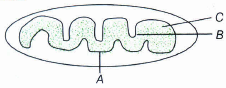
Fill in the blanks at A, B, and C as shown in diagram
18.
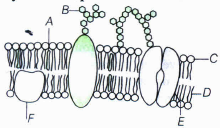
The diagram shows a section of cell membrane.Identify the components labelled A-F.
19.
Distinguish between chloroplast and chromoplast.
20.
State the chief functions of mitochondria.
21.
The lysosomal enzyme does not destroy the cell's own cytoplasm.why?
22.
What are plasmids? Describe their role in bacteria.
23.
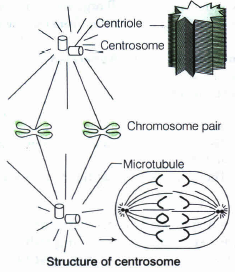
Describe the structure of the following with the help of labelled diagrams.
(i) Nucleus
(ii) Centrosome
24.
The diagram shows some of the structures present in an animal cell.
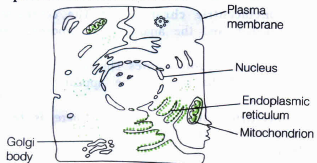
Which of these structures is responsible for
(i) Manufacture of lipids and steroids
(ii) Release of energy
(iii) Manufacture of hormones and digestive enzymes
(iv) Production of spindle fibres in cell division
(v) Endo and exocytosis?
1.
Interaction of molecules within the membrane, intercellular functions, secretion, endocytosis are the advantages of lipid bilayer fluidity.
2.
The stack of thylakoids of chloroplast is called a granum.
3.
Mitochondria are known as the power house of the cell because they generate ATP, the energy currency of the cell. Terminal oxidation takes place through oxidative phosphorylation. This produces ATP. Even the reduced coenzymes produced in cytosol through glycolysis, transfer their reducing power to mitochondria for ATP synthesis. ATP synthesised inside mitochondria provides energy for all cellular activities including overcoming the tendency for entropy. Hence, known as powerhouse of the cell
4.
The body of a multicellular organism has cell as a basic structural unit. The cells are organised to form tissues such as blood, bone, etc. The tissue are organised to form organs such as heart, kidney, etc. The organs are then organised to form organ systems such as digestive system, reproductive system respiratory system, etc. The various organ system of organism gets arranged to form a complete individual.
5.
Lysosomes are the organelle known as suicide bags. They consist of a single membrane surrounding powerful digestive enzymes. If the membrane of a lysosome breaks, the enzymes released may also destroy the cell itself, giving lysosomes the name suicide bag.
6.
Ribosomes in the cytoplasm of prokaryotic and eukaryotic cells slightly differ. However, prokaryotes have 70S ribosomes, each consisting of a small 30S and a large 50S subunit whereas, each consists the large one.
Both prokaryotic and eukaryotic ribosomes are composed of ribosome RNA and ribosomal proteins. Their basic function is proteins synthesis.
7.
The cell of Gram positive bacteria is single-layered (outer membrane is absent) and contains 70-80% peptidoglycan and little amount of lipids. It's wall also has teichoic acid. The light cell wall of Gram negative bacteria on the other hand is two-layered, outer membrane is present, i.e., thin layer of peptidoglycan and plasma membrane is present, teichoic acid is absent in wall.
8.
Muscle cells have a well developed SER and cells which synthesise proteins.
9.
The term given is plastido ribosomes.
10.
Gas vacuoles are name so, because these are permeable to atmospheric gases and not to water
11.
Proteins required are formed in the cytoplasm.
12.
Those chromosomes which have a secondary constriction, are called sat chromosomes.
13.
Mesosomes are the areas in the cell membrane of prokaryotic cell which fold inwards. It helps in cell wall formation, DNA replication, respiration and increases the surface area of the plasma membrane.
14.
Glycocalyx is found as a thick outermost covering of cell either as a capsule or a slime layer.
15.
WBCs ae amoeboid and tracheids are elongated in shape.
16.
On the outer and inner surface of phospholipid matrix.
17.
A - Inner membrane,
B - Crista,
C - Matrix.
18.
Following are the labelled sections of cell membrane
A - Cholesterol
B - Glycolipid
C - Hydrophilic head of phospholipid
D - Hydrophobic tail of phospholipid
E - Transmembrane protein
F - Intrinsic protein
19.
| Chloroplasts | Chromoplasts |
| They contain mainly chlorophylls and some amount of carotene and xanthophyll | They contain mainly carotene and xanthophyll |
| They are present in the mesophyll of leaves | They are present in the petals of flowers, the skin of fruits, etc. |
| Their main role is to prepare food by the process of photosynthesis | Their main role is to impart coloration to plants |
20.
Mitochondria perform the following major functions
(i) Mitochondria are the main site of aerobic respiration, where respiratory substrates are completely oxidised to carbon dioxide and water. The energy liberated in the process is utilised in the synthesis of energy-rich molecules ATP.
(ii) They have a group of enzymes that carry out elongation of fatty acids of adding acetyl Co-A and subsequently reducing the keto-acid and produced
(iii) The matrix of mitochondria has enzymes thge synthesis of fatty acids.
21.
The lysosomal enzyme does not destroy its own cytoplasm, because of the following reasons
(i) The enzymes are separated from the cytoplasm by the lysosomal membrane.
(ii) The enzymes have the capability of recognishing and digest only foreign matter.
(iii) The lysosomal enzymes usually work in the acidic medium of pH less than 7 and the medium is more than 7 i.e. around 7.4 or more.
22.
(a). Plasmids are the small, circular, extra-chromosomal (or extra genomic) DNA in the prokaryotic cells.
(b). They confer certain unique features like resistance to antibiotics, sex factors, etc.
23.
(i) Nucleus: It is a naked, round and slightly irregular structure, which is attached to the chromatin at a specific region. The content of nucleolus is continuous with the rest of the nucleoplasm as it is not a membrane bound structure.
It is a site for active ribosomal RNA synthesis.Larger and more numerous nucleoli are present in cells activitely carrying out protein synthesis.
(ii) Centrosome
24.
Structures responsible are
(i) Smooth endoplasmic Reticulim (SER) is responsible for the manufacture of lipids and steroids.
(ii) Mitochondrion is responsible for the release of energy.
(iii) Ribosomes is responsible for the production of hormones and digestive enzymes.
(iv) Centrioles is responsible for production of spindle fibres.
(v) Plasma membrane is responsible for endo and exocytosis.

11th Standard CBSE Syllabus & Materials
11th Standard CBSE
CBSE 11th Business Studies Forms of Business Organisation Sample Question Papers Study Material - QB365 Set A
NEW11th Standard CBSE
CBSE 11th Business Studies Business, Trade and Commerce Sample Question Papers Study Material - QB365 Set A
NEW11th Standard CBSE
CBSE 11th Physics Waves Sample Question Papers Study Material - QB365 Set A
NEW11th Standard CBSE
CBSE 11th Physics Kinetic Theory Sample Question Papers Study Material - QB365 Set A



CBSE 11th Standard CBSE Subjects
CBSE Standards









