 100% FREE ACCESS
10th Standard Syllabus & Materials
10th Standard
TN 10th English Prose - 4 - The Attic Important Questions And Answers Study Material - QB365 Set A
NEW10th Standard
TN 10th English Supplementary - 3 - The Story of Mulan Important Questions And Answers Study Material - QB365 Set A
NEW10th Standard
TN 10th English Poem - 3 - I am Every Woman Important Questions And Answers Study Material - QB365 Set A
NEW10th Standard
TN 10th English Prose - 3 - Empowered Women Navigating The World Important Questions And Answers Study Material - QB365 Set A
NEW10th Standard
TN 10th English Supplementary - 2 - Zigzag Important Questions And Answers Study Material - QB365 Set A
NEW10th Standard
TN 10th English Poem - 2 - The Grumble Family Important Questions And Answers Study Material - QB365 Set A

Published on: 28/06/2019
centum ten mark questions
Download Tamil Nadu 10th Standard Science question papers, model tests, one-mark questions, important questions, and public exam papers in PDF format. Free study materials and answer keys for TN State Board students.
Questions + Answers key
Take MCQ Science Test1.
Give the applications of universe law gravitation.
2.
State the universal law of gravitation and derive its mathematical expression.
3.
“Wearing helmet and fastening the seat belt is highly recommended for safe journey” Justify your answer using Newton’s laws of motion.
4.
A heavy truck and bike are moving with the same kinetic energy. If the mass of the truck is four times that of the bike, then calculate the ratio of their momenta. (Ratio of momenta = 2:1)
5.
Two blocks of masses 8 kg and 2 kg respectively lie on a smooth horizontal surface in contact with one other. They are pushed by a horizontally applied force of 15 N. Calculate the force exerted on the 2 kg mass.
6.
Calculate the force of gravitation between two bodies of weight 50 kg and 10 kg respectively place at 10 m apart. If their distance increased to 100 % then find the change in percentage of force. (New force is 75% less than the original force)
7.
A person of weight 50 kg is moving down in an elevator Calculate downward acceleration offered by the elevator whose reaction force is 400 N on the surface.
8.
Force of 50 N acts perpendicular on a body, which is fixed at a point O. The distance of point of action of force from O is 5 cm. Find the moment of force.
9.
A pistol fired a bullet of mass 50 g triggered with a speed 250 ms-1 penetrated into a wooden plank comes to rest at 1 ms. Find the impulse and average force offered by the planks.
10.
When a constant force acts of 10 s on a body of mass 10 kg, which is initially at rest, moves a distance of 500 cm in 10 s. Calculate the frictional force required to bring the body to rest.
1.
Application of Newton's law of gravitation
(i) Dimensions of the heavenly objects can be measured using gravitation law. Mass of the earth, radius of the earth, acceleration due to gravity etc. can be calculated with a higher accuracy.
(ii) Helps in discovering new stars and planets. Mass of the double stars can be calculated.
(iii) One of the irregularities in the motion of stars is called "Wobble" which leads to the disturbance in the motion of planet nearby. In this condition mass of the star can be calculated using law of gravitation.
(iv) Helps to explain germination of roots due to the property of geotropism, which is the property of root responding to the gravity.
(v) Helps to predict the path of the astronomical bodies.
2.
Statement:
Universal law of gravitation states that, 'every particle of matter in this universe attracts every other particle with a force. This force is directly proportional to the product of their masses and inversely proportional to the square of the distance between centers of these masses. The direction of the force acts along the line joining the masses'.
Deviation: Force between the masses is always attractive and it does not depend on the medium where they are placed.
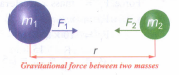
Let m1 and m2 be the masses of two bodies A and B placed at r meter apart in space
Force \(\mathrm{F} \propto \mathrm{m}_{1} \times \mathrm{m}_{2}\)
\(\mathrm{F} \propto 1 / r^{2}\)
On combining the above two expressions,
\(\mathrm{F} \propto \frac{\mathrm{m}_{1} \times \mathrm{m}_{2}}{\mathrm{r}^{2}} \)
\(F=\frac{G m_{1} m_{2}}{r^{2}}\)
Where G is the universal gravitational constant.
Its value in SI unit is \(6.674 \times 10^{-11} \mathrm{~N} \mathrm{~m}^{2} \mathrm{~kg}^{-2}\).
3.
(i) The Newton second law tells us that applying a force on an object produces an acceleration proportional to the object's mass.
(ii) When you're wearing your seat belt, it supplies the force to decelerate you in the event of a crash so that you don't hit the wind shield.
(iii) According to Newton's first law an object in motion continues in motion with the same speed and in same direction, unless acted upon by a force.
(iv) If the motor cycle were to abruptly stop, then the rider in motion would continue in motion.
(v) The rider would likely be propelled from the motor cycle, the rider becomes a projectile.
(vi) If the person is not wearing the helmet, the injury would be severe.
(vii) Thus "wearing helmet and fastening the seat belt is highly recommended for safe journey".
4.
Given: K1 = K2 = K, m1 = 4m2
The kinetic energy of the truck \(=\frac{1}{2} m_{1} v_{1}^{2} \Rightarrow v_1= \sqrt\frac{2 k}{m_{1}}\)
The kinetic energy of the bike \(=\frac{1}{2} \mathrm{~m}_{2} \mathrm{v}_{2}^{2}\Rightarrow v_2= \sqrt\frac{2 k}{m_{2}}\)
∴ Momentum p = mv
∴ Momentum of the two bodies are given by,
\(P_1=\sqrt{2m_1K,}\)
\(P_2=\sqrt{2m_2K,}\)
\(\therefore \frac{P_1}{P_2} =\sqrt{\frac{2 m_1K}{2m_{2}K}}=\sqrt{\frac{m_1}{m_{2}}}=\sqrt{\frac{4m_2}{m_{2}}}=\frac{\sqrt { 4}}{\sqrt 1}= \frac{2}{1}\)
Ratio of momenta = 2: 1
5.
Given: Let m1 = 8 kg, m2 =2 kg. F = 15 N
Consider both the masses as a unit system as they will move with common acceleration,
\({\mathrm{F}}_{1}=\mathrm{M_1}a\)
\(F_2=m_2a\)
\(F=F_1+F_2\)
\(=\left(\mathrm{m}_{1} +\mathrm{~m}_{2}\right){a}\)
\(15=(8+2) {a} \)
\(15=10 a \)
\(a=15 / 10=1.5 \mathrm{~ms}^{-2}\)
a = 1.5 ms-2
Let \(\mathrm{F}_{2}\) be the force exerted on 2 kg mass, then
\({\mathrm{F}_{2}}=\mathrm{m_2} {a} \)
\({\mathrm{F}_{2}}=2 \times 1.5=3 \mathrm{~N}\)
So, the force exerted on 2 kg mass is 3 N.
6.
Mass of body 1, m1 = 50 kg
Mass of body 2, m2 = 10kg
Distance, R = 10m
Universal gravitation
constant, G = 6.67 x 10⁻¹¹ Nm2 kg-2
To find :Force of gravitation, F =\(\frac { G{ m }_{ 1 }{ m }_{ 2 } }{ { R }^{ 2 } } \)
F=\(\frac { 6.67\times 10^{ -11 }\times 50\times 10 }{ 10^{ 2 } } \)
Force, F = 33.35 x 10⁻¹¹ N
7.
Given:
Weight = 50 kg
To find: Acceleration, a = ? (downward)
Reaction, R = 400 N
R = m (g - a)
400 = 50 (10 - a)
400 = 500 - 50 a
500 = 500 - 400
50 a = 100
a=\(\frac{100}{50}\)
Downward acceleration, a = 20 ms-1
8.
Force, F = 50 N
Distance, d = 5 cm
To find: Momentum of force= F x d
Momentum of force, 50 x 5 x 10-2
= 250 x 10-2
= 2.5 Nm
9.
Given:
Mass, m 50 g = 50 x 10-3 kg
Final speed, v = 0
Initial speed, u = 250 ms-1
Time, t = 1ms = 10-3 s
To find: J = F x t = ? Average force, F = ma = ?
F=\(\frac { m(v-u) }{ t } \)
=\(\frac { 50\times { 10 }^{ -3 }[0-250] }{ 1\times { 10 }^{ -3 } } \)
F = 12500 = 1.25 x 10⁴ N
J = F x t
= 1.2 x 104 x 10-3
J = 12.50 Ns
10.
Time, t = 10 s
Mass of body, m = 10 kg
Initial velocity of the body, u1 = 0
Distance, d = 500 cm
= 500 x 10-2 m
To find : Force, F = ?
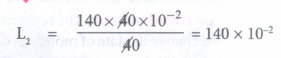
F=m1\(\frac { ({ u }_{ 1 }-{ v }_{ 1 }) }{ t } \)
v1=\(\frac { distance }{ time\quad taken } \)
F=v1=\(\frac { 500\times 10^{ -2 } }{ 10 } \)
Force, F=0.5 N

10th Standard Syllabus & Materials
10th Standard
TN 10th English Prose - 2 - The Night the Ghost Got in Important Questions And Answers Study Material - QB365 Set A
NEW10th Standard
TN 10th English Supplementary - 1 - The Tempest Important Questions And Answers Study Material - QB365 Set A
NEW10th Standard
TN 10th English Poem - 1 - Life Important Questions And Answers Study Material - QB365 Set A
NEW10th Standard
TN 10th English Prose - 1 - His First Flight Important Questions And Answers Study Material - QB365 Set A



Tamilnadu Stateboard 10th Standard Subjects
Tamilnadu Stateboard Standards