
 100% FREE ACCESS
10th Standard CBSE Syllabus & Materials
10th Standard CBSE
CBSE 10th Social Science ECO - Globalisation and the Indian Economy - New Model Questions Papers Study Material - QB365 Set A
NEW10th Standard CBSE
CBSE 10th Social Science ECO - Money and Credit - New Model Questions Papers Study Material - QB365 Set A
NEW10th Standard CBSE
CBSE 10th Social Science ECO - Sectors of the Indian Economy - New Model Questions Papers Study Material - QB365 Set A
NEW10th Standard CBSE
CBSE 10th Social Science ECO - Development - New Model Questions Papers Study Material - QB365 Set A
NEW10th Standard CBSE
CBSE 10th Social Science PS - Outcomes of Democracy - New Model Questions Papers Study Material - QB365 Set A
NEW10th Standard CBSE
CBSE 10th Social Science PS - Gender, Religion and Caste - New Model Questions Papers Study Material - QB365 Set A

Published on: 31/07/2018
From the chapter Challenges to Democracy, some of the important questions are covered in this question paper.
Teachers can prepared question paper with answer key within five minutes. Please Click Here for subscribe.
Download CBSE Class 10th Standard CBSE Social Science question papers, sample papers, important questions, and previous year solved papers in PDF format. Get free study materials, NCERT solutions, and exam preparation resources for Class 10th Standard CBSE Social Science
Questions + Answers key
Take MCQ Social Science Test
1.
Explain the challenge of deepening of democracy by stating three points.
2.
Explain the challenge of expansion of democracy by stating three points.
3.
Explain any three aspects of challenge of expansion of democracy.
4.
Explain with examples how do some countries face foundational challenge of democracy.
5.
What are the differences between democracy and dictatorship in the decision making process
6.
Write a note on the challenge of "depending Democracy".
7.
Analyse three challenges before the countries which do not have a democratic form of government.
8.
Discuss briefly foundational challenge of making transition to Democracy.
9.
Describe the expanded scope of democracy in the modern world.
10.
Write about your definition of good democracy in not more than fifty words. Also discuss some features of democracy.
11.
Explain the three major challenges faced by modern democracies.
12.
Discuss the broad challenges to democracy.
13.
Democracy does not stand for
Democratic right
Elections
Violence
Accommodation of diversity
14.
Which one of the following challenges does not come under 'foundation of challenges'?
To bring down the existing non-democratic government
Ensuring greater power to local government
Keeping military away from controlling government
Establishing a sovereign and functional state
15.
The studies on political and social inequalities in democracy show the
inequalities exist in democracies
development under democracy is not much different from that of dictatorships
democracy and development go together
dictatorship is better than democracy
16.
Which of the following step/steps can be taken for the removal of poverty in India?
check the ever-growing population
Development of industries
increase the agricultural production
All of these
17.
Which of the following is the challenge to democracy?
Corrupt leaders
Illiterate citizens
Communication
All of these
18.
Which act empowers the people to find out what is happening in the government?
The Right to Information Act
The Information to Right Act
Both (a) and (b)
None of these
19.
Which among the given is the dominant form of government in the contemporary world?
Dictatorship
Democracy
Military rule
None of these
20.
The challenge of expansion in democracy includes
More powers to local government
Application of basic principle of democracy everywhere
Including women and minority in decision-making process
All of these
21.
Any person, who can read and write in any Indian language, is known as
Illiterate
Literate
Semi-literate
None of these
22.
Are legal reforms sufficient to overcome the challenges of democracy?
23.
Which is the most common form of democracy in today's world and why?
24.
Which type of laws are best for political reforms?
25.
What are the legal ways of reforming politics?
26.
Which is the very common challenge faced by every democracy?
27.
Which type of challenge is faced by a non-democratic country for democratic set-up?
1.
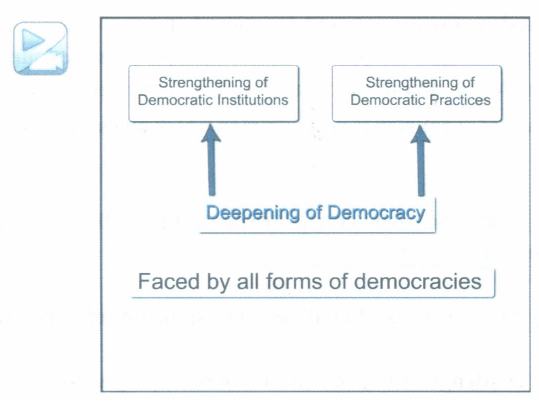
The challenge of deepening of democracy is faced by every democracy in one way or the other. This challenge ensures:
(a) strengthening of democratic institutions and principles.
(b) to check the influence of the wealthy and powerful people in the democratic decisions.
(c) empowering the general section of people through democratic institutions
2.
The challenge of expansion is very common challenge faced by an established democracy.
(a) The challenge of expansion involves applying the basic principles of democracy across all the regions, different social groups and various institutions.
(b) It involves ensuring greater power to local governments, extension of federal principle to all the units of the federation and inclusion of women and minority groups.
(c) It also implies that less and less decisions should remain outside the arena of democratic control. Most countries including India and other democracies, like the United States, face this challenge.
3.
The challenge of expansion is very common challenge faced by an established democracy.
(a) The challenge of expansion involves applying the basic principles of democracy across all the regions, different social groups and various institutions.
(b) It involves ensuring greater power to local governments, extension of federal principle to all the units of the federation and inclusion of women and minority groups.
(c) It also implies that less and less decisions should remain outside the arena of democratic control. Most countries including India and other democracies, like the United States, face this challenge.
4.
(i) Foundational challenge relates to making the transition to democracy and then instituting democratic government. It involves establishing a sovereign and functional state.
(ii) It involves bringing down the existing non-democratic regime, keeping military away from controlling government and establishing civilian control over all governmental institutions by holding elections.
(iii) It involves the recognition of peoples choice and opportunity to change rulers, recognize people's will. In countries like Myanmar political leader Suu Kyi was kept under house arrest for more than 20 years. Thus, in this case, foundational challenge recognizes the need to release political leaders and recall them from exile and holding of multiparty elections.
5.
| Democracy | Dictatorship |
| (i) Based on the idea of deliberation and negotiation. Thus the necessary delay in implementation. | (i) Do not have to bother about majorities and/or public opinion, thus can be quicj and efficient in decision-making. |
| (ii) Decisions are acceptable to people and are more effective. | (ii) May take decisions not accepted by the people. |
| (iii) A citizen has the right and the means to examine the process of decision making. There is transparency. | (iii) Transparency is missing from a non-democratic form of government. There is no accountability of the government to the people. |
| (iv) Democratic government is legitimate government, people's own government. | (iv) In a dictatorship there is rule of monarch or military or religious leader. There is no participation by the people. |
6.
The challenge of deepening of Democracy is applied to every Democracy in one or the other way.
This challenge ensures
(i) Strengthening of democratic institutions and democratic principles.
(ii) It also ensures, to check the influence of the wealthy and powerful people in the democratic decisions.
(iii) The challenge deepening thus, tries to empower the general section of people through democratic institutions.
7.
(i) Bringing down the existing non-democratic regime.
(ii) Keeping military away from controlling government.
(iii) Establishing a sovereign and functional state. At least one-fourth of the globe is still not under democratic governance. The challenge for democracy in these parts of the world is very stark. These countries face the foundational challenge of making the transition to democracy and then instituting a democratic government.
8.
The 'Foundational Challenge' applied to the non-democratic countries of the world. It implies:
(a) Making transition to Democracy
(b) Non-democratic regime to democratic regime.
(c) Control of government from military to the elected leaders.
(d) Promotion of sovereign and functional state.
9.
The following points show the expanded scope of democracy
(i) Democratic rights are not limited to political rights like, the right to vote, to stand in elections and form political organisations. A democracy should grant some social and economic rights to its citizens.
(ii) The power sharing in democracy is extended to the power sharing between government and social groups.
(iii) Modern democracy cannot value only the voice of majority, but it respects the voice of minority 'as well.
(iv) The democracy has extended its scope from government and its activities to eliminate discrimination based on caste, religion and gender.
10.
Democracy is the governance by a group of people (government) who are elected by the people of the country in free and fair elections. The government governs the country according to the constitution. In a democracy, people have freedom of speech and expression and judiciary is independent of the control of executive and legislature.
Features:
(a) People choose their own government.
(b) Final decision making powers rests with the elected representatives of the people.
(c) Holding of free and fair elections.
(d) Every adult citizen has one vote and every vote has equal value.
(e) Guarantee of fundamental rights and freedom to the people.
(f) Rule of law prevails.
(g) Judiciary is independent of legislature and executive.
11.
The following are the major challenges to democracy in India.
(a) Foundational Challenge: This challenge involves:
(i) making transition to democracy and then instituting democratic government.
(ii) bringing down the existing non-democratic regime.
(iii) keeping military away from controlling government.
(iv) establishing a sovereign and functional state.
(b) Challenge of expansion of democracy: This challenge signifies:
(i) extension of democratic power to local governments
(ii) expansion of federal principles to all the federal units
(iii) political empowerment to women and minorities.
(c) Challenge of deepening of democracy: This challenge ensures:
(i) strengthening of democratic institutions and democratic principles.
(ii) to check the influence of the wealthy and powerful people in democratic decisions.
(iii) empowering the general section of people through democratic institutions.
12.
(i) Politics through religion: Religious communities on their own can find ways of peaceful existence, but increasing political interference has led to a greater religious intolerance. This intolerance becomes dangerous when politicians interfered with people's passions. For example, Sectarian tensions mixed with the rivalries of the 2007 'elections in Punjab, when activists of various Sikh bodies clashed with the followers of the Sirsa based Dera Sacha Sauda, which had close ties with the Congress Party, over an advertisement the Dera placed in various dailies depicting its chief dressed as Guru Gobind Singh, the 10th Sikh Guru.
(ii) Caste War: Caste wars are not going to disappear from the democratic map of India because politics is moving consistently on narrow sectarian lines. At present, it is difficult to decide if caste is altering politics or politics is shifting caste equations. For example, caste alienation has been deepened by the reservation for Jats and the government needs to rethink about its reservation policy.
(iii) Remove economic inequality: To remove economic inequality the need is delivery of basic social and physical infrastructure. we still have poor infrastructure. Inspector Raj and labour policy that discourages employment. It is the failure of the State which is major cause of concern. The present growth is in stride with the rapidly changing global environment but for the poor to really benefit the country needs more functioning schools and health centres. Our concern in India should be to lift poor people into the middle class.
(iv) Gender division: Gender discrimination and women's political representation are not given adequate attention. In India proportion of women in legislatures has been very low.
(v) Corruption: The Indian democracy has faced with routine cases of corruption. For example. 2G scam, CWG scam, fodder scam, to mention a few. In substantive terms it may be reasonable to expect from democracy a government that is attentive to the needs and demands of the people and is largely free of corruption. But unfortunately the record of Indian democracy is not impressive and clean.
13.
(c)
Violence
14.
(b)
Ensuring greater power to local government
15.
(a)
inequalities exist in democracies
16.
(d)
All of these
17.
(d)
All of these
18.
(b)
The Information to Right Act
19.
(b)
Democracy
20.
(d)
All of these
21.
(b)
Literate
22.
()
No, legal reforms are not sufficient or effective to meet the challenges unless they are backed by political parties, politically-conscious citizens and movements.
23.
()
The most common form of democracy in today's world is representative democracy because most of the modern democracies involve large number of people in the decision-making process.
24.
()
The best laws for political reforms are those which empower people to carry out activities that out a check on the functioning of the government machinery.
25.
()
Legal ways of reforming politics denote carefully-devised changes in law which can help to discourage wrong political practices and encourage the good ones.
26.
()
The challenge of deepening of democracy is faced by every democracy in one form or another. It involves strengthening of the institutions and practices of democracy.
27.
()
A non-democratic country faces the foundational challenge of making the transition to democracy and then instituting democratic government.

10th Standard CBSE Syllabus & Materials
10th Standard CBSE
CBSE 10th Social Science PS - Federalism - New Model Questions Papers Study Material - QB365 Set A
NEW10th Standard CBSE
CBSE 10th Social Science PS - Power Sharing - New Model Questions Papers Study Material - QB365 Set A
NEW10th Standard CBSE
CBSE 10th Social Science GEO - Manufacturing Industries - New Model Questions Papers Study Material - QB365 Set A
NEW10th Standard CBSE
CBSE 10th Social Science GEO - Minerals and Energy Resources - New Model Questions Papers Study Material - QB365 Set A



CBSE 10th Standard CBSE Subjects
CBSE Standards





