
 100% FREE ACCESS
11th Standard Syllabus & Materials
11th Standard
TN 11th Tamil இயற்கை வேளாண்மை,சுற்றுச்சூழல் -செய்யுள் - மனோன்மணீயம் Important Questions And Answers Study Material - QB365 Set A
NEW11th Standard
TN 11th Tamil என்னுயிர் என்பேன் -துணைப்பாடம் - இசைத்தமிழர் இருவர் Important Questions And Answers Study Material - QB365 Set A
NEW11th Standard
TN 11th Tamil மொழி கலை -செய்யுள் - ஒவ்வொரு புல்லையும் Important Questions And Answers Study Material - QB365 Set A
NEW11th Standard
TN 11th Tamil பீடு பெற நில் - இலக்கணம் - பகுபத உறுப்புகள் Important Questions And Answers Study Material - QB365 Set A
NEW11th Standard
TN 11th Tamil பீடு பெற நில் - துணைப்பாடம் - வாடிவாசல் Important Questions And Answers Study Material - QB365 Set A
NEW11th Standard
TN 11th Tamil பீடு பெற நில் - செய்யுள் - குறுந்தொகை Important Questions And Answers Study Material - QB365 Set A

Published on: 29/04/2019
Periodic Classification Of Elements most expected five mark questions
Download Tamil Nadu 11th Standard Chemistry question papers, model tests, one-mark questions, important questions, and public exam papers in PDF format. Free study materials and answer keys for TN State Board students.
Questions + Answers key
Take MCQ Chemistry Test
1.
What are the anomalous properties of second period elements?
2.
Distinguish between electron affinity and electron negativity.
3.
(a) Define ionization energy.
(b) Prove that ionization energy is a periodic property.
4.
Explain about the factors that influence the ionization enthalpy.
5.
Prove that the atomic radii is a periodic property.
6.
(a) Define atomic radius.
(b) What are the difficulties in determining atomic radius?
7.
Explain the classification of elements based on chemical behaviour and on physical properties.
8.
Explain about the salient features of groups.
9.
Explain about the general characteristics of periods.
10.
Explain the merits of Moseley's long form of periodic table.
11.
Explain about the structural features of Moseley's long form of periodic table.
12.
Explain about the anomalies of Mendeleev's periodic table.
13.
(a) State Mendeleev's periodic law.
(b) Describe about the merits of Mendeleev's periodic table.
14.
Using Slater's rule calculate the effective nuclear charge on a 3p electron in aluminium and chlorine. Explain how these results relate to the atomic radius of the two atoms.
1.
(i) In the 1st group, lithium differs in many aspects from its own family elements. Similarly, in the 2nd group, beryllium differs in many aspects from its own family.
(ii) For example, lithium forms compounds with more covalent character. But other alkali metals of this group form only ionic compounds.
(iii) Similarly, beryllium forms compounds with more covalent character while the other elements of this family form only ionic compounds.
(iv) Lithium and beryllium resemble more with the elements lying at their right hand side in the 3rd period than with the other members of their own family.
(v) These kinds of anomalies are also observed from 13th to 17th groups.
(vi) This sort of similarity is commonly referred to as diagonal relationship in the periodic properties.
(vii) The anomalous behaviors are attributed to the following factors:
(a) Smaller atomic size
(b) Higher ionization enthalpy
(c) High electronegativity
2.
| Electron affinity | Electron negativity | |
| 1. | It is the tendency of an isolated gaseous atom to gain an electron. | It is the tendency of an atom in a molecule to attract the shared pair of electrons. |
| 2. | It is the property of an isolated atom. | It is the property of bonded atom. |
| 3. | It does not change regularly in a period or a group. | It changes regularly in a period or a group. |
| 4. | ·It is measured in electron volts\atom or kcal\mole or kJ/mole. | It is a number and has no units. |
3.
(a) The energy required to remove the most loosely held electron from an isolated gaseous atom is called as ionization energy.
(b) (i) Variation in a period:
On moving across a period from left to right, the ionization enthalpy value increases. This is due to the following reasons:
1. Increase of nuclear charge in a period
2. Decrease of atomic size in a period
Because of these reasons, the valence electrons are held more tightly by the nucleus, thus ionization enthalpy increases.
Hence, ionization energy is a periodic property.
(ii) Variation in a group:
As we move from top to bottom along a group, the ionization enthalpy decreases. This is due to the following reasons:
1. A gradual increase in atomic size.
2. Increase of screening effect on the outermost electrons due to the increase of number of inner electrons.
Hence, ionization enthalpy is a periodic property.
4.
Factors influencing ionization enthalpy:
(i) Size of the atom:
If the size of an atom is larger, the outermost electron shell from the nucleus is also larger and hence the outermost electrons experience lesser force of attraction. Hence it would be more easy to remove an electron from the outermost shell. Thus, ionization energy decreases with increasing atomic sizes.
Ionization enthalpy \(\infty{1\over Atomic \ size}\)
(ii) Magnitude of nuclear charge:
As the nuclear charge increases, the force of attraction between the nucleus and valence electrons also increases. So, more energy is required to remove a valence electron. Hence I.E increases with increase in nuclear charge.
Ionization enthalpy \(\alpha \ nuclear \ charge\)
(iii) Screening or shielding effect of the inner electrons:
The electrons of inner shells form a cloud of negative charge and this shields the outer electron from the nucleus. This screen reduces the coulombic attraction between the positive nucleus and the negative outer electrons. If screening effect increases, ionization energy decreases.
Ionization enthalpy \(\infty{1\over Screening\ effects}\)
(iv) Penetrating power of subshells s, p, d, and f:
The s-orbital penetrate more closely to the nucleus as compared to p-orbitals. Thus, electrons in s-orbitals are more tightly held by the nucleus than electrons in p-orbitals. Due to this, more energy is required to remove a electron from an s-orbital as compared to a p-orbital. For the same value of 'n', the penetration power decreases in a given shell in the order.
s>p>d>f.
(v) Electronic configuration:
If the atoms of elements have either completely filled or exactly half filled electronic configuration, then the ionization energy increases.
5.
Atomic radius is the distance between the centre of its nucleus and the outermost shell containing the electron. Atomic radius is a periodic property.
(i) Variation in periods:
The atomic radius decreases while going from left to right in a period, As we move from left to right in a period, the nuclear charge increases by one unit in each succeeding element. But the number of the shell remains same. Hence, the electrons are attracted strongly by the nucleus. Hence the atomic radius decreases along the period.
In 2nd period rLi > rBe > rB > rC > rN> rO > rF
(ii) Variation in a group:
The atomic radius of elements increases with increase in atomic number as we move from top to bottom in a group. The attraction of the nucleus for the electrons decreases as shell number increases. Hence atomic radius increases along the group.
In 1st group rLi < rNa < rK < rRb < rCs
Hence, atomic radii is a periodic property.
6.
(a) Atomic radius is the distance between the centre of its nucleus and the outermost shell containing the electron.
(b) Difficulties in determining atomic radius
(i) The size of an atom is very small (~1.2\(\mathring A\) i.e 1.2 x 10 -10)
(ii) The atom is not a rigid sphere; it is more like a spherical cotton ball rather than like a cricket ball.
(iii) It is not possible to isolate an atom and measure its radius.
(iv) The size of an atom depends upon the type of atoms in its neighborhood and also the nature of bonding between them.
7.
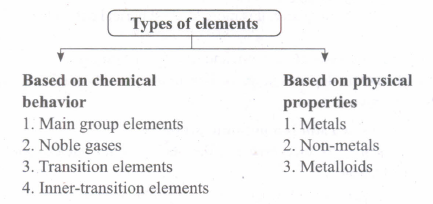
Based of chemical behavior:
(i) Main group elements:
All s-block and p-block elements excluding 18th group elements are called representative elements.
(ii) Noble gases:
The 18th group elements are exclusively called noble gases. They have completely filled electronic configuration as ns2 np6, These elements are highly stable.
(iii) Transition elements:
The elements of d-block are called transition elements. These include elements of groups from yd to 12th lying between s-block and p-block elements.
(iv) Inner transition elements.
The elements of f-block are called inner-transition elements. These consist of lanthanides and actinides, with 14 elements in each. Based of physical properties:
(i) Metals:
Metals comprise more than 78% of all known elements. They are usually solids at room temperature (except Hg, Ga and Cs). They have high melting and boiling points. They are good conductors of heat and electricity.
(ii) Non-metals:
Non-metals are usually solids or liquids or gases at room temperature with low melting and low boiling points (except boron and carbon). They are poor conductors of heat and electricity. Most of the non-metallic solids are brittle and are neither malleable nor ductile.
(iii) Metalloids or Semi-metals:
Some elements in the periodic tables show properties that are characteristic of both metals and non-metals, They are called metalloids. Example: Silicon, germanium, arsenic, antimony and tellurium.
8.
(i) Number of electrons in outermost shell: The number of electrons present in the outermost shells does not change on moving down in a group, i.e remains the same. Hence, the valency also remains same within a group.
(ii) Number of shells: In going down a group the number of shells increases by one at each step and ultimately becomes equal to the period number to which the element belongs.
(iii) Valency: The valencies of all the elements of the same group are the same. The valency of an element with respect to oxygen is same in a group.
(iv) Metallic character: The metallic character of the elements increases in moving from top to bottom in a group.
9.
(i) Number of electrons in outermost shell: The number of electrons present in the outermost shell increases from 1 to 8 as we proceed in a period.
(ii) Number of shells: As we move from left to right in a period the shells remains the same. The number of shells present in the elements corresponds to the period number. For example all the elements of 2nd period have on 2 shells (K, L)
(iii) Valency: The valency of the elements increases from left to right in a period. With respect to hydrogen, the valency of period elements increases from 1 to 4 and then falls to one. With respect to oxygen, the valency increases from 1 to 7.
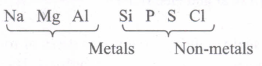
(iv) Metallic character: The metallic character of the elements decreases across a period.
For example: 3rd period
10.
Merits of Moseley's long form of periodic table:
(i) As this classification is based on atomic number, it relates the position of an element to its electronic configuration.
(ii) The elements having similar electronic configuration fall in a group. They also have similar physical and chemical properties.
(iii) The completion of each period is more logical. In a period as the atomic number increases, the energy shells are gradually filled up until an inert gas configuration is reached.
(iv) The position of zero group is also justified in the table as group 18.
(v) The table completely separates metals and non-metals.
(vi} The table separates two subgroups, lanthanides and actinides, dissimilar elements do not fall together.
(vii) The greatest advantage of this periodic table is that this can be divided into four blocks namely s, p, d and f-block elements.
(viii) This arrangement of elements is easier to remember, understand and reproduce.
11.
(i) The long form of periodic table of the elements is constructed on the basis of modem periodic law. The arrangement resulted in repeating electronic configurations of atoms at regular intervals.
(ii) The elements placed in horizontal rows are called periods and in vertical columns are called groups.
(iii) According to IUPAC, the groups are numbered from 1 to 18.
(iv) There are 18 vertical columns which constitute 18 groups or families. All the members of a particular group have similar outer shell electronic configuration.
(v) There are 7 horizontal rows called periods.
| Period number | Number of elements |
| 1 | 2 |
| 2 | 8 |
| 3 | 8 |
| 4 | 18 |
| 5 | 18 |
| 6 | 32 |
| 7 | 19(incomplete) |
The elements are shown in the above table along with its atomic number.
(vi) The atomic number also indicates the number of electrons in the atoms of an element.
(vii) This periodic table is important and useful because we can predict the properties of any element using periodic trend, even though that element may be unfamiliar to us.
12.
Anomalies of Mendeleev's periodic table
(i) Some elements with similar properties were placed in different groups whereas some elements having dissimilar properties were placed in same group, but iodine (127) was placed in VII group.
Example: Tellurium (127.6) was placed in VI group.
(ii) Some elements with higher atomic weights were placed before lower atomic masses in order to maintain the similar chemical nature of elements. This concept was called inverted pair of elements concept.
Example: 5927Co and 58.7 28Ni
(iii) Isotopes did not find any place in Mendeleev's periodic table.
(iv) Position of hydrogen could not be made clear.
(v) He did not leave any space for lanthanides and actinides which were discovered later on.
(vi) Elements with different nature were placed in one group, Example: Alkali metals and coinage metals were placed together:
(vii) Diagonal and horizontal relationships were not explained.
13.
(a) Mendeleev's periodic law:
Mendeleev's periodic law states that the physical and chemical properties of elements are a periodic function of their atomic weights.
(b) Merits of Mendeleev's periodic table:
(i) The comparative studies of elements were made easier.
(ii) The table shows the relationship'in properties of elements in a group.
(iii) The table helped to correct the atomic masses of some elements later on. At the time of Mendeleev, the atomic weight of Au and Pt were known as 196.2 and 196.7 respectively. However, Mendeleev placed Au (196.2) after Pt (196.7) saying that atomic weight of Au is incorrect, which was later on found to be 197.
(iv) At the time of Mendeleev, about 70 elements were known and thus blank spaces were left for unknown elements which helped further discoveries.
(v) Both Gallium (Ga) in III group and Germanium. (Ge) in IV group, were unknown at that time by Mendeleev predicted their existence and properties. He referred the predicted elements as eka-aluminium and eka-silicon. After discovery of the actual elements, their properties were found to match closely to those predicted by Mendeleev.
14.
Electronic Configuration of Aluminium
\(\underbrace { { Al }^{ 13 }{ 1s }^{ 2 } }_{ (n-2) } \underbrace { 2s^{ 2 }{ 2p }^{ 2 } }_{ (n-1) } \underbrace { { 3s }^{ 2 }{ 3p }^{ 1 } }_{ n } \)
| Group | no.of electrons |
Contribution of each electron to'S' value |
Contribution of a particular group |
| n (n-1) (n-2) |
2 8 2 |
0.35 0.85 1 |
0.70 6.80 2.00 |
| 9.50 |
∴ Effective nuclear charge = Z - S = 13 - 9.5
(Zeff)Al =3.5
Electronic Configuration of chlorine
\(\underbrace { { 1s }^{ 2 } }_{ (n-2) } \underbrace { 2s^{ 2 }{ 2p }^{ 2 } }_{ (n-1) } \underbrace { { 3s }^{ 2 }{ 3p }^{ 5 } }_{ n } \)
| Group | no.of electrons |
Contribution of each electron to'S' value |
Contribution of a particular group |
| n (n-1) (n-2) |
6 8 2 |
0.35 0.85 1 |
2.1 6.8 2 |
| S= | 10.9 |
∴ Effective nuclear charge = Z - S = 17 - 10.9
(Zeff)cl = 6.1
(Zeff)cl > (Zeff)Al and hence rcl

11th Standard Syllabus & Materials
11th Standard
TN 11th Tamil பீடு பெற நில் - செய்யுள் - காவடிச்சிந்து Important Questions And Answers Study Material - QB365 Set A
NEW11th Standard
TN 11th Tamil பீடு பெற நில் - உரைநடை - மலை இடப்பெயர்கள் : ஓர் ஆய்வு Important Questions And Answers Study Material - QB365 Set A
NEW11th Standard
TN 11th Tamil மாமழை போற்றுதும் - துணைப்பாடம் - யானை டாக்டர் Important Questions And Answers Study Material - QB365 Set A
NEW11th Standard
TN 11th Tamil மாமழை போற்றுதும் - செய்யுள் - ஐங்குறுநூறு Important Questions And Answers Study Material - QB365 Set A



Tamilnadu Stateboard 11th Standard Subjects

Maths

Commerce

Economics

Biology

Business Maths and Statistics

Accountancy

Computer Science

Physics
Chemistry
Maths
Biology
Economics
Physics
Chemistry

History
Business Maths and Statistics

Computer Science
Accountancy

Computer Applications
History
Computer Technology
Commerce
Computer Applications
Computer Technology

Tamil

English

French
Tamilnadu Stateboard Standards
