
 100% FREE ACCESS
11th Standard CBSE Syllabus & Materials
11th Standard CBSE
CBSE 11th Economics PART-A - Presentation of Data - New Sample Question Papers Study Material - QB365 Set A
NEW11th Standard CBSE
CBSE 11th Economics PART-A - Organisation of Data - New Sample Question Papers Study Material - QB365 Set A
NEW11th Standard CBSE
CBSE 11th Economics PART-A - Collection of Data - New Sample Question Papers Study Material - QB365 Set A
NEW11th Standard CBSE
CBSE 11th Economics PART-A - Introduction to Economics and Statistics - New Sample Question Papers Study Material - QB365 Set A
NEW11th Standard CBSE
CBSE 11th Business Studies International Trade Sample Question Papers Study Material - QB365 Set A
NEW11th Standard CBSE
CBSE 11th Business Studies Evolution and Fundamentals of Business Sample Question Papers Study Material - QB365 Set A

Published on: 05/03/2019
Chemical Bonding and Molecular Structure Important Questions
Download CBSE Class 11th Standard CBSE Chemistry question papers, sample papers, important questions, and previous year solved papers in PDF format. Get free study materials, NCERT solutions, and exam preparation resources for Class 11th Standard CBSE Chemistry
Questions + Answers key
Take MCQ Chemistry Test
1.
Explain the diamagnetic behaviour of F2 molecule on the basis of molecular orbital theory
2.
Give the shapes of the following molecules:
(i) AB3
(ii) AB4
3.
Define antibonding molecular orbital.
4.
Define covalent bond according to orbital concept?
5.
Define the bond length.
6.
Group the given molecules as linear and non-linear molecules.
7.
Out of p-orbital and sp-hybrid orbital which has greater directional character and why?
8.
Why is NaCl harder than sodium metal?
9.
Define Hybridisation. Explain Sp3 hybridisation with suitable example.
10.
Explain the formation of H2 molecule on the basis of valence bond theory.
11.
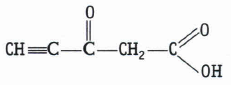
Predict the hybridisation of each carbon in the molecule of organic compound given below. Also indicate the total number of \(\sigma \ and \ \pi \)-bonds in this molecule.
12.
Give reasons for the following. Ethyne molecule is linear.
13.
Describe the hybridisation in case of PCl5, Why are the axial bonds longer as compared to equatorial bonds?
14.
Draw diagrams showing the formation of a double bond and a triple bond between carbon atoms in C2 H4 and C2 H2 molecules.
15.
Explain with the help of suitable example polar covalent bond.
16.
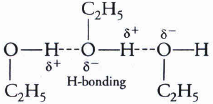
Reena loves to from experiment. When she read about the solubility of different compounds in water, she decided to prove it. She took some chemical compounds from her teacher in the laboratory and tried to dissolve them. These compounds were magnesium chloride, lime, ethanol, ethylamine. But she got confused because she found all of these are soluble in water. She discussed these results with her teacher who clarity her reason for this.
What explanation was given by the teacher? Explain
17.
Give the geometry of (CH3)3N and [(CH3)3Si]3N state if they are isostructural?
18.
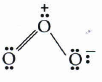
Calculate formal charge on each 0-atom of O3 molecule.
19.
Out of the following, intramolecular hydrogen bonding exists in ______.
water
H2S
4-nitrophenol
2-nitrophenol
20.
The molecule Ne2 does not exist because ______.
Nb > Na
Nb = Na
Nb < Na
None of these
21.
The axial overlap between the two orbitals leads to the formation of a: ______.
sigma bond
pi bond
multiple bond
none of these
1.
The orbital electronic configuration of fluorine (Z = 9)
\(={ 1s }^{ 2 }{ 2s }^{ 2 }{ 2p }_{ x }^{ 2 }{ 2p }_{ y }^{ 2 }{ 2p }_{ z }^{ 1 }\)
M.O.E.C. of fluorine =[σ2s]2 [σ*2s]2 [σ2pz]2 [\(\pi\)2px]2 [\(\pi\)2py]2 [\(\pi\)*2px]2 [\(\pi\)*2py]2
Due to presence of all filled orbitals, F2 is diamagnetic
2.
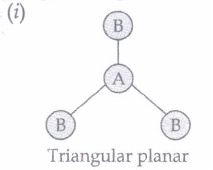
(ii) AB4- Tetrahedral
3.
The molecular orbital fonned by the subtractive effect of the electron waves of the combining atomic orbitals, is called antibonding molecular orbital.
4.
Covalent bond can be formed by the overlap of the orbitals belonging to the two atoms having opposite spins of electrons
5.
Bond-length: It is the equilibrium distance between the nuclei of two bonded atoms in a molecule. Bond-lengths are measured by spectroscopic methods.
6.
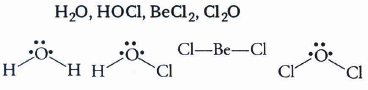
Therefore, only BeCl2 is linear and rest of the molecules are non-linear.
7.
sp = orbital has greater directional character than p = orbital. This is because p-orbital has equal sized lobes, with equal electron density in both the lobes where as sp-hybrid orbital has greater electron density on one side.
8.
This is because in NaCl, there is strong ionic bond between Na+ and Cl-1 whereas in Na metal, there is weak metallic bond.
9.
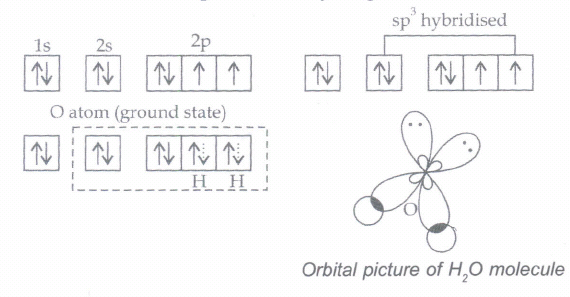
Hybridisation: It is the phenomenon of intermixing of atomic orbitals of slightly different energies to form new hybrid orbitals of equivalent energy. Formation of water. In water (H20), the atomic number of oxygen is 8 and its orbitals electronic configuration is 1s2 2s2 \({ 2 }_{ x }^{ 2 }{ \ 2p }_{ y }^{ 1 }{ \ 2p }_{ z }^{ 1 }\) . The oxygen atom is also Sp3 hybridised. However, in this case, the two orbitals with one electron each (half filled) are involved in overlap with the hydrogen orbitals.
10.
Let us consider the combination between atoms of hydrogen HA and HB and eA and eB be their respective electrons.
As they tend to come closer, two different forces operate between the nucleus and the electron of the other and vice versa. The nuclei of the atoms as well as their electrons repel each other. Energy is needed to overcome the force of repulsion. Although the number of new attractive and repulsive forces is the same, but the magnitude of the attractive forces is more. Thus, when two hydrogen atoms approach each other, the overall potential energy of the system decreases. Thus, a stable molecule of hydrogen is formed.
11.
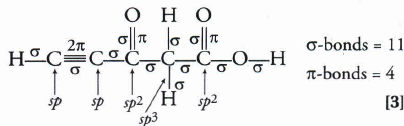
12.
In ethyne molecule, both the carbon atoms are sp hybridised having two unhybridised orbitals, i.e. 2Px and 2Py. The two sp hybrid orbitals of both the carbon atoms are oriented in opposite direction forming an angle of 180o.
\(H-C\overset { \sigma }{ \underset { 2\pi -bond }{ \equiv } C } -H\)
That's why ethyne molecule is linear.
13.
The ground state and excited state outer electronic configurations of phosphorus (Z = 15) are
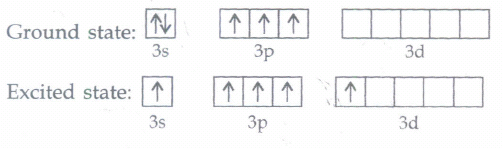
Phosphorus atom is sp3 d hybridized in the excited state. These orbitals are filled by the electron pairs donated by five Cl atoms as:
PCI5
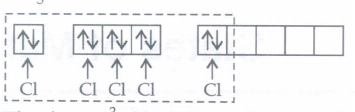
The five Sp3 d hybrid orbitals are directed towards the five corners of the trigonal bipyramidal. Hence, the geometry of PCI5 can be represented as:
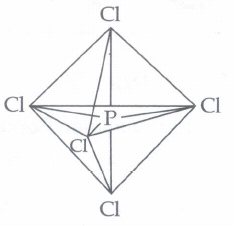
There are five P-Cl sigma bonds in PCl5 Three P-Cl bonds lie in one plane and make an angle of 120° with each other. These bonds are called equatorial bonds. The remaining two P-CI bonds lie above and below the equatorial plane and make an angle of 90° with the plane. These bonds are called axial bonds. As the axial bond pairs suffer more repulsion from the equatorial bond pairs, axial bonds are slightly longer than equatorial bonds.
14.
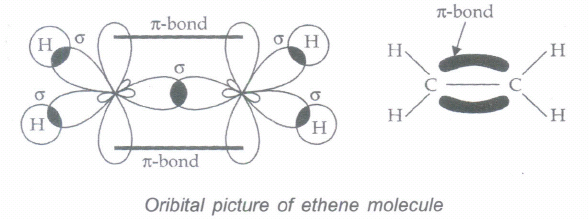
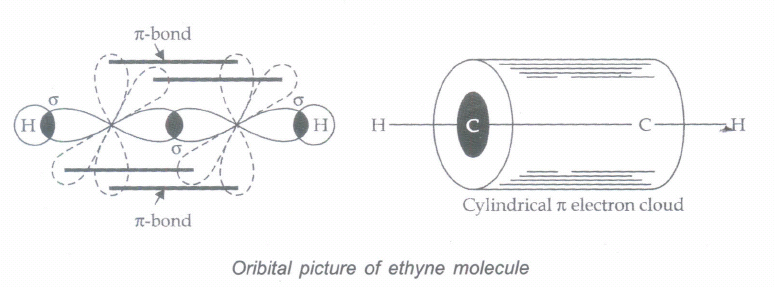
15.
When two atoms with different electronegativity are linked to each other by covalent bond, the shared electron pair will not in the centre because of the difference in electronegativity. For example, in hydrogen flouride molecule, flouride haspeater electronegativity than hydrogen. Thus, the shared electron pair is displaced more towards flourine atom, the later will acquire a partial negative charge (\(\delta ^{ - }\)).At the same time hydrogen atom will have a partial positive charge (\(\delta ^{ + }\)). Such a covalent bond is known as polar covalent bond or simply polar bond. It is represented as
\(\overset { { \delta }^{ + } }{ \underset { 2.1 }{ H } - } \overset { { \delta }^{ - } }{ \underset { 4.0 }{ F } } \)
16.
Teacher told her that the former two compounds dissolve because of their ionic nature whereas the later two because of H-bonding with the water molecules.
17.
\({ (CH }_{ 3 }{ ) }_{ 3 }\ddot { N } \) is trimethyl amine.It has pyramidal geometry as shown below
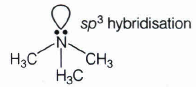
[(CH3)3Si]3 N has triangular planar geometry as shown in diagram below.
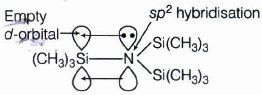
Due to the presence of empty d-orbital on Si, there is an effective back bonding.
Thus, the two species are not isostructural.In (CH3)3N, the N-atom assumes sp3 hybrid state where as in [(CH3)3Si]3N, the N-atom assumes sp2 hybridtate.
18.
The Lewis of O3 may be draw as

The oxygen atoms have been numbered as 1, 2 and 3. The formal charge on
(i) The central O-atom marked as 1 = V - L - \(\frac { 1 }{ 2 } \)S
= 6 - 2 - \(\frac { 1 }{ 2 } \)(6) = +1
(ii) The end O-atom marked as 2 = V - L - \(\frac { 1 }{ 2 } \)S
= 6 - 4 - \(\frac { 1 }{ 2 } \)(4) = 0
(iii) The end O-atom marked as 3 = V - L - \(\frac { 1 }{ 2 } \)S
= 6 - 6 - \(\frac { 1 }{ 2 } \)(2) = -1
Hence, the O3 molecule along with the formal charges can be represented as follows
19.
(d)
2-nitrophenol
20.
(b)
Nb = Na
21.
(a)
sigma bond

11th Standard CBSE Syllabus & Materials
11th Standard CBSE
CBSE 11th Business Studies Forms of Business Organisation Sample Question Papers Study Material - QB365 Set A
NEW11th Standard CBSE
CBSE 11th Business Studies Business, Trade and Commerce Sample Question Papers Study Material - QB365 Set A
NEW11th Standard CBSE
CBSE 11th Physics Waves Sample Question Papers Study Material - QB365 Set A
NEW11th Standard CBSE
CBSE 11th Physics Kinetic Theory Sample Question Papers Study Material - QB365 Set A



CBSE 11th Standard CBSE Subjects
CBSE Standards









