
 100% FREE ACCESS
10th Standard CBSE Syllabus & Materials
10th Standard CBSE
CBSE 10th Social Science ECO - Globalisation and the Indian Economy - New Model Questions Papers Study Material - QB365 Set A
NEW10th Standard CBSE
CBSE 10th Social Science ECO - Money and Credit - New Model Questions Papers Study Material - QB365 Set A
NEW10th Standard CBSE
CBSE 10th Social Science ECO - Sectors of the Indian Economy - New Model Questions Papers Study Material - QB365 Set A
NEW10th Standard CBSE
CBSE 10th Social Science ECO - Development - New Model Questions Papers Study Material - QB365 Set A
NEW10th Standard CBSE
CBSE 10th Social Science PS - Outcomes of Democracy - New Model Questions Papers Study Material - QB365 Set A
NEW10th Standard CBSE
CBSE 10th Social Science PS - Gender, Religion and Caste - New Model Questions Papers Study Material - QB365 Set A

Published on: 13/10/2018
CHAPTER 1,2 @ CHEMISTRY
Download CBSE Class 10th Standard CBSE Science question papers, sample papers, important questions, and previous year solved papers in PDF format. Get free study materials, NCERT solutions, and exam preparation resources for Class 10th Standard CBSE Science
Questions + Answers key
Take MCQ Science Test
1.
(a) In the following reactions, name the reactants, which undergoes oxidation and reduction:
(i) CuO(s) + H2(g) \(\longrightarrow \) Cu(s) + H2O(g)
(ii)CuO(s) + Zn(s) \(\longrightarrow \) ZnO(s) + Cu(s)
(b) State one industrial application of reduction.
2.
(a) What is the action of litmus on:
(i) dry ammonia gas
(ii) Solution of ammonia gas in water
(b) State the observations you would make on adding sodium hydroxide to an aqueous solution of:
(i) ferrous sulphate
(ii) aluminum chloride.
Give balanced chemical equations.
3.
To the three solutions listed below, a few drops of phenolphthalein and blue litmus were added separately. Specify the colour change in each case, if any:
| Name of the Solution |
Colour change with phenolphthalein |
Colour change with blue litmus |
|---|---|---|
| 1. Sodium carbonate |
||
| 2. Hydrochloric acid |
||
| 3. Sodium chloride |
4.
A liquid has a pH less than 7 which represent all acidic solution:
(i) State the nature of the solution, if its pH increases from 7 to 14.
(ii) Mention the ion whose concentration increases with the increase in pH value.
(iii) Suggest a method that is generally used for measuring the pH value.
5.
Write the balanced equation for the following chemical reactions.
(i) Hydrogen + Chlorine \(\rightarrow\) Hydrogen chloride
(ii) Barium chloride + Aluminium sulphate \(\rightarrow\) Barium sulphate + Aluminium chloride
(iii) Sodium + Water \(\rightarrow\) Sodium hydroxide + Hydrogen
6.
What happens when ZnCO3 is heated in the absence of air? Give the relevant equation.
7.
What happens when quick lime is added to water?
8.
State one basic difference between a physical change and a chemical change.
9.
Name the acid present in ant sting.
10.
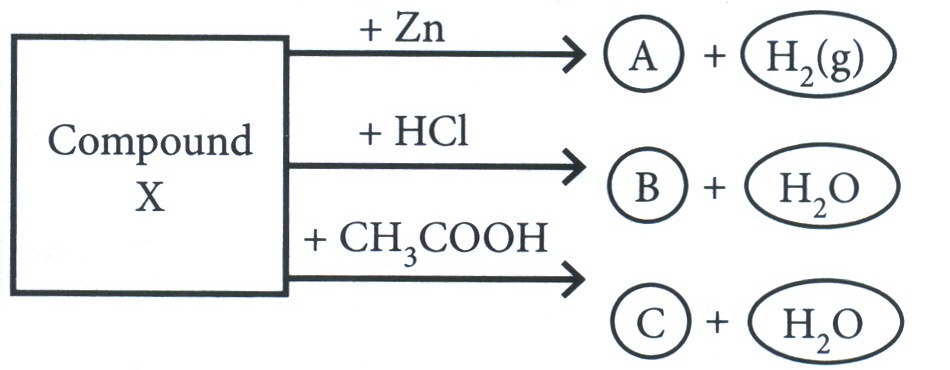
Identify the compound X on the basis of the reactions given below. Also, write the name and chemical formulae of A, B and C.
11.
Name the reaction seen during rancidity of food.
12.
What type of reaction is this:
Na2SO4 + BaCl2 \(\rightarrow\) BaSO4 + 2NaCl
13.
Give an example of photochemical reactions.
14.
What is the role of a catalyst in a chemical
15.
Classify the following reactions into slow and fast reaction:
(i) Reaction between an acid and a base
(ii) Rusting of iron
16.
Dry ammonia gas has no action on litmus paper, but a solution of a ammonia in water turns red litmus paper blue, why is it so?
17.
Given below are the pH values of four different liquids : 7.0, 14.0, 4.0, 2.0
Which of these could be that of
(i) lemon juice,
(ii) distilled water,
(iii) 1 M sodium hydroxide solution,
(iv) tomato juice
18.
Identify the oxidising agent (oxidant) in the following reactions
(a) Pb3O4 + 8HCl \(\rightarrow\) 3PbCl2 + Cl2 + 4H2O
(b) 2Mg + O2 \(\overset { V_2O_5 }{ \rightarrow } \) 2MgO
(c) CuSO4 + Zn \(\rightarrow\) Cu + ZnSO4
(d) V2O5 + 5Ca \(\rightarrow\) 2V + 5CaO
(e) 3Fe + 4H2O \(\rightarrow\) Fe3O4 + 4H2
(f) CuO + H2 \(\rightarrow\) Cu + H2O
19.
Identify the reducing agent in the following reactions
(a) 4NH3 + 5O2 \(\rightarrow\) 4NO + 6H2O
(b) H2O + F2 \(\rightarrow\) HF + HOF
(c) Fe2O3 + 3CO \(\rightarrow\) 2Fe + 3CO2
(d) 2H2 + O2 \(\rightarrow\) 2H2O
20.
Match the important chemicals given in Column (A) with the chemical formulae given in Column (B).
| Colum (A) | Column (B) |
|
(A) Plaster of Paris (B) Gypsum (C) Bleaching Powder (D) Slaked Lime |
(i) \(Ca(OH)_2\) (ii) \(CaSO_4.1/2\ H_2O\) (iii) \(CaSO_4.2H_2O\) (iv) \(CaOCl_2\) |
21.
A substance 'A' displaces 'B' from its solution in water. It is called displacement reaction. What other chemical name can be given to such type of reactions? Explain with an example.
22.
A yellowish coloured compound 'A' is photosensitive material. On exposure to sunlight, it gives a greyish substance 'B' and brown fumes of a gas 'C'. Identify A, B and C. How will you obtain A from the nitrate salt of B?
23.
Balance the following chemical equations.
(a) HNO3 + Ca(OH)2 \(\rightarrow\) Ca(NO3)2 + H2O
(b) NaOH + H2SO4 \(\rightarrow\) Na2SO4 + H2O
(c) NaCl + AgNO3 \(\rightarrow\) AgCl + NaNO3
(d) BaCl2 + H2SO4 \(\rightarrow\) BaSO4 + HCl
24.
A solution of a substance 'X' is used for white washing.
(i) Name the substance 'X' and write its formula.
(ii) Write the reaction of the substance 'X' named in (i) above with water.
25.
Write a balanced chemical equation with state symbols for the following reactions.
(i) Solutions of barium chloride and sodium sulphate in water react to give insoluble barium sulphate and the solution of sodium chloride.
(ii) Sodium hydroxide solution (in water) reacts with hydrochloric acid solution (in water) to produce sodium chloride solution and water.
26.
(a) Why is sulphuric acid called 'King of Chemicals'?
(b) Describe the three chemical reactions that take place during the conversion of sulphur dioxide to sulphuric acid in the 'Contact Process'.
(c) Why should water be never added drop wise to concentrated sulphuric acid?
1.
(a) (i) The reactants are copper oxide and hydrogen. Copper oxide undergoes reaction and hydrogen (H2) undergoe oxidation.
(ii) The reactants are copper oxide and zinc. Zinc undergoes oxidation and copper oxide undergoes reduction.
(b) Calcium carbonate is reduced in industries to get CaO and CO2.
2.
(a) (i) No change in color.
(ii) Red litmus turns blue.
(b) (i) 2NaOH(aq)+FeSO4(aq)\(\rightarrow\)Fe(OH)2(s)+Na2SO4(aq)
3.
| Name of the Solution |
Colour change with phenolphthalein |
Colour change with blue litmus |
|---|---|---|
| 1. Sodium carbonate |
turns pink | no change |
| 2. Hydrochloric acid |
no change | turns red |
| 3. Sodium chloride |
no change | no change |
4.
(i) Increase in the strength of alkali. So the nature of solution will be basic.
(ii) Hydroxide ion or hydroxyl ion or OH- ion.
(iii) A paper impregnated with the universal indicator is generally used to measure the pH of a solution.
5.
(i) H2 + Cl2 \(\rightarrow\) 2HCI
(ii) 3BaCl2 + Al2(SO4)3 \(\rightarrow\) 3BaSO4 \(\downarrow\)+ 2AlCl3
(iii) 2Na + 2H2O \(\rightarrow\) 2NaOH + H2
6.
ZnO(s) and CO2(g) are formed.
Chemical Equation:
ZnCO3 → ZnO + CO2
7.
Quick lime reacts with water vigorously to produce slaked lime and a large amount of heat.
\(\underset { (Quick\quad lime) }{ CaO(s) } +{ H }_{ 2 }O\rightarrow \underset { (Slaked\quad lime) }{ Ca(O{ H) }_{ 2 } } +Heat\)
8.
In a physical change, no new substance is formed. In a chemical change, new substance is formed.
9.
Formic acid(Methanoic acid) HCOOH.
10.
X - NaOH (Sodium hydroxide)
A - Na2ZnO2 (Sodium zincate)
B - NaCI (Sodium chloride)
C - CH3COONa (Sodium acetate)
11.
Oxidation the reaction seen during rancidity of food.
12.
It is a double displacement reaction.
13.
An example of photochemical reactions is the process of photosynthesis occurring in the leaves of green plants.
\(\underset { Carbon\\ dioxide }{ { 6CO }_{ 2 } } +\underset { Water}{ { 6H }_{ 2 } O} \overset { sunlight }{ \underset { Chlorophyll }{ \rightleftharpoons } } \underset {Glucose }{ C_6H_{12}O_6 } +\underset {Oxygen }{6{ O }_{ 2 }}\)
14.
A catalyst changes the rate of reaction without taking part in the reaction itself.
15.
i. Neutralization reaction
ii. Oxidation reaction
16.
A solution of ammonia in water results in the formation of ammonium hydroxide (NH4OH). Ammonium hydroxide is basic in nature and turns red litmus blue.
17.
| pH | Liquid |
| 7.0 | Distilled Water |
| 14.0 | 1 M sodium hydroxide solution |
| 4.0 | Tomato juice |
| 2.0 | Lemon juice |
18.
(a) Pb3O4
(b) O2
(c) CuSO4
(d) V2O5
(e) H2O
(f) CuO
19.
(a) NH3
(b) F2
(c) CO
(d) H2
20.
(a) - (ii); (b) - (iii); (c) - (iv); (d) - (i)
21.
A substance 'A' which displaces 'B' from its solution in water must be higher in reactivity. Therefore, 'A' must be high reactivity metal, let us say zinc(Zn). The 'B' must be copper sulphate solution. This is because copper is least reactive than zinc.
CuSO4+Zn\(\rightarrow\)ZnSO4+Cu
In this reaction, zinc is oxidised to zinc sulphate and copper sulphate is reduced to copper metal. Thus this reaction is also called redox reaction.
22.
The yellowish compound is silver bromide [AgBr].
When silver bromide is exposed to sun light, it produces a grey coloured silver metal.
\(2AgBr\longrightarrow2Ag+Br_2\)
Thus 'A' is silver bromide [AgBr], 'B' is silver metal [Ag] and 'C' is bromine [Br2]
The nitrate of 'B' is silver nitrate [AgNO3]
Silver nitrate when treated with sodium bromide, it forms silver bromide.
AgNO3+NaBr\(\rightarrow\)AgBr+NaNO3
23.
(a) 2HNO3 + Ca(OH)2 \(\rightarrow\) Ca(NO3)2 + 2H2O
Nitric acid Calcium hydroxide Calcium nitrate Water
(b) 2NaOH + H2SO4 \(\rightarrow\) Na2SO4 + 2H2O
Sodium hydroxide Sulphuric acid Sodium sulphate Water
(c) NaCl + AgNO3 \(\rightarrow\) AgCl + NaNO3
Sodium chloride Silver nitrate Silver chloride Sodium nitrate
(d) BaCl2 + H2SO4 \(\rightarrow\) BaSO4 + 2HCl
Barium chloride Sulphuric acid Barium sulphate Hydrochloric acid
24.
(i) Substance X is calcium oxide or quicklime. Its formula is CaO
(ii) Quicklime reacts with water as:
CaO(s) + H2O(l) \(\rightarrow\)Ca(OH)2 (aq)
X Water Slaked lime (Calcium hydroxide)
25.
(i) BaCl2(aq) + Na2SO4 (aq) \(\rightarrow\) BaSO4(s)\(\downarrow\) + 2NaCl(aq)
(ii) NaOH (aq) + HCl (aq) \(\rightarrow\) NaCl (aq) + H2O(l)
26.
(a) Concentrated sulphuric acid is called the king of chemicals as it is a very strong acid and is highly corrosive.
(b) The three chemical reactions that take place during the conversion of sulfur dioxide to sulphuric acid in the 'Contact Process' are given below.
Step I: Sulphur dioxide is mixed with air and passed over vanadiumpent (V) oxide catalyst heated to \(450^oC\) to form sulphur trioxide.
\(\underset{Sulphur\ dioxide}{2SO_{2(g)}}+\underset{Oxygen}{O_{2(g)}}\underset{\rightleftharpoons }{V_2O_5}\underset{Sulphur\ trioxide}{2SO_{3(g)}}+Heat\)
Step II : Sulphur trioxide is dissolved in concentrated sulphuric acid to form a thick fuming liquid called oleum.
\(\underset{Sulphuric\ acid}{H_2SO_4(l)}+\underset{Sulphur\ trioxide}{SO_{3(g)}}\begin{matrix} V_2O_5 \\ \rightleftharpoons \\ \end{matrix}\underset{Oleum}{H_2S_2O_{7(l)}}\)
Step III: Oleum is diluted with a calculated quantity of water to obtain sulphuric acid.
\(H_2S_2O_{7(l)}+\underset{Water}{H_2O_{(l)}}\rightarrow\underset{Sulphuric\ acid}{2H_2SO_{4(aq)}}\)
(c) If water is added to sulphuric acid then a large amount of heat is evolved. This changes water to steam, which can splash the acid. Hence, it is dangerous.

10th Standard CBSE Syllabus & Materials
10th Standard CBSE
CBSE 10th Social Science PS - Federalism - New Model Questions Papers Study Material - QB365 Set A
NEW10th Standard CBSE
CBSE 10th Social Science PS - Power Sharing - New Model Questions Papers Study Material - QB365 Set A
NEW10th Standard CBSE
CBSE 10th Social Science GEO - Manufacturing Industries - New Model Questions Papers Study Material - QB365 Set A
NEW10th Standard CBSE
CBSE 10th Social Science GEO - Minerals and Energy Resources - New Model Questions Papers Study Material - QB365 Set A



CBSE 10th Standard CBSE Subjects
CBSE Standards





