
 100% FREE ACCESS
10th Standard CBSE Syllabus & Materials
10th Standard CBSE
CBSE 10th Social Science ECO - Globalisation and the Indian Economy - New Model Questions Papers Study Material - QB365 Set A
NEW10th Standard CBSE
CBSE 10th Social Science ECO - Money and Credit - New Model Questions Papers Study Material - QB365 Set A
NEW10th Standard CBSE
CBSE 10th Social Science ECO - Sectors of the Indian Economy - New Model Questions Papers Study Material - QB365 Set A
NEW10th Standard CBSE
CBSE 10th Social Science ECO - Development - New Model Questions Papers Study Material - QB365 Set A
NEW10th Standard CBSE
CBSE 10th Social Science PS - Outcomes of Democracy - New Model Questions Papers Study Material - QB365 Set A
NEW10th Standard CBSE
CBSE 10th Social Science PS - Gender, Religion and Caste - New Model Questions Papers Study Material - QB365 Set A

Published on: 05/03/2019
Circles Important Questions
Download CBSE Class 10th Standard CBSE Maths question papers, sample papers, important questions, and previous year solved papers in PDF format. Get free study materials, NCERT solutions, and exam preparation resources for Class 10th Standard CBSE Maths
Questions + Answers key
Take MCQ Maths Test
1.
In given figure, PA and PB are tangents from a point P to the circle with centre O. At the point M, another tangent to the circle is drawn cutting PA and PB at K and N. Prove that the perimeter of \(\triangle PNK\)= 2PB.
2.
To draw a pair of tangents to a circle which are inclined to each other at an angle of 30°, it is required to draw tangents at end points of two radii of the circle, what will be the angle between them?
3.
ABC is raght-angled triangle, right angled at B, such that AB=8 cm and BC=6 cm, find the radius of its circumcircle.
4.
Define a secant line.
5.
Two chords PQ and RS intersect at T outside the circle. If PQ = 5 cm, OT = 3cm. TS = 2 cm, then find the length of RS.
6.
AB and AC are two tangents to a circle having centre O.If \(\angle BOC=(3x-8)^0\)and \(\angle BAC=(2x+3)^0\) find x.
7.
O is the centre of a circle.PA and PB are tangents to the circle fom a point P.Prove that (i) quadrilateral PAOB is a cyclic quadrilateral (ii) PO is the bisector of \(\angle APB\) (iii) \(\angle OAB=\angle OPA.\)
8.
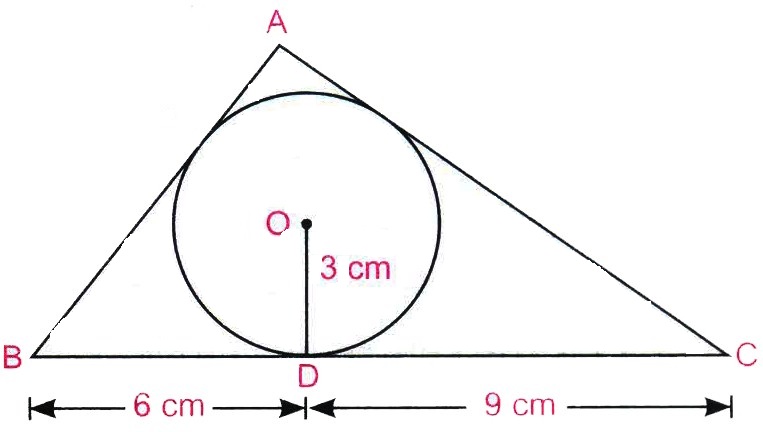
In figure, a triangle ABC is drawn to circumscribe a circle of radius 3cm, such that the segments BD and DC are respectively of lengths 6cm and 9cm.If the area of \(\Delta\)ABC is 54cm2, then find the lengths of sides AB and AC.
9.
The two tangents from an external point P to a circle with centre O are PA and PB.If \(\angle APB=70^0\), what is the value of \(\angle AOB ?\)
10.
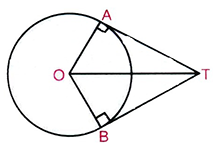
In figure if \(\angle ATO=40^0, find\ \angle AOB.\)
11.
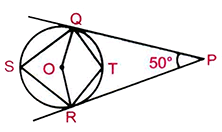
In the figure given below, find \(\angle QSR.\)
12.
Two concentric circles are of radii 6.5 cm and 2.5 cm. Find the length of chord of the larger circle which is tangent to the smaller circle.
13.
At the point of contact the angle between radius and tangent to a circle is 90o.
14.
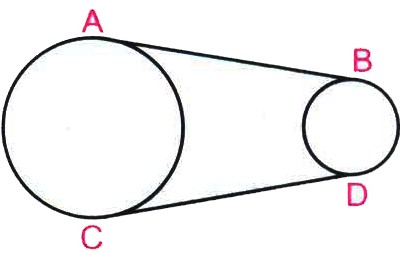
In figure, AB and CD are common tangents to two circles of unequal radii.Prove that AB=CD.
15.
In figure, a triangle ABC is drawn to circumscribe a circle of radius 2cm such that the segments BD and DC into which BC is divided by the point of contact D are the lengths 4cm and 3cm respectively.If area of \(\Delta ABC=cm^2\), then find the lengths of sides AB and AC.
-S.jpg)
16.
Prove that the lengths of the tangents drawn from an external point to a circle are equal.
17.
If the radius of a circle is 5 cm, then find the distance between two parallel tangents.
18.
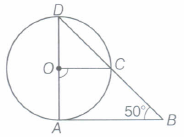
In the given figure, AD is a diameter of a circle with centre 0 and AB is a tangent at A.C is a point on the circle such that DC produced intersects the tangent at Band ㄥABC = 50°. Find ㄥCOA.
19.
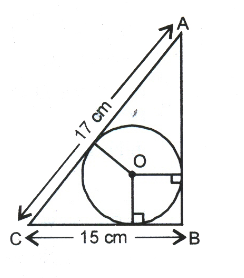
In the given figure, a circle with centre O, inscribed in a right triangle, right-angled at B. If AC = 17 cm, BC = 15 cm, Then find the radius of the circle.
20.
In figure, the sides AB, BC and CA of triangle ABC touch a circle with centre O and radius r at P, Q and R respectively.Prove that
(i) AB + CQ = AC + BQ
(ii)area (\(\Delta\)ABC) = \(1\over2\) (perimeter of \(\Delta\)ABC) x r
-S.jpg)
21.
A circle can have _____________ parallel tangents at the most.
22.
If a line and a circle have no point common, then the line lies ______________
23.
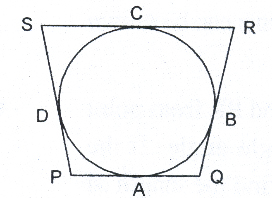
In figure, PQ = 6 cm, QR = 7cm, RS = 4 cm PS = ...........
24.
In figure, value of x is............... .

25.
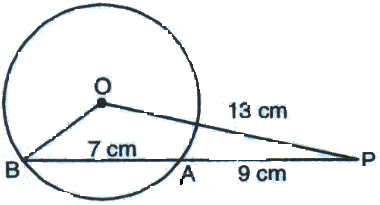
Radius of circle given below is
26.
In the given figure, PA and PB are tangents to a circle from an external point P. Then, PA and PB may or may not be equal.

27.
A circle can have maximum two tangents.
1.
KN = KM + MN
But KM = KA and MN = BN, (\(\because\) tangents drawn from an external point to a circle are equal)
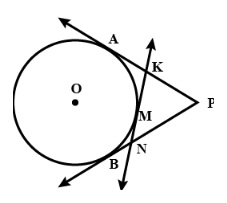
KN = KA + BN
\(\therefore\) Perimeter of \(\triangle PNK\) = PN + KN + PK
= PN + BN + KA + PK
= PB + PA = 2PB,
(\(\because\) PA = PB)
2.
Angle between the radii = 180°- 30° = 150°
(Since the sum of opposite angles = 180°).
3.
5 cm
4.
A line which intersects a circle in two distinct point is called a secant line.
5.
10 cm
6.
37
7.
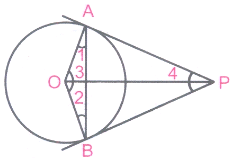
Given: A circle with the centre O. PA and PB are tangents to the circle form a point P.
To prove: (i) PAOB is a cyclic quadrilateral
(ii) Po is the bisector of \(\angle \)APB
(iii) \(\angle \)OAB = \(\angle \)OPA
Proof: PA and PB are tangent to the circle at the point A and B respectively.
⇒ \(\angle \)OAP = \(\angle \)OBP = 90o .....(i)
[Tangent makes 90o angle with the radius at the point of contact]
⇒ \(\angle \)OAP + \(\angle \)OBP = 90o + 90o = 180o ......(ii)
In quadrilateral OAPB,
\(\angle \)AOB + \(\angle \)OAP + \(\angle \)OBP + \(\angle \)APB = 360o
[Angle sum property of a quadrilateral]
⇒ \(\angle \)AOB + \(\angle \)APB + 180o = 360o [From (ii)]
⇒ \(\angle \)APB + \(\angle \)AOB
= 360o + 180o = 180o ....(iii)
From (ii) and (iii), we have
\(\angle \)OAP + \(\angle \)OBP = 180o
and \(\angle \)APB + \(\angle \)AOB = 180o
⇒ Opposite angles of the quadrilateral are supplementary.
⇒ Quadrilateral OAPB is a cyclic quadrilateral.
(ii) In \(\triangle\)OAP and \(\triangle\)OBP
AP = BP [Tangent from the same external point are equal]
OP = OP [common]
OA = OB [Radii of the sama ecircle]
⇒ \(\triangle\)OAP ≅ \(\triangle\)OBP [Using SSS congruency]
⇒ \(\angle \)AOP = \(\angle \)BPO [CPCT]
⇒ PO bisects APB
(iii) \(\angle \)3 + \(\angle \)4 = 180o From (iii)
\(\angle \)1 + \(\angle \)2 + \(\angle \)3 = 180o [Angle sum property] ....(iv)
In \(\triangle\)OAB OA = OB [Radii]
⇒ 1 = 2 [Angles opposite to equal sides of a \(\triangle\) are equal] ......(v)
From (iii) and (iv)
\(\angle \)3 + \(\angle \)4 = \(\angle \)1 + \(\angle \)2 + \(\angle \)3
⇒ \(\angle \)4 = \(\angle \)1 + \(\angle \)2 = \(\angle \)1 + \(\angle \)1 = \(\angle \)2 + \(\angle \)2
\(\angle \)4 = 2\(\angle \)1 = 2\(\angle \)2 [From (v)]
⇒ \(1\over2\)\(\angle \)4 = \(\angle \)1 ⇒ \(\angle \)OPA = \(\angle \)OAB Hence proved
8.
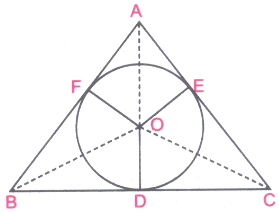
Let AF = x cm
∵ AF = AE = x [tangent from A]
Also BD = BF = 6 cm
and CD = CE = 9 cm
ஃ AB = (6 + x) cm and AC = (9+x)cm
Area \(\triangle\)ABC = Area \(\triangle\)BOC + Area \(\triangle\)COA + Area \(\triangle\)AOB
⇒ 54 = \(1\over2\) BC x OD + \(1\over2\)AC x OE + \(1\over2\)AB x OF
⇒ 54 x 2 = 15 x 3 + (6 + x) x 3 + (9 + x) x 3
108 = 45 + 18 + 3x + 27 + 3x
6x = 18 ⇒ x = 3
⇒ AB = 6 + x = 6 + 3 = 9 cm and
AC = 9 + x = 9 + 3 = 12 cm
9.
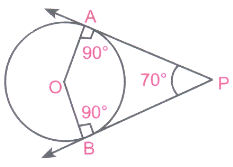
PA and PB are tangent to the circle
\(\angle \)A = \(\angle \)B = 90o
[Tangent makes 90o angle with the radius at the point of contact]
In quadrilateral OAPB
\(\angle \)AOB + \(\angle \)A + \(\angle \)P + \(\angle \)B = 360o
[Angle sum property of a quadrilateral].
⇒ \(\angle \)AOB + 90o + 70o + 90o = 360o
⇒ \(\angle \)AOB + 250o = 360o
⇒ \(\angle \)AOB = 360o - 250o = 110o
10.
In OAT \(\angle \)ATO = 40o, \(\angle \)OAT = 90o
∴ \(\angle \)AOT = 50o [Angle sum property]
Now \(\angle \)BTO = 40o as OT bisects
ஃ \(\angle \)AOB = \(\angle \)AOT + \(\angle \)BOT = 50o + 50o = 100o
11.
In the figure given below, find \(\angle \)QSR.
Given: PQ and PR are tangents to a circle with centre O and
\(\angle \)QPR = 50
To find: QSR
sol. \(\angle \)QOR + \(\angle \)QPR = 180°
⇒ \(\angle \)QOR + 50° = 180°
⇒ \(\angle \)QOR = 130QOR
⇒ \(\angle \)QOR = \(1\over2\) \(\angle \)QSR [Degree measure theorem]
⇒ \(\angle \)QSR = \(1\over2\) x 130° = 65°
12.
Here OA = 6.5 cm and OC = 2.5 cm
\(\therefore \quad AC=\sqrt { { OA }^{ 2 }-{ OC }^{ 2 } } \)
\(=\sqrt { { \left( 6.5 \right) }^{ 2 }-{ \left( 2.5 \right) }^{ 2 } } \)
\(=\sqrt { 42.25-6.25}\) = 6 cm
\(\therefore\) AB = 12 cm
13.
Given: A circle C (O, r) with centre O. AB is a tangent to the circle at the point p.
To Prove: OP ⊥ AB
Const: Take any point Q on AB other than P and join OQ.
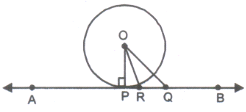
OR > OP .........(ii)
Thus, we find that among all such line segments, the line segment OP is the shortest, which is possible only when OP is perpendicular to AB.
Hence, OP ⊥ AB.
14.
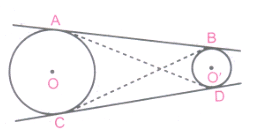
Construction: Join AD and BC
Proof: The tangent drawn from an internal point to a circle are equal in length.
If A is external point for circle hving centre O.
AB = AD .....(i)
If C is external point then
BC = CD .....(ii)
Now, B is external point for circle having centre O
AB = BC .....(iii)
So, from (i), (ii) and (iii), we get
AB = BC = CD
So, AB = CD Hence proved.
15.
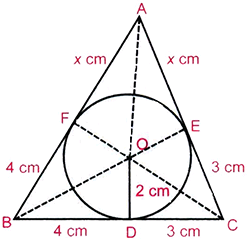
Let AE = AF = x
Length of tangents from an external point are equal
ar \(\triangle\)BOC = \(1\over2\) x 7 x 2 = 7 cm2
ar \(\triangle\)BOC = \(1\over2\)x (4 + x) x2=(4 + x) cm2
ar \(\triangle\)AOC = \(1\over2\) x (3 + x) x 2=(3 + x) cm2
ar \(\triangle\)ABC = \(1\over2\) AOB +ar \(\triangle\)BOC + a r\(\triangle\)AOC
S=\(a+b+c \over2\)
\(=\frac { 4+x+7+3+x }{ 2 } =\frac { 14+2x }{ 2 } =7+x\)
\(ar\Delta ABC=\sqrt { s(s-a)(s-b)(s-c) } \)
\(=\sqrt { (7+x)(7+x-4-x)[7+x-7][7+x-3-x] } \)
\(=\sqrt { (7+x)\times 3\times x\times 4 } =2\sqrt { 3x(7+x) } \)
\(2\sqrt { 3x(7+x) } =4+x+7+3+x\Rightarrow 2\sqrt { 3x(7+x) } \) = 14 + 2x
\(\sqrt { 3x(7+x) } =7+x\Rightarrow 3x(7+x)={ (7+x) }^{ 2 }\)
⇒ 21x+3x2 = 49 +x2 + 14x ⇒ 2x2 + 7x - 49 = 0
⇒ 2x2 + 14x - 7x - 49 = 0 ⇒ 2x(x+7)-7(x+7) = 0
⇒ (2x - 7)(x + 7) = 0 ⇒ x = \(7\over2\), x = -7 [Rejected]
The length of side AB = 4 + 3.5 = 7.5 cm and AC = 3 + 3.5 = 6.5 cm
16.
Let P be any external point from which two tangents PA and PB are drawn to a circle with centre O.
To Prove: PA = PB
Proof : \(\angle OAP=\angle OBP=90\)
(radius is \(\bot\) to tangent)
In \(\triangle APO\) and \(\triangle BPO\),
\(\angle OAP=\angle OBP\) (each 90°)
OA = OB (radius)
OP = OP common
\(\therefore \triangle APO\cong \triangle BPO\) (by RHS)
\(\Rightarrow\) PA = PB (CPCT)
17.
The distance between two parallel tangents is equal to diameter of the circle.
= 10 cm
18.
Since, AD is a diameter of a circle, so AD is perpendicular to the tangent AB.
ㄥDAB =90°
In ΔABD,
ㄥDAB + ㄥABD +ㄥADB = 180°
90° + 50° + ㄥADB = 180°
ㄥADB = 180° -140° = 40°
In ΔODC,
OD = OC [same radii of circle]
ㄥOCD = ㄥCDO = 40°
ㄥDOC + ㄥOCD + ㄥCDO = 180°
ㄥDOC + 40° + 40° = 180°
ㄥDOC = 1,00°
Since, AD is a straight line.
ㄥDOC +ㄥCOA = 180°
100° +ㄥCOA = 180°
ㄥCOA = 80°
19.
3 cm
20.
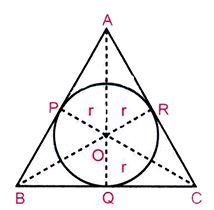
(i) AP = AR [Tangents from A] ...(i)
Similarly, BP = BQ ...(ii)
CR = CQ ...(iii)
Now, ∵ AP = AR
⇒ (AB - BP) = (AC-CR)
⇒ AB + CR = AC+ BP
⇒ AB + CQ = AC + BQ
(ii) Let AB = x, BC =y, AC = z
ஃ Perimeter of \(\triangle\)ABC = x + y + z
Area of \(\triangle\)ABC = [area of AOB + area of BOC + area AOC]
⇒ Area of ABC = AB x OP + x BC x OQ + x AC x OR
Area of ABC = \(1\over2\)X x r + \(1\over2\)y x r + \(1\over2\)z x
\(\Rightarrow\) Area of \(\Delta\)ABC=\(1\over2\)(x+y+z) x r
\(\Rightarrow\) Area of \(\Delta\)ABC=\(1\over2\)(Perimeter of \(\Delta\)ABC) x r
21.
()
two
22.
()
outside the circle.
23.
()
3 cm
24.
()
10 cm
25.
()
5 cm
26.
(b)
27.
(b)

10th Standard CBSE Syllabus & Materials
10th Standard CBSE
CBSE 10th Social Science PS - Federalism - New Model Questions Papers Study Material - QB365 Set A
NEW10th Standard CBSE
CBSE 10th Social Science PS - Power Sharing - New Model Questions Papers Study Material - QB365 Set A
NEW10th Standard CBSE
CBSE 10th Social Science GEO - Manufacturing Industries - New Model Questions Papers Study Material - QB365 Set A
NEW10th Standard CBSE
CBSE 10th Social Science GEO - Minerals and Energy Resources - New Model Questions Papers Study Material - QB365 Set A



CBSE 10th Standard CBSE Subjects
CBSE Standards





