100% FREE ACCESS
10th Standard CBSE Syllabus & Materials
10th Standard CBSE
CBSE 10th Social Science ECO - Globalisation and the Indian Economy - New Model Questions Papers Study Material - QB365 Set A
NEW10th Standard CBSE
CBSE 10th Social Science ECO - Money and Credit - New Model Questions Papers Study Material - QB365 Set A
NEW10th Standard CBSE
CBSE 10th Social Science ECO - Sectors of the Indian Economy - New Model Questions Papers Study Material - QB365 Set A
NEW10th Standard CBSE
CBSE 10th Social Science ECO - Development - New Model Questions Papers Study Material - QB365 Set A
NEW10th Standard CBSE
CBSE 10th Social Science PS - Outcomes of Democracy - New Model Questions Papers Study Material - QB365 Set A
NEW10th Standard CBSE
CBSE 10th Social Science PS - Gender, Religion and Caste - New Model Questions Papers Study Material - QB365 Set A

Published on: 29/12/2018
Class 10 Full Test
Download CBSE Class 10th Standard CBSE Science question papers, sample papers, important questions, and previous year solved papers in PDF format. Get free study materials, NCERT solutions, and exam preparation resources for Class 10th Standard CBSE Science
Questions + Answers key
Take MCQ Science Test
1.
Why is it not easy for carbon to take part in the formation of ionic compounds ?
2.
An element 'M' has atomic number 12.
(a) Write its electronic configuration.
(b) State the group to which 'M' belongs.
(c) State the group to which 'M' belongs.
(c) Is 'M' a metal or a non-metal?
(d) Write the formula of its oxide.
3.
What will happen to grasslands if all the grazers are removed from there?
4.
Suggest any four activities in daily life which are eco-friendly.
5.
How do organisms, whether reproduced asexually or sexually maintain a constant chromosome number through several generation? Explain with the help of suitable example.
6.
How is the sex of a newborn determined in humans?
7.
What is meant by a saturated hydrocarbon?
8.
State a reaction in which SO2 acts as an oxidising agent.
9.
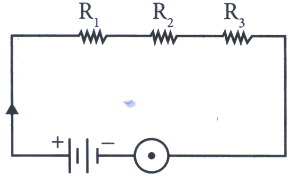
You are given a hammer, a battery, a bulb, wires and a switch :
(a) How could you use them to distinguish between samples of metals and non-metals?
(b) Assess the usefulness of these tests in distinguishing between metals and non-metals.
10.
Write balanced chemical equations for each of the following reactions and also classify them.
(a) Lead acetate solution is treated with dilute hydrochloric acid to form lead chloride and acetic acid solution.
(b) A piece of sodium metal is added to absolute ethanol to form sodium ethoxide and hydrogen gas.
(c) Iron (III) oxide on heating with carbon monoxide gas reacts to form solid iron and liberates carbon dioxide gas.
(d) Hydrogen sulphide gas reacts with oxygen gas to form solid sulphur and liquid water.
11.
A man went door to door posing to be a goldsmith. He promised to bring back the glitter of old and dull gold ornaments. An unsuspecting lady gave a set of gold bangles to him which he dipped in a particular solution. The bangles sparkled like new but their weight was reduced drastically. The lady was upset but after a futile argument, the man beat a hasty retreat.
(i) Can you play the detective to find out the nature of the solution he had used?
(ii) What is 24 carat gold?
12.
An object 5 cm in length is held 25 cm away from a converging lens of focal length 10 cm. Draw the ray diagram and find the position, size and the nature of the image formed.
13.
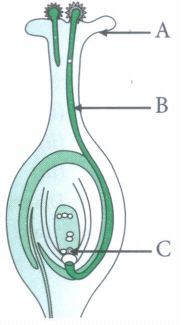
(a)Identify A, B and C in the given diagram and write their functions.
(b)Mention the role of gamete and zygote in sexually reproducing organisms.
14.
State the reason why carbon can neither form C4+ cations for C4- anions, but forms covalent compounds. Also state reasons to explain why covalent compounds:
(a) are bad conductors of electricity?
(b) have low melting and boiling points
15.
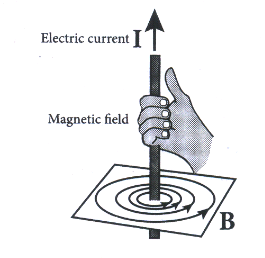
With the help of a labelled circuit diagram illustrate the pattern of field lines of the magnetic field around a current carrying straight long conducting wire. How is the right hand thumb rule useful to find direction of magnetic field associated with a current carrying conductor?
16.
Explain the important of soil for plant growth.
17.
For making cake, baking powder is taken. If at home your mother uses baking soda instead of baking powder in cake,
(a) How will it affect the taste of the cake and why?
(b) How can baking soda be converted into baking powder?
(c) What is the role of tartaric acid added to baking soda?
18.
What happens when:
(i) Dilute hydrochloric acid is added to solid sodium carbonate.
(ii) Quicklime is treated with water.
(iii) Sodium chloride solution is added to lead nitrate solution.
Also write the chemical equation in each case.
19.
Name the three products of 'chlor-alkali' process. Write one commercially or industrially important material each that can be prepared from each of these products
20.
State reason for the following:
(i) Non-metals cannot displace hydrogen from the acids.
(ii) Hydrogen is not a metal, yet it is placed in the activity series of metals.
(iii) Aluminium is more reactive than iron, yet its corrosion is less than that of iron
21.
(i) Giving a reason for each, state which of the following will conduct electricity and which will not:
(a) A solution of glucose
(b) Dil. Hydrochloric acid?
(ii) If acetic acid and hydrochloric acid of same concentration are taken, which of the two is,1 stronger acid and why?
(iii) How is the strength of an acid affected when some water is added to it?
22.
List three properties of sodium in which it differs from the general physical properties of most metals.
23.
Distinguish between an electric motor and generator?
24.
What is 'translocation'? Why is it essential for plants?Where in plants are the following synthesized:
(i)Sugar (ii)Hormones
25.
(a) What is a 'solar cell'?
(b) Why is biogas considered an ideal fuel for domestic use?
(c) Name a device in which controlled chain reaction is used.
26.
Give the differences between series and parallel connections of resistors.
27.
Two lamps, one related 60W at 220 W at 220V and the other 40 W at 220 V, are connected in parallel to the electric supply at 220V.
(a) Draw a circuit diagram to show the connections.
(b) Calculate the current drawn from the electric supply.
(c) Calculate the total energy consumed by the two lamps together when they operate for one hour.
28.
(i) An aqueous solution has a pH value of 7.0. Is this solution acidic, basic or neutral?
(ii) If H+ concentration of a solution is \(1\times 10^{-2}\ mol\ L^{-1},\) what is the pH value for it?
(iii) Which has a higher pH value, 1 M HCl or 1 M NaOH solution?
29.
Energy from various sources is considered to have been derived from the sun. do you agree? Justify your answer.
1.
In order to form ionic bond, carbon atom either has to lose four electrons to form C4+ ion or gain four electrons to form C4- ions.
The loss or gain of four electrons is not easy for carbon since energy needed is very high.
2.
(a) 2, 8, 2
(b) Group 2
(c) 'M' is a metal
(d) 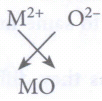
MO is formula of its oxide
3.
If all the grazers are removed from grassland, grass will grow from grassland, grass will grow unchecked. It may help the growth of some organisms harmful to the animals and the animals which feed on the grazers will die of starvation. The biogeochemical cycle will stop and the whole biosphere will get disturbed.
4.
(a) Walking and cycling for commute.
(b) Using jute/cloth shopping bag.
(c) using public transport.
(d) Switching off light/fans in unoccupied rooms.
5.
1. When organisms reproduce asexually, only mitotic divisions are involved and the chromosome number remains the same. During asexual reproduction the DNA. (in the chromosomes) of the cells involved are copied and then equally divided among the two daughter cells formed. Thus, chromosome number remains unchanged.
2. In sexual reproduction, organisms produce gametes through a special type of division, meiosis-reductional division, in which the original number of chromosomes becomes half. These two gametes combine to form the zygote and the original number of chromosomes is restored. In sexual reproduction specialized cells/germ cells with only half the number of chromosomes are formed. When these germ cells from two individuals combine to form a new individual, the original chromosome number is restored.
3. Example: In humans, the parents father and mother each have 46 or 23 pairs of chromosomes. In the gametes - the sperm has half the number of chromosomes i.e., 23and the egg also has 23 chromosomes, when the sperm and the egg fuse, the zygote has 46 or 23 pairs of chromosomes. Thus, the chromosome number remains constant.
6.
The sex of the individual is genetically determined from parents. A new born who inherits an 'X' chromosome from father will be a girl and one who inherits a 'Y' chromosome will be a boy.
7.
Those hydrocarbons in which valency of carbon is satisfied by single bonds only are called saturated hydrocarbons.
8.
Sulphur dioxide oxidises hydrogen sulphide (H2 S) to sulphur (S).
SO2(g)+2H2S(aq)→3S(s)+2H2O(I)
9.
(i) (a) Take the given samples of metals and non-metals; and strike them with the hammer. If it converts into a sheet, it is a metal and if not, it is non-metal. Metals are malleable, non-metals are not.
(b) If it produces sound when struck with the hammer, it is a metal. Metals are sonorous. But if it does not produce a sound, it is non-metal.
(c) Now arranging the given objects to form an electric circuit.
Insert any one sample between clips A and B. If the bulb glows, it is a metal (good conductor of electricity). If the bulb does not glows, it is a non-metal.
(ii) From the above tests, it is clear that metals are generally malleable, sonorous and good conductors of electricity while non-metals are generally non-malleable/brittle, non-sonorous and poor conductors of electricity.
10.
(a) \(\underset{Lead\ acetate}{Pb(CH_3COO)_2}+\underset{Hydrochloric\ acid}{2HCl}\rightarrow\underset{Lead\ chloride}{PbCl_2}+\underset{Aceti}{2CH_3COOH}\)
It is a double displacement reaction .
(b) \(\underset{sodium}{2Na}+\underset{Ethanol}{2C_2H_5ONa}+\underset{Hydrogen}{H_2}\)
It is a displacement reaction.
(c) \(\underset{Ferric\ oxiside}{Fe_2O_3(s)}+\underset{Carbon\ monoxide}{3CO(s)}\rightarrow\underset{Iron}{2Fe(s)}+\underset{Carbon\ dioside}{3CO_2(g)}\)
It is a redox reaction.
(d) \(\underset{Hydrogen\ sulphate}{2H_2S(g)}+\underset{Oxygen}{O_2(g)}\rightarrow\underset{sulphur}{2S(s)}+\underset{Water}{2H_2O(l)}\)
It is a redox reaction.
11.
(i) The nature of the solution is acidic. It is a mixture of conc. HNO3, and conc. HCI in the ratio of 1 : 3. It can dissolve gold as it is an oxidising agent.
(ii) Pure gold is 24 carat gold which is very soft.
12.
Object distance, u = -25 cm, Object height, h = 5 cm, Focal length, f = +10 cm Substituting the values in the lens formula,
\(\frac { 1 }{ u } +\frac { 1 }{ v } =\frac { 1 }{ f } \)
We get v = 16.66 cm
The positive value of v shows that the image is formed at the other side of the lens.
Magnification =\(\frac { h' }{ h } =-\frac { v }{ u } \) =-16.66/25=-0.66
The negative sign shows that the image is real and formed behind the lens.
Magnification m=\(\frac { h' }{ h } \)
h' =-3.3 cm
The negative value of image height indicates that the image formed is inverted. The position, size, and nature of image are shown in the following ray diagram.
-S.png)
13.
(a) A - Stigma: The top part of carpel is called stigma. Stigma is for receiving the pollen grains from the anther of stamen during pollination.
B - Pollen tube: When a pollen grain falls on the stigma, it bursts open and grows a pollen tube downward through the style towards the female gamete in the ovary. A male gamete moves down the pollen tube.
C - Female gamete (ovum): It is a special reproductive female sex cell which combines with male gamete to form zygote.
(b) Sexual reproduction takes place by the combination of special reproductive cells called sex cells. These cells are of two types male sex cells and female sex cells, which are coming from two different parents a male and a female. The cells involved in sexual reproduction are called gametes. In sexual reproduction, a male gamete fuses with a female gamete to form a new cell called zygote. This zygote then grows and develops into a new organism in due course of time.
14.
Carbon atoms have 4 electrons in their outcomes shell. So need to gain or lose electrons to attain noble gas configuration.
(i) It could gain four electrons forming c4- anion. But it would be difficult for the nucleus with six protons to hold on to ten electrons.
(ii) It could lose four electrons forming C4+ cations. But it would require a large amount energy to remove four electrons from its outermost shell.
Because of these reasons, carbon shares its valence electrons to complete its octet with other atoms to form covalent bonds.
(a) Covalent compounds are bad conductors of electricity because they do not contain ions.
(b) Covalent compounds have usually low melting and boiling because they are made up of electronically neutral molecule. So the force of attraction between the molecules of a covalent compound is very weak. Only a small amount of heat energy is required to break these weak molecular forces, due to which covalent compounds have low melting and boiling points.
15.
The following diagram depicts the pattern and direction of magnetic field lines around a straight current-carrying conductor.
Right Hand Thumb Rule: If a current carrying conductor is held by right hand, keeping the thumb straight and if the direction of electric current is in the direction of thumb, then the direction of wrapping of other fingers will show the direction of magnetic field.
16.
(i)Anchoring the plant
(ii)Source of water and minerals
(iii)Availability of oxygen for respiration of root cells
(iv)Symbiotic association with microbes.
17.
(a) Baking soda is sodium hydrogen carbonate. On heating, it is converted carbonate. On heating, it is converted into sodium carbonate which is bitter to taste.
\(2NaHCO_3\xrightarrow{Heat}Na_2CO_3+H_2O+CO_2\)
(b) Baking soda can be converted into baking powder by the addition of appropriate acid to it.
(c) The role of tartaric acid is to neutralise sodium carbonate and cake will not taste bitter.
18.
(i) Na2CO3(s) + 2HCl(aq) \(\longrightarrow \) 2NaCI(aq) + H2O(I) + CO2(g)
(ii) CaO(s) + H2O(I) \(\longrightarrow \)Ca(OH)2(aq) + Heat
(iii) Pb(NO3)2(aq) + NaCl(aq) \(\longrightarrow \) PbCI2(s) + 2NaNO3(aq)
19.
The three products are:
Sodium hydroxide (NaOH), Chlorine (CI2) and Hydrogen (H2).
NaOH - for soaps and detergents and paper making or artificial fibers.
Cl2- PVC, pesticides, CFCs.
H2- fuels, margarine, NH3 for fertilizers.
20.
(i) Non-metals are electron accepters, they cannot supply electrons so as to convert H+ ion to H2(g).
(ii) Like metals, hydrogen can lose an electron to form positive H+ ion.
(iii) Aluminium is covered with a strong protective layer of oxide which protects the metal from further corrosion.
21.
(i) (a) A solution of glucose will not conduct electricity because it does not have ions.
(b) Oil. HCl will conduct electricity because it produces H+ ions in water.
(ii) HCI is stronger because it gives rise to more H+ ions than acetic acid.
(iii) The strength of the acid decreases.
22.
Three properties of sodium are:
(i) Sodium is so soft that it can be cut with a knife.
(ii) It has low density.
(iii) It has low melting point.
23.
The major differences between an electric motor and generator are stated below:
Electric Motor:
1. It converts electrical energy into mechanical energy.
2. It needs electrical energy for its works.
3. They are used as water pumps, marble grinders etc.
Generator:
1. It converts mechanical energy into electrical energy
2. It needs mechanical energy for its working.
3. They are used as water pumps, marble grinders etc.
4. diesel generator, hydro-electric generator are the examples of it.
24.
The transport of soluble products of photosynthesis is known as translocation. Translocation in plants occurs by means of the vascular tissue known as phloem. Translocation is necessary because without it, the food prepared by the leaves cannot reach other parts of the plant.
(i)In plants, the synthesis of sugars takes place in the leaves by the process of photosynthesis.
(ii)Hormones are synthesised away from their targrt site.
25.
(a) A solar cell is a device which converts solar energy into electricity. It is a sandwich of a silicon-boron layer and a silicon-arsenic layer.
(b) Biogas is an ideal fuel for domestic use because it is a cheap and clean fuel, which does not leave behind any residue.
(c) A nuclear power plant is a device in which controlled chain reaction is used.
26.
| Series connection | Parallel connection |
| 1. The potential difference (V) across the combination of resistors connected in series is equal to the sum of all the individual potential differnece. | The potential difference across all resistors in parallel connection remains constant. |
|
2. Current (I) remains the same. |
Current (I) will be different for different resistor.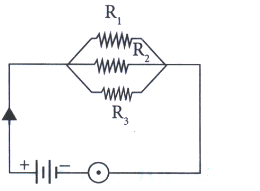 |
| 3. The resistance will be the sum of all the resistors in the circuit. Rs = R1 + R2 + R3. |
Total resistance will be given as \(\frac { 1 }{ { R }_{ p } } =\frac { 1 }{ { R }_{ 1 } } +\frac { 1 }{ { R }_{ 2 } } +\frac { 1 }{ { R }_{ 3 } } \) |
| 4. Equivalent resistance is high. | Equivalent resistance is less than each resistor. |
27.
(a)
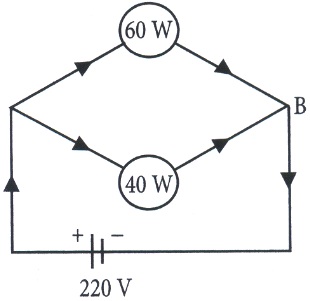
(b) Electric current flowing through a bulb = \(\frac { Power\quad of\quad the\quad bulb }{ Voltage\quad across\quad the\quad bulb } \)
\(i.e.,\quad I=\frac { P }{ V } \)
Therefore, \({ I }_{ 60 }=\frac { 60W }{ 220V } =\frac { 3 }{ 11 } A\quad and\quad { I }_{ 40 }=\frac { 40W }{ 220V } =\frac { 2 }{ 11 } A\)
Therefore, total current flowing through the circuit \(={ I }_{ 60 }+{ I }_{ 40 }=\frac { 3 }{ 11 } +\frac { 2 }{ 11 } =\frac { 5 }{ 11 } A=0.45A\)
(c) Total energy consumed = Power \(\times \) Time
That is, E = P \(\times \) T
= (40W+60W)\(\times \)1h
= 100 Wh
= 0.1 kWh
28.
(i) An aqueous solution with pH value 7.0 is neutral in nature.
(ii) The pH value is given by the formula:
\(pH=-log[H^+]\)
\(pH+-(-2)\ log\ 10\)
or, pH = 2
(iii) 1 M NaOH solution has a higher pH value. This because \(pH=-log[H^+]\ NaOH\) dissociates to give hydroxyl ion, not hydrogen ions. On the other hand, HCl is a strong acid and dissociates to give hydrogen ions.
29.
i) All fossil are the remains of the prehistoric plants and animals. Th energy of the fossil fuels is in fact that solar energy which was trapped by natural processes a long time ago.
ii) Solar energy also appears in the form of energy of water flowing in rivers as is obvious from the water cycle in nature. It is this energy which generates in hydroelectric power plants.
iii) Biomass energy is also the solar energy absorbed by the plans which convert it into chemical energy through photosynthesis.
iv) Human and animals use bioenergy to carry out their life activities.
v) Solar energy is one of the main factors responsible for the movement of air in the atmosphere leading to wind energy.
vi) Solar energy is used directly in solar.

10th Standard CBSE Syllabus & Materials
10th Standard CBSE
CBSE 10th Social Science PS - Federalism - New Model Questions Papers Study Material - QB365 Set A
NEW10th Standard CBSE
CBSE 10th Social Science PS - Power Sharing - New Model Questions Papers Study Material - QB365 Set A
NEW10th Standard CBSE
CBSE 10th Social Science GEO - Manufacturing Industries - New Model Questions Papers Study Material - QB365 Set A
NEW10th Standard CBSE
CBSE 10th Social Science GEO - Minerals and Energy Resources - New Model Questions Papers Study Material - QB365 Set A



CBSE 10th Standard CBSE Subjects
CBSE Standards