
 100% FREE ACCESS
10th Standard CBSE Syllabus & Materials
10th Standard CBSE
CBSE 10th Social Science ECO - Globalisation and the Indian Economy - New Model Questions Papers Study Material - QB365 Set A
NEW10th Standard CBSE
CBSE 10th Social Science ECO - Money and Credit - New Model Questions Papers Study Material - QB365 Set A
NEW10th Standard CBSE
CBSE 10th Social Science ECO - Sectors of the Indian Economy - New Model Questions Papers Study Material - QB365 Set A
NEW10th Standard CBSE
CBSE 10th Social Science ECO - Development - New Model Questions Papers Study Material - QB365 Set A
NEW10th Standard CBSE
CBSE 10th Social Science PS - Outcomes of Democracy - New Model Questions Papers Study Material - QB365 Set A
NEW10th Standard CBSE
CBSE 10th Social Science PS - Gender, Religion and Caste - New Model Questions Papers Study Material - QB365 Set A

Published on: 01/08/2018
From the chapter The Human Eye and the Colourful World, some of the important questions are covered in this question paper. The questions are covers from the Higher Order Thinking Questions and Value based questions.
Download CBSE Class 10th Standard CBSE Science question papers, sample papers, important questions, and previous year solved papers in PDF format. Get free study materials, NCERT solutions, and exam preparation resources for Class 10th Standard CBSE Science
Questions + Answers key
Take MCQ Science Test
1.
A prism ABC (with BC as base) is placed in different orientations. A narrow beam of white light is incident on the prism as shown in Figure. In which of the following cases, after dispersion, the third colour from the top corresponds to the colour of the sky?
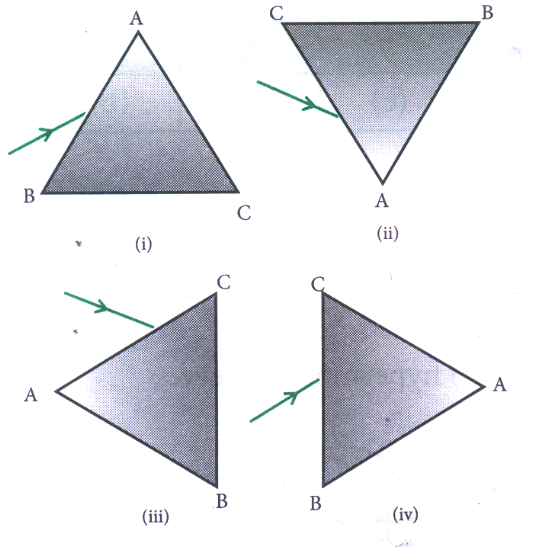
(i)
(ii)
(iii)
(iv)
2.
The focal length of the eye lens increases when eye muscles
are relaxed and lens becomes thinner
contract and lens becomes thicker
are relaxed and lens becomes thicker
contract and lens becomes thinner
3.
The bluish colour of water in deep sea is due to
the presence of algae and other plants found in water
reflection of sky in water
scattering of light
absorption of light by the sea
4.
The danger signals installed at the top of tall buildings are red in colour. These can be easily seen from a distance because among all other colours, the red light
is scattered the most by smoke or fog
is scattered the least by smoke or fog
is absorbed the most by smoke or fog
moves faster in air
5.
Which of the following statements is correct regarding the propagation of light of different colours of white light in air?
Red light moves fastest
Blue light moves faster than green light
All the colours of the white light move with the same speed
Yellow light moves with the mean speed as that of the red and the violet light
6.
A student sitting on the bench can read the letters written on the blackboard but is not able to read the letters written in his text book. Which of the following statement is correct?
The near point of his eyes has receded away
The near point of his eyes has come closer to him
The far point of his eyes has come closer him
The far point of his eyes has receded away
7.
The change in focal length of eye lens is caused by action of
Pupil
Retina
Ciliary muscles
Iris
8.
The human eye forms the image of an object at its
Cornea
Iris
Pupil
Retina
9.
The human eye can focus objects at different distances by adjusting the focal length of the eye lens. This is due to
Presbyopia
Accommodation
Near sightedness
Far sightedness
10.
(a)What is meant by the power of accommodation of an eye?
(b)A person with a myopic eye cannot see objects beyond 1.2m directly. What should be the type of the correction lens used? What would be its power?
11.
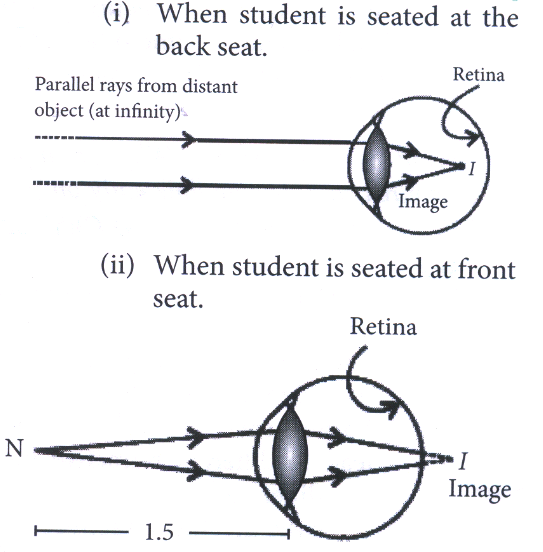
Student sitting at the back bench in a class in not able to see what is written on the blackboard. He however, sees it clearly when sitting on the front seat at an approximate distance of 1.5m from the blackboard. Draw ray diagrams to illustrate the image formation of the blackboard when he is seated at the (i) back seat (ii) front seat.
12.
Give reasons:
(i)The extent of deviation of a ray of light on passing through a glass prism depends on its colour.
(ii)Lights of red colour are used for danger signals.
13.
What is meant by the term 'power of accommodation' of human eye? How does it help a person to see nearby as well as distant object clearly.
14.
What is the nature of image formed on the retina?
15.
What is the least distance of distinct vision of a normal human eye?
16.
What will be the colour of the sky, when it is observed from a place in the absence of any atmosphere? Why?
17.
As light rays pass from air to glass prism, are they reflected towards or away from normal?
18.
Why do different colours deviate through different angles on passing through a prism?
19.
What is the difference in colours of the Sun observed during sunrise/sunset and noon? Give explanation for each
20.
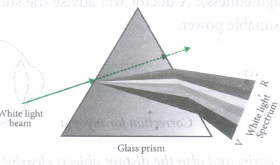
Draw a ray diagram showing through a prism when a narrow beam of white light is incident on one of its refracting surfaces. Also indicate the order of the colours of the spectrum obtained.
21.
Mention few important features of visual system of a person?
22.
Why do stars twinkle?
23.
(a)Write the function of each of the following parts of human eye:
cornea; iris; crystalline lins; ciliary muscles
(b)Millions of people of the developing countries of the work are suffering from corneal blindness. These persons can be cured by replacing the defective cornea with the cornea of a donated eye. A charitable society of your city has organised a campaign in your neighbourhood in order to create awareness about this fact. If you are asked to participate in this mission how would you contribute in this noble cause?
(i)State the objective of organising such campaigns.
(ii)List two arguments which you would give to motivate the people to donate their eyes after death.
(iii)List two values which are developed in the persons who actively participate and contribute in such programmes.
24.
(a)Explain the following terms used in relation to defects in vision and correction provided by them:
(i)Myopia (ii)Astigmatism
(iii)Bifocal lenses (iv)Far-sightedness.
(b)Why is the normal eye unable to focus on an object placed within 10cm from the eye?
1.
(b)
(ii)
2.
(a)
are relaxed and lens becomes thinner
3.
(c)
scattering of light
4.
(b)
is scattered the least by smoke or fog
5.
(c)
All the colours of the white light move with the same speed
6.
(a)
The near point of his eyes has receded away
7.
(c)
Ciliary muscles
8.
(d)
Retina
9.
(b)
Accommodation
10.
(a) The ability of eye lens to adjust its focal length to form the sharp image of the object at varying distances on the retina is called its power of accommodation.
(b)v = 1.2 m= -120 u = \(\infty\)
P of the corrective lens=?
Bye lens formula
\({1\over v}-{1\over u}={1\over f}\)
\(\Rightarrow\ {1\over -120}-{1\over \infty}={1\over f}\)
\(\Rightarrow\ {-1\over 20}-0={1\over f}\left(\therefore{1\over \infty}=0 \right)\)
\(\Rightarrow\ {-1\over 120}={1\over f}\)
\(\therefore\ f=-120cm\)
Thus the corrective lens for the above defect is concave lens (as focal length has - ve sign) of focal length of 120 cm
(c)\(P={1\over f(in\ metres)}={1\times 100\over -120}=-0.83D\)
11.
12.
(i)Refractive index of a medium is different for colour of light
(ii)Due to large wavelength, red colour is least scattered and travel to large distance.
13.
(a) The ability of eye lens to adjust its focal length to form the sharp image of the object at varying distances on the retina is called its power of accommodation.
(b) When we see the nearby object the cillary muscles contract, it increases the thickness of eye lens. The eye lens then becomes thicker. As a result the focal length of eye lens decreases in such a way that the clear sharp image of nearby object is formed on the retina. Thus, the object is seen clearly to us. When we see the distant object these muscles becomes relaxed, thus the eye lens becomes thinner, and consequently focal length of the lens increases. Therefore, the parallel rays coming from the distant object are focused on the retina and object is seen clearly to us Thus the accommodation power of an eye helps a person to see nearby as well as distant objects clearly
14.
Real and inverted.
15.
25cm
16.
Since there is no atmosphere, there would be no scattering of light. Hence the colour of the sky will be dark.
17.
Towards the normal
18.
Different colours travel through prism with different speeds and have different refractive index
19.
During sunrise/sunset, the looks reddish. This is because at this because at this stage, rays from the sun have to travel a much larger part of atmosphere. The red colour having largest wavelength is scattered the least.
At noon, the sun is nearly overhead. The sunlight has to pass through much smaller portion of earth's atmosphere the scattering is much less and the sun looks white.
20.
21.
(i) The structures of the eye such as cornea, pupil, ciliary muscles, eye lens, aqueous humour and vitreous humour etc.,
(ii) The retina of the eye which converts light signals to electrical impulses and
(iii) Optic nerve that transmit electrical impulses to brain.
22.
Stars twinkle due to atmospheric refraction of starlight. The starlight passes through different layers of atmospheric medium of gradually changing refractive index. So, it is refracted multiple times. As the apparent position of star and the physical condition of the earth's atmosphere are not constant the amount of starlight entering the eye flickers and gives a twinkling effect.
23.
(a) Functions of the following parts of human eye:
(i) Comea: Objects enters the eye through cornea.
(ii) Iris: Iris controls the size of the pupil.
(iii) Crystalline lens: It focuses the image of the object on the retina.
(iv) Ciliary muscles: Ciliary muscles hold the eye lens and change the thickness of eye lens while focussing.
(b) (i) Objective of such campaigns. To make people aware of corneal blindness and make them realise their duties towards the society by taking pledge for eye donation.
(ii) (a) One pair of eyes can give eyesight to two corneal blind persons and make them see this beautiful world.
(b) Our eyes can live even after our death. People belonging to all age groups, even people with medical conditions like cataract, diabetes, hypertension can donate their eyes.
(iii) Values developed in persons who actively participate in such programmes:
(a) Concern for others and social welfare.
(b) Responsible behaviour and awareness.
24.
(a) (i) Myopia: Short-sightedness is caused due to excessive is caused due to excessive curvature in cornea or elongation of eyeball. Image is formed before of the retina. So, a concave lens is used to correct it.
(ii) Astigmatism: The inability to focus the light n both vertical and horizontal lines is called astigmatism. It is caused due to varying curvature in lens both horizontally and vertically. It is corrected by using cylindrical lens.
(iii) Bifocal lenses: These are used to correct presbyopic eye. These contain lenses with upper concave and lower convex surface. Presbyopia arises with age.
(b) The focal length of the lens cannot be changed up to an extent that objects nearer than 25 cm can be viewed. So it is not able to focus for 10 cm.

10th Standard CBSE Syllabus & Materials
10th Standard CBSE
CBSE 10th Social Science PS - Federalism - New Model Questions Papers Study Material - QB365 Set A
NEW10th Standard CBSE
CBSE 10th Social Science PS - Power Sharing - New Model Questions Papers Study Material - QB365 Set A
NEW10th Standard CBSE
CBSE 10th Social Science GEO - Manufacturing Industries - New Model Questions Papers Study Material - QB365 Set A
NEW10th Standard CBSE
CBSE 10th Social Science GEO - Minerals and Energy Resources - New Model Questions Papers Study Material - QB365 Set A



CBSE 10th Standard CBSE Subjects
CBSE Standards





