
 100% FREE ACCESS
11th Standard CBSE Syllabus & Materials
11th Standard CBSE
CBSE 11th Economics PART-A - Presentation of Data - New Sample Question Papers Study Material - QB365 Set A
NEW11th Standard CBSE
CBSE 11th Economics PART-A - Organisation of Data - New Sample Question Papers Study Material - QB365 Set A
NEW11th Standard CBSE
CBSE 11th Economics PART-A - Collection of Data - New Sample Question Papers Study Material - QB365 Set A
NEW11th Standard CBSE
CBSE 11th Economics PART-A - Introduction to Economics and Statistics - New Sample Question Papers Study Material - QB365 Set A
NEW11th Standard CBSE
CBSE 11th Business Studies International Trade Sample Question Papers Study Material - QB365 Set A
NEW11th Standard CBSE
CBSE 11th Business Studies Evolution and Fundamentals of Business Sample Question Papers Study Material - QB365 Set A

Published on: 30/12/2018
Class 11 Model Question
Download CBSE Class 11th Standard CBSE Physics question papers, sample papers, important questions, and previous year solved papers in PDF format. Get free study materials, NCERT solutions, and exam preparation resources for Class 11th Standard CBSE Physics
Questions + Answers key
Take MCQ Physics Test
1.
How much stronger nuclear force is compared to electromagnetic force?
2.
How does Young's modulus change with rise in temperature?
3.
Why does the clouds float in the sky?
4.
Two sound waves produce 12 beats in 4s. By how much do their frequencies differ?
5.
The equation of a wave travelling on a string stretched along the X -axis is given by Y = ke - ( \(\frac{x}{b}\) + \(\frac{t}{T}\) )\(^2\) Where , is the maximum of the pulse located at t = T? At t = 2T?
6.
What are the basic properties required by a system to oscillate?
7.
A spring compressed by 0.1 m develops a restoring force 10 N. A body of mass 4 kg placed on it . Deduce
(i) the force constant of the spring
(ii) the depression of the spring under the weight of the body (take g=10 N/kg)
(iii) the period of oscillation, the body is distributed and
(iv) the frequency of oscillation
8.
How an adiabatic can be carried practically?
9.
Can we boil water inside in the earth satellite?
10.
Three vessels have same base area and different neck area. Equal volume of liquid is poured into them, which will possess more pressure at the base?
11.
A spherical planet has mass \({ M }_{ P }\)and diameter \({ D }_{ P }\).A particle of mass m falling freely near the surface of this planet will experience an acceleration due to gravity, equal to whom?
12.
Does the speed of a satellite remain constant in a particular orbit(circular)?
13.
A wheel of moment of inertia 50 kg-m2 about its own axis is revolving at a rate of 5 revolutions per second. What is its angular momentum?
14.
Calculate the kinetic energy of a body of mass 0.1 kg, if lenear momentum is 20 kg-m/s.
15.
Why are porcelain objects wrapped in paper or straw before packing for transportation ?
16.
A bullet fired at an angle of 30o with the horizontal hits the ground 3 km away. By adjusting its angle of projection, can one hope to hit a target 5 km away? Assume the muzzle speed to be fixed, and neglect air resistance?
17.
Which of the following is true for displacement ?
(i) It cannot be zero .
(ii) Its magnitude is either less than or equal to the distance travelled by the object.
18.
Explain this common observation clearly : If you look out of the window of a fast moving train, the nearby trees, houses etc. seem to move rapidly in a direction opposite to the train’s motion, but the distant objects (hill tops, the Moon, the stars etc.) seem to be stationary. (In fact, since you are aware that you are moving, these distant objects seem to move with you).
19.
Name some physical quantities which are dimensionless.
20.
A particle of mass 0.8 kg is executing simple harmonic motion with an amplitude of 1.0 metre and periodic time \(\frac{11}{7}\)sec. Calculate the velocity and the kinetic energy of the particle at the moment when its displacement is 0.6 metre.
21.
Determine the force required to double the length of a steel wire of area of cross-section 5 x 10⁻⁵m2. Young's modulus of steel =2 x 10¹¹ Nm-2.
22.
Transverse waves are generated in two uniform steel wires A and B of diameters 10-3 m and 0.5 \(\times\) 10-3 m respectively, by attaching their free end to a vibrating source of frequency 500 Hz. Find the ratio of the wavelengths if they are stretched with the same tension.
23.
Derive the condition of floatation of a body.
24.
A black body at 2000 K emits maximum energy at a wavelength of 1.56 um. At what temperature will it emit maximum energy at a wavelength of 1.8 um?
25.
Menu is student of class XIth. Suddenly she think to do an experiment. She take two vessel A and B. In the vessel A contains hydrogen and another vessel B whose volume is twice of A contains same of oxygen at the same temperature. She get some result from her experiment.
(i) The ratio of average kinetic energies of hydrogen and oxygen molecules
(ii) The ratio of root-mean-square speeds of hydrogen and oxygen molecules
(iii) According to you what value were displayed by Menu.
26.
A meteor is falling. How much gravitational acceleration would it experience when its height from the surface of the earth is equal to three times the radius of the earth?
27.
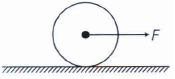
uniform disc of radius R is resting on a table on its rim. The coefficient of friction between disc and table is \(\mu \)(figure). Now, the disc is lled with a force F as shown in the figure. What is the maximum value of F for which the disc rolls without slipping?
28.
A cricket ball is thrown at a speed of 28 m s–1 in a direction 30° above the horizontal. Calculate (a) the maximum height, (b) the time taken by the ball to return to the same level, and (c) the distance from the thrower to the point where the ball returns to the same level.
29.
In the relation \(p=\left( a/b \right) { e }^{ -\left( az/\theta \right) }\)p is the pressure, Z is the distance and \(\theta \) is the temperature. What is the dimensional formula of p?
30.
The coefficient of apparent expansion of a liquid when determined using two different vessels A and Bare \(\gamma\)l and \(\gamma\)2 respectively. If the coefficient of linear expansion of vessel A is a, find the coefficient of linear expansion of vessel B.
31.
A SONAR system fixed in a submarine operates at a frequency 40.0 KHz. An enemy submarine of 360 km/h. What is the frequency of sound reflected by the submarine? Take the speed of sound in water to be 1450 \({ ms }^{ -1 }\)
32.
At a point above the surface of the earth, the gravitational potential is \(-5.12\times { 10 }^{ 7 }\ J/kg\) and the acceleration due to gravituy is 0.4 m/s2 .Assuming the mean radius of the earth to be 6400 km, calculate the height of the point above the earth's surface.
33.
A block of mass 15 kg is placed on a long trolley. The coefficient of static friction between the block and the trolley is 0.18.The trolley accelerates from rest with 0.5m/s2 for 20s and then moves with uniform velocity. Discuss the motion of the block as viewed by
(i) stationary observer on the ground.
(ii) an observer moving with the trolley
34.
The frequency\('\nu '\)of vibration of stretched string depends upon
(i) its length l,
(ii) its mass per unit length 'm' and
(iii) the tension T in the string
Obtain dimensionally an expression for frequency \(\nu \)
1.
()
A strong nuclear force is 100 times stronger than the electromagnetic force in strength.
2.
Young's modulus of a material decreases with rise in temperature.
3.
Because they have zero terminal velocity.
4.
3 beats/s
5.
x = -b and x = -2b
6.
Inertia and elasticity are the properties which are required by a system to oscillate.
7.
(i) Here F = 10 N,\(\triangle l=0.1m,m=4kg\)
\(k=\frac { F }{ \triangle l } =\frac { 10 }{ 0.1 } =100Nm^{ -1 }\)
(ii) Here F = 10 N,\(\triangle l=0.1m,m=4kg\)
\(y=\frac { mg }{ k } =\frac { 4\times 10 }{ 100 } =0.4m\)
(iii) Here F = 10 N,△l = 0.1m,m = 4kg
\(T=2\pi \sqrt { \frac { m }{ k } } =2\times \frac { 22 }{ 7 } \sqrt { \frac { 4 }{ 100 } } =1.26s\)
(iv) Here F = 10 N,△l = 0.1m,m = 4kg
Frequency, \(v=\frac { 1 }{ T } =\frac { 1 }{ 1.26 } =0.8\quad Hz\)
8.
For an adiabatic process, \(\triangle Q=0\) .So, if a process is carried very fast so that heat cannot transferred from system to surroundings and vice-versa, it is an adiabatic process.
9.
No, the process of transfer of heat by convection is based on the fact that a liquid becomes lighter .on becoming hot and rise up. In condition of weightlessness, this is not possible. So, transfer of heat by convection is not possible in the earth satellite.
10.
If the volumes are same, then height of the liquid will be highest in which the cross-sectional area is least at the top. So, the vessel having least cross-sectional area at the top possess more pressure at the base(∵p=ρgh)
11.
Force is given by
\(F=\frac { GM_{ e }m }{ R^{ 2 } } =\frac { GM_{ p }m }{ ({ { D }_{ p } }/{ 2 })^{ 2 } } =\frac { 4GM_{ p }m }{ { D }_{ p }^{ 2 } } \)
\(\frac { F }{ m } =\frac { 4GM_{ p } }{ { D }_{ p }^{ 2 } } \)
12.
Yes,as v = \(\sqrt {\frac{GM}{r}}\) ,v depends only upon r.For a particular orbit,r is constant and so is v.
13.
Here, I = 50 kg-m2, ω= 5rps = 5 × 2 π rad/s
Angular momentum, L = Iω = 50 × 10π = 500 πJ−s
14.
Given :P20 kg ms \({ }^{-1}, m=0.1 \mathrm{~kg}\)
Kinetic energy \(K=\frac{1}{2} m v^2\) and
Momentum p=m v or \(v=\frac{p}{m}\)
Eliminating v,
\(K=\frac{1}{2} m \times\left(\frac{p}{m}\right)^2=\frac{p^2}{2 m}\)
\(\therefore K=\frac{(20)^2}{2 \times 0.1}=2000 J=2 \times 10^3 J\)
15.
Porcelain objects are wrapped in paper or straw before packing to reduce the chances during transportation. During transportation sudden jerks or even fall can take place. Forces are created at the point of collision and the force takes longer time to reach the porcelain objects through paper or straw for same change in momentum as F = \({ \Delta p }/{ \Delta t }\) and therefore a lesser force acts on object.
16.
Horizontal range,
R = \(\frac { { u }^{ 2 }sin2\theta }{ g } or\quad 3=\frac { { u }^{ 2 }sin6{ 0 }^{ o } }{ g } =\frac { { u }^{ 2 } }{ g } \sqrt { 3/2 } \)
or \(\frac { { u }^{ 2 } }{ g } 2\sqrt { 3 } \)
Since, the muzzle velocity is fixed
Therefore, maximum horizontal range,
\({ R }_{ max }=\frac { { u }^{ 2 } }{ g } 2\sqrt { 3 } =3.464km\)
So, the bullet cannot hit the target.
17.
Both these statements are not true , because
(i) Its magnitude can be zero.
(ii) Its magnitude is either less than or equal to the distance travelled by the object.
18.
Line of sight is defined as an imaginary line joining an object and an observer’s eye. When we observe nearby stationary objects such as trees, houses, etc. while sitting in a moving train, they appear to move rapidly in the opposite direction because the line-of-sight changes very rapidly.
On the other hand, distant objects such as trees, stars, etc. appear stationary because of the large distance. As a result, the line of sight does not change its direction rapidly.
19.
Solid angle, relative density, strain, Reynold's number and Poisson's ratio.
20.
We know that,\(v=\omega \sqrt { \left( { a }^{ 2 }-{ y }^{ 2 } \right) } \)
Further \(\omega =\frac { 2\pi }{ T } \)
\(v=\frac { 2\pi }{ T } \sqrt { ({ a }^{ 2 }-{ y }^{ 2 }) } =\frac { 2\times 3.14 }{ \left( \frac { 11 }{ 7 } \right) } \sqrt { [({ 1.0) }^{ 2 }-({ 0.6) }^{ 2 })] } \)
= 3.2 m/sec.
Kinetic energy at this displacement is given by
\(K=\frac { 1 }{ 2 } { mv }^{ 2 }\)
\(=\frac { 1 }{ 2 } \times 0.8\times { (3.2) }^{ 2 }=4.1joule\)
21.
Here, Young's modulus, \(\Upsilon \) = 2 x 10¹¹Nm-2
Area of cross-section, A = 5 x 10⁻⁵ m2
Let the initial length of wire be L. Then, increase in length of wire,
ΔL= L
Now, \(\Upsilon \)=\(\frac { F\times L }{ A\times \triangle L } \)
∴ F = \(\frac { \Upsilon \times A\times \triangle L }{ L } \)
⇒ F = \(\frac { 2\times 10^{ 11 }\times 5\times 10^{ -5 }\times L }{ L } \)
or F = 107 N.
22.
The density \(\rho\) of a wire of mass M, length L and diameter 'd' is given by
\(\rho = \frac{4M}{\pi d^{2}L}= \frac{4m}{\pi d^{2}}\)
Now \(\rho_{A} = \sqrt{ \frac{T}{m_{A}}}\)
and \(v_{B}=\sqrt{ \frac{T}{m_{B}}}\)
∴ \( \frac{v_{A}}{v_{B}}=\sqrt{ \frac{m_{B}}{m_{A}}}= \frac{d_{B}}{d_{A}}\)
but \(v_{A} = v\lambda_{A}\) and \(v_{A}=v\lambda_{B}\) n being the frequency of the source.
Hence \(\frac{\lambda_{A}}{\lambda_{B}}=\frac{v_{A}}{v_{B}}=\frac{d_{A}}{d_{B}}=\frac{0.5 \times 10^{-3}}{10^{-3}}=0.5\)
23.
When a body floats in a liquid with a part submerged in the liquid, the weight of the liquid displaced by the submerged part is always equal to the weight of the body.
Let V = volume of the body
\(\sigma\) = density of its material
\(\rho\) = density of the liquid in which the body floats such that its
volume V' is outside the liquid.
Then volume of the body inside the liquid = V - V'
Weight of the displaced liquid = (V - V') Pg
Also weight of the body = V \(\sigma\) g
For the body to float,
weight of the liquid displaced by the submerged part = weight of the body
i.e., (V - V') \(\rho g\) = V \(\sigma\) g
or \(V'=\frac{(\rho-\sigma)V}{\rho}\)
24.
\(\lambda \)m1 = 1.56 um, T1 = 2000 K
\(\lambda \)m2 = 1.8 um, T2 = ?
\({ \lambda }_{ m }=\frac { b }{ T } \)
\(\therefore\) \(\frac { { \lambda }_{ m1 } }{ { \lambda }_{ m2 } } =\frac { { T }_{ 2 } }{ { T }_{ 1 } } \)
\(\Rightarrow\) \(\frac { 1.56 }{ 1.8 } =\frac { { T }_{ 2 } }{ 2000 } \)
\(\Rightarrow\) \({ T }_{ 2 }=\frac { 1.56\times 2000 }{ 1.8 } \)
\(\therefore\) \({ T }_{ 2 }=1733.3K\)
25.
(i) 1 : 1
(ii) 4 : 1
26.
\(\frac { g }{ 16 } \)
27.
Let the acceleration of the centre of mass of disc be a, then , Ma = F - f
The angular acceleration of the disc is a =a/ R (if there is no sliding).
Then, \(\left( \frac { 1 }{ 2 } M{ R }^{ 2 } \right) \alpha \) = Rf \(\Rightarrow \) Ma =2f
Thus, f = F /3.Since, there is no sliding.
\(\Rightarrow \) f <\(\mu \) F\(\le \) 3\(\mu \) Mg
28.
(a) The maximum height is given by
\(h_m=\frac { \left( { \nu }_{ 0 }^{ 2 }\sin2\theta _{ 0 } \right)^2 }{ 2g } =\frac { ( 28\times \sin60^{ \circ })^2 }{ 2(9.8) } =m\)
\(= \frac{14 \times 14}{2 \times 9.8} = 10.0 m\)
(b) The time taken to return to the same level is Tf = (2 vo sin θo )/g = (2 × 28 × sin 30° )/9.8 = 28/9.8 s = 2.9 s
(c) The distance from the thrower to the point where the ball returns to the same level is
\(R=\frac { \left( { \nu }_{ 0 }^{ 2 }\sin2\theta _{ 0 } \right) }{ g } =\frac { 28\times 28\times \sin60^{ \circ } }{ 9.8 } =69m\)
29.
Since, \({ e }^{ -\left( az/\theta \right) }\) is dimensionless, we have \(aZ/\theta =1\)
or \(a=\frac { \theta }{ Z } =\frac { K }{ L } =\left[ { L }^{ -1 }K \right] \)
We find that a/b = dimensions of p and b =\(\left[ { ML }^{ -1 }{ T }^{ -2 } \right] \)
Therefore, dimensional formula of p is obtained as
\(p=\frac { a }{ \left[ { ML }^{ -1 }{ T }^{ -2 } \right] } =\frac { \left[ { L }^{ -1 }K \right] }{ \left[ { ML }^{ -1 }{ T }^{ -2 } \right] } =\left[ { M }^{ -1 }{ L }^{ 0 }{ T }^{ 2 }K \right] \)
30.
We know that coefficient of real expansion of liquid (\(\gamma\)r)= Coefficient of apparent expansion of the liquid (\(\gamma\)a) + coefficient of volume expansion (\(\gamma\)v).
i..e \(\gamma +{ \gamma }_{ a }+{ \gamma }_{ v }={ \gamma }_{ a }+3a\)
Since the liquid is same in both the vessel, so value of Yr is same
For vessel A, \({ \gamma }_{ r }={ \gamma }_{ 1 }+{ \gamma }_{ a1 }=\gamma _{ 1 }+3a\)
For vesseal B = \({ \gamma }_{ r }={ \gamma }_{ 2 }+{ 3a }_{ 2 }\)
\(\therefore\) \({ \gamma }_{ 1 }+3a={ \gamma }_{ 2 }+{ 3a }_{ 2 }\)
or \({ a }_{ 2 }=\frac { { \gamma }_{ 1 }-{ \gamma }_{ 2 } }{ 3 } +a\)
31.
Frequency of SONAR, \(v=40kHz=40\times { 10 }^{ 3 }Hz\)
Speed of observer/enemy's submarine
\(360km/h=\frac { 360\times 1000 }{ 60\times 60 } =100\quad m/s\)
Given, speed of sound wave in water =1450m/s
As observer is moving towards stationary source,hence, apparent frequency observed will be
\({ v }^{ ' }=\left( \frac { v+{ v }_{ 0 } }{ v } \right) v=\frac { (1450+100) }{ 1450 } \times 40\times { 10 }^{ 3 }\)
The wave is reflected by the submarine.
Now, submarine of theenemy willa ct as a source and SONAR will be observer.
Hence, apparent frequency observed
\({ v }^{ ,, }=\frac { v\times v }{ v-{ v }_{ s } } =\frac { 1450\times 4.276\times 1{ 0 }^{ 4 } }{ 1450-100 } \)
\(=4.59\times { 10 }^{ 4 }Hz=45.9kHz\)
32.
If r is the distance of the given point from the centre of the earth, then gravitational potential at the point.
\(V=-\frac { GM }{ r } =-5.12\times { 10 }^{ 7 }\quad J/kg\)
Acceleration due to gravity at this point,
\(g=\frac { GM }{ { r }^{ 2 } } =6.4\quad m/{ s }^{ 2 }\)
\(\\ Clearly,\quad \frac { \left| V \right| }{ g } =\frac { GM/r }{ GM/{ r }^{ 2 } } =r\)
\(\\ Thus,\quad r=\frac { 5.12\times { 10 }^{ 7 }J/kg }{ 6.4m/{ s }^{ 2 } } =8\times { 10 }^{ 6 }m=8000\ km\)
Obviously, height of the point from the earth's surface
= (r-R) = 8000km - 6400km = 1600 km.
33.
Mass of the block, m =15kg
Coefficient of friction between the block and the trolley
\(\mu =0.18\)
Acceleration of the trolley, a = 0.5m/s2
Time, t = 20 s
(i) As block is placed on the trolley, therefore, friction force is applied on the block by the trolley
F = ma = \(15\times 0.5=7.5N\)
Force on the block is the friction applied by trolley on the block, its direction is in the direction of motion of the trolley.
For the stationary observer on the ground, the block will appear to move with acceleration initially and then with uniform velocity as given in the question.
(ii) For an observer on the trolley, the block is always at rest either initially or finally. Trolley always becomes intertial frame with respect to block because both have the same acceleration initially and same velocity finally.
34.
Let the frequency of vibration of the string be given by
\(\nu =Kl^{ a }m^{ b }T^{ c }\) ......(i)
where K = a dimensionless constant
Dimensions of the various quantities are
\(\nu =\left[ T^{ -1 } \right] ,l=\left[ L \right] ,T=\left[ T \right] \)
Force =\(\left[ MLT^{ -2 } \right] \)
and \(m=\frac { mass }{ length } =\left[ ML^{ -1 } \right] \)
Substituting these dimensions in equation(i), we get
\(\left[ T^{ -1 } \right] ={ \left[ L \right] }^{ a }\left[ ML^{ -1 } \right] ^{ b }\left[ MLT^{ -2 } \right] ^{ c }\)
or \(\left[ M^{ 0 }L^{ 0 }T^{ -1 } \right] =\left[ { M }^{ b+c }{ L }^{ a-b+c }{ T }^{ -2c } \right] \)
Equating the dimensions of M,L and T, we get
b + c = 0, a - b + c=0 and - 2c = - 1
on solving,\(a=-1,b=-\frac { 1 }{ 2 } and\quad c=\frac { 1 }{ 2 } \)
\(\therefore \quad \left( \nu \right) =Kl^{ -1 }m^{ { -1 }/{ 2 } }T^{ { 1 }/{ 2 } }\quad or\quad \left( \nu \right) =\frac { K }{ l } \sqrt { \frac { T }{ m } } \)

11th Standard CBSE Syllabus & Materials
11th Standard CBSE
CBSE 11th Business Studies Forms of Business Organisation Sample Question Papers Study Material - QB365 Set A
NEW11th Standard CBSE
CBSE 11th Business Studies Business, Trade and Commerce Sample Question Papers Study Material - QB365 Set A
NEW11th Standard CBSE
CBSE 11th Physics Waves Sample Question Papers Study Material - QB365 Set A
NEW11th Standard CBSE
CBSE 11th Physics Kinetic Theory Sample Question Papers Study Material - QB365 Set A



CBSE 11th Standard CBSE Subjects
CBSE Standards









