
 100% FREE ACCESS
11th Standard CBSE Syllabus & Materials
11th Standard CBSE
CBSE 11th Economics PART-A - Presentation of Data - New Sample Question Papers Study Material - QB365 Set A
NEW11th Standard CBSE
CBSE 11th Economics PART-A - Organisation of Data - New Sample Question Papers Study Material - QB365 Set A
NEW11th Standard CBSE
CBSE 11th Economics PART-A - Collection of Data - New Sample Question Papers Study Material - QB365 Set A
NEW11th Standard CBSE
CBSE 11th Economics PART-A - Introduction to Economics and Statistics - New Sample Question Papers Study Material - QB365 Set A
NEW11th Standard CBSE
CBSE 11th Business Studies International Trade Sample Question Papers Study Material - QB365 Set A
NEW11th Standard CBSE
CBSE 11th Business Studies Evolution and Fundamentals of Business Sample Question Papers Study Material - QB365 Set A

Published on: 09/09/2022
QB365 provides a detailed and simple solution for every Possible Case Study Questions in Class 11 Applied Mathematics Subject - Algebra, CBSE. It will help Students to get more practice questions, Students can Practice these question papers in addition to score best marks.
Download CBSE Class 11th Standard CBSE undefined question papers, sample papers, important questions, and previous year solved papers in PDF format. Get free study materials, NCERT solutions, and exam preparation resources for Class 11th Standard CBSE undefined
Questions + Answers key
Take MCQ Biology Test
1.
A man took a loan from the bank of Rs.32500. Hestarted paying Rs.200 in the first month and then increases the payment by Rs.150 every month.
On the basis of this information answer the following questions:
(i) What type of series is formed, when he increases his amount by Rs.150 every month.
| (a) A.P. | (b) G.P | (c) H.P | (d) eNone of these |
(ii) How much amount he pay in the sixth month?
| (a) 850 | (b) 950 | (c) 1350 | (d) 1200 |
(iii) How much loan amount he repays after 10 months?
| (a) 8650 | (b) 7950 | (c) 8200 | (d) 8750 |
(iv) What will be the nth term of this series?
| (a) 150 n + 50 | (b) 150 n – 50 | (c) 150 n ÷ 5 | (d) 150 n × 5 |
(v) After how many months (approx) the loan will be cleared?
| (a) 20 | (b) 65 | (c) 25 | (d) 52 |
2.
A manufacturer produces 600 computers in third year and 700 computers in seventh year. Assuming that the production increases uniformly by a constant number every year.
On this information answer the following questions:
(i) Find the number of production of computers which increase in every year?
| (a) 25 | (b) 35 | (c) 20 | (d) 15 |
(ii) Find the production in the first year?
| (a) 450 | (b) 700 | (c) 550 | (d) 650 |
(iii) Find total production in 8 years?
| (a) 4440 | (b) 3950 | (c) 4600 | (d) 4800 |
(iv) If an is given then what will be the common difference?
| (a) 2an–an–1 | (b) an + an –1 | (c) an–an–1 | (d) an– 2an–1 |
(v) Find the difference of computers manufactured in 4th year and 8th year?
| (a) 2450 | (b) 2520 | (c) 2350 | (d) 2400 |
3.
Two friends Saurabh and Manoj were playing cards. There were 52 cards in a deck. On the basis of this information answer the following questions.
(i) In how many ways Saurabh can select all four cards from same suit ?
| (a) 2950 | (b) 2250 | (c) 1920 | (d) 2860 |
(ii) In how many ways Manoj can select four cards from different suit ?
| (a) 25261 | (b) 28561 | (c) 29448 | (d) 27564 |
(iii) In how many ways Saurabh can select all face cards ?
| (a) 475 | (b) 390 | (c) 395 | (d) 495 |
(iv) In how many Saurabh select two red and two black cards ?
| (a) 128755 | (b) 103825 | (c) 105625 | (d) 109850 |
(v) In how many ways Manoj can select two cards of same colour ?
| (a) 560 | (b) 600 | (c) 506 | (d) 650 |
4.
Five friends Rahul, Chetan, Ravi, Sunil and Pramod were playing in a ground, where they sit in a row in a straight line. On the basis of this answer the following questions:
(i) In how many ways these five students can sit in a row?
| (a) 140 | (b) 110 | (c) 130 | (d) 120 |
(ii) Total number of sitting arrangements if Rahul and Chetan sit together:
| (a) 34 | (b) 24 | (c) 48 | (d) 27 |
(iii) What are the possible arrangements if Ravi and Sunil sits at the extrement positions?
| (a) 12 | (b) 20 | (c) 16 | (d) 14 |
(iv) What are the possible orders if Pramod is sitting in the middle ?
| (a) 16 | (b) 18 | (c) 36 | (d) 24 |
(v) What are the possible arrangements if Pramod, Chetan and Ravi sits together
| (a) 10 | (b) 12 | (c) 16 | (d) 14 |
5.
In a library 25 students are reading books. It was found that 15 students are reading Mathematics, 12 reading Physics, and 11 students are reading Chemistry. If 5 students are reading both Mathematics and Chemistry, 9 students reading Physics and Mathematics and 4 students reading Physics and Chemistry and 3 students are reading all three subjects
On the basis of the above information answer the following questions:
(i) The number of students reading only chemistry book ?
| (a) 4 | (b) 5 | (c) 6 | (d) 8 |
(ii) The number of students reading only one subject ?
| (a) 12 | (b) 10 | (c) 11 | (d) 9 |
(iii) The number of students reading atleast one subject ?
| (a) 23 | (b) 32 | (c) 20 | (d) 21 |
(iv) The number of students reading none of the subject ?
| (a) 1 | (b) 4 | (c) 5 | (d) 2 |
(v) If the total time taken to read chemistry book is 14 hrs, then how many hours were devoted to read only chemistry book by those students who are reading only chemistry book ?
| (a) 84 | (b) 90 | (c) 70 | (d) 75 |
6.
A party was arranged by Rahul and total 25 people joined the party. Out of 25 people, 12 like to take tea, 15 like to take coffee and 7 like to take coffee and tea both.

On the basis of the above information answer the following questions:
(i) How many of them like atleast one of the two drinks?
| (a) 25 | (b) 30 | (c) 45 | (d) 20 |
(ii) How many of them only like tea but not coffee?
| (a) 4 | (b) 6 | (c) 5 | (d) 8 |
(iii) How many of them like only coffee but not tea?
| (a) 10 | (b) 12 | (c) 6 | (d) 8 |
(iv) How many of them like neither tea nor coffee?
| (a) 4 | (b) 6 | (c) 5 | (d) 3 |
(v) If the cost of a Tea per cup in the party was RS. 35 and the cost of a Coffee per cup in the party was RS.75 and it is assumed that each person who like only tea or only coffee have consumed two cups of tea and coffee respectively. Then what was the total cost of Tea and Coffee which was consumed in the party by such persons?
| (a) 1200 | (b) 1500 | (c) 1555 | (d) 1550 |
1.
(i) (a): A.P
200, 350, 500... It forms an A.P.
(ii) (b): 950
We know that,Tn = a+ (n– 1)
Here, a = 200, d = 150
ஃ T6 = 200 + 5 × 150
= 200 + 750
= 950
(iii) (d): 8750
Using formula,\(S_{n}=\frac{n}{2}[2 a+(n-1) d]\)
we get, \(S_{10}=\frac{10}{2}[400+9 \times 150]\)
= 8750
He pays Rs. 8750 in 10 months.
(iv) (a): 150 n + 50
Using formula, Tn = a + (n – 1) d
we get an = 200 + (n – 1) × 150
= 200 – 150 + 150 n
= 50 + 150 n
(v) (a): 20
\(S_{n}=\frac{n}{2}[2 \times 200+(n+1) \times 150]\)
\(\Rightarrow\ 32500=\frac{n}{2}[250 n+50]\)
⇒ 5n2+ 150n= 32500
⇒ 3n2 + 5 n – 1300 = 0
⇒ (n – 20)(3n + 65) = 0
⇒ n = 20 \(\left[\because n \neq \frac{-65}{3}\right]\)
2.
(i) (a): 25
Explanation: Here, a3 = a +(3 – 1) d
= a + 2d
= 600 ........(i)
a7 = a + (7 – 1)
= 700 ........(ii)
Solving (i) and (ii), we get
d = 25
(ii) (c): 550
Substituting the value of d in (i), we get a = 550
(iii) (d): 4800
We know that, \(S_{n}=\frac{n}{2}[2 a+(n-1) d]\)
Here, n = 8,a= 550 and d = 25
\(S_{8}=\frac{8}{2}(2 \times 550+(4) 25)\)
S8 = 4(1100 +100)
= 4800
(iv) (c): an–an–1
Difference between the nth and (n– 1)th term is common difference.
(v) (a): 2450
\(S_{4}=\frac{4}{2}[2 \times 550+(3) 25]\)
= 2(1100+75)
= 2350
and S8 = 4800
Therefore, difference = 4800 – 2350
= 2450
3.
(i) (d): 2860
Saurabh can choose four cards from same suit in 4 x 13 C4 way
\( =4 \times \frac{13 !}{9 ! \times 4 !} \)
\(=4715=2860\)
(ii) (b): 28561
Here one card to be selected from each suit therefore, he can select in 13C1 x 13C1 x 13C1 x 13C1 ways
= (13C1)4 = 28561
(iii) (d): 495
There are 12 face cards and 4 are to be selected out of these 12 cards. This can be done in 12 C4 ways
\(=\frac{12 !}{8 ! 4 !} 495\)
(iv) (c): 105625
Two red and two black cards can be selected in 26C2 \(\times{ }^{26} C_{2} \text { ways }=\left(\frac{26 !}{24 ! 2 !}\right)^{2} 105625\)
(v) (d): 650
Manoj can select two cards of same colour in 26 C2 + 26C2 ways = 325 + 325 = 650
4.
(i) (d): 120
Total number of ways = 5! = 120
(ii) (c): 48
Two position are fixed for Rahul and Chetan therefore considering it as one unit, total students left = 3 + 1 = 4
Total possible arrangement = 4! x 2! = 48
(iii) (a): 12
Total possible arrangements = 3! x 2! = 12
(iv) (d): 24
Total possible arrangements = 4! = 24
(v) (b): 12
Total possible arrangements = 2! x 3! = 12
5.
(i) (b): 5
We can make the following Venn diagram to understand the problem easily:
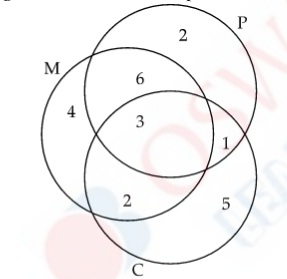
Here, we have: n(C∩M∩P) = 3 (given), where Crepresents Chemistry, P represents Physics and Mrepresents Mathematics.
n(U) = Total students = 25
By using Venn diagram, we can easily see thatstudents who read only chemistry are 5
(ii) (c): 11
Here we have to find n(C) + n(P) + n(M) = 5 + 2 + 4 = 11
Therefore, total students who read only one subject
= 11
(iii) (a): 23
Here we need to find:
n(P∪C∪M) = n(M) +n(P) + n(C) – n(P∩C)–n(P∩M) –n(M∩C) + n(P∩C∩M)
= 23
(adding all the numbers from venn diagram will give us result).
(iv) (d): 2
Here we need to findn(M∪C∪P)'
= n(U) – n(P∪C∪M)
= 25 – 23 = 2
(v) (c): 70
Since total student who read only Chemistry book are 5, therefore total time devoted to read only chemistry book by these students are: 514 = 70 hrs.
6.
(i) (d): 20
Given that, n(T) = 12, n(C) = 15 n(T∩C) = 7
As we know that:
n (T∪C) = n (T) + n(C) – n(T∩C)
= 12 + 15 – 7 = 20
Therefore total person who like atleast one of the two drinks were 20.
(ii) (c): 5
To find total number of person who like only tea but not coffee we can use :
= n(T) – n(T∩C)
= 12 – 7 = 5
(iii) (d): 8
Only coffee but not tea
= n(C) – n(T∩C)
= 15 – 7
= 8
(iv) (c):
Neither tea nor coffee
= n(U) – n(T∪C)
= 25 – 20
= 5
(v) (d): 1550
Total number of person like only Tea = 5 and total number of person who liked only Coffee = 8
So, total cost will be: 5 x 2 x 35 + 8 x 2 x 75
[ As each person had taken two cup of tea and coffee ]
= 350 + 1200 = 1550
So, total cost for tea and coffee will be RS. 1550

11th Standard CBSE Syllabus & Materials
11th Standard CBSE
CBSE 11th Business Studies Forms of Business Organisation Sample Question Papers Study Material - QB365 Set A
NEW11th Standard CBSE
CBSE 11th Business Studies Business, Trade and Commerce Sample Question Papers Study Material - QB365 Set A
NEW11th Standard CBSE
CBSE 11th Physics Waves Sample Question Papers Study Material - QB365 Set A
NEW11th Standard CBSE
CBSE 11th Physics Kinetic Theory Sample Question Papers Study Material - QB365 Set A



CBSE 11th Standard CBSE Subjects
CBSE Standards










