
 100% FREE ACCESS
11th Standard CBSE Syllabus & Materials
11th Standard CBSE
CBSE 11th Economics PART-A - Presentation of Data - New Sample Question Papers Study Material - QB365 Set A
NEW11th Standard CBSE
CBSE 11th Economics PART-A - Organisation of Data - New Sample Question Papers Study Material - QB365 Set A
NEW11th Standard CBSE
CBSE 11th Economics PART-A - Collection of Data - New Sample Question Papers Study Material - QB365 Set A
NEW11th Standard CBSE
CBSE 11th Economics PART-A - Introduction to Economics and Statistics - New Sample Question Papers Study Material - QB365 Set A
NEW11th Standard CBSE
CBSE 11th Business Studies International Trade Sample Question Papers Study Material - QB365 Set A
NEW11th Standard CBSE
CBSE 11th Business Studies Evolution and Fundamentals of Business Sample Question Papers Study Material - QB365 Set A

Published on: 09/09/2022
QB365 provides a detailed and simple solution for every Possible Case Study Questions in Class 11 Applied Mathematics Subject - Basics of Financial Mathematics, CBSE. It will help Students to get more practice questions, Students can Practice these question papers in addition to score best marks.
Download CBSE Class 11th Standard CBSE undefined question papers, sample papers, important questions, and previous year solved papers in PDF format. Get free study materials, NCERT solutions, and exam preparation resources for Class 11th Standard CBSE undefined
Questions + Answers key
Take MCQ Biology Test
1.
In XI standard, teacher was giving lecture on GST topic. Following points were discus sed on this topic.
Goods and Services Tax (GST)
GST is known as the Goods and Services Tax. It is an indirect tax which has replaced many indirect taxes in India such as the excise duty, VAT, services tax, etc. The Goods and Services Tax Act was passed in the Parliament on 29 th March 2017 and came into effect on 1 st July 2017.
In other words, Goods and Services Tax (GST) is levied on the supply of goods and services. Goods and Services Tax Law in India is a comprehensive, multi-stage, destination-based tax that is levied on every value addition. GST is a single domestic indirect tax law for the entire country. In order to address the complex system in India, the Government introduced 4 types of GST which are given below.
(i) CGST (Central Goods and Services Tax): levied and collected by Central Government.
(ii) SGST (State Goods and Services Tax): levied and collected by State Governments/Union Territories with Legislatures.
(iii) UTGST (Union Territory Goods and Services Tax): levied and collected by Union Territories without Legislatures, on intra-state supplies of taxable goods and/or services.
(iv) IGST (Integrated Goods and Services Tax): Inter- state supplies of taxable goods and/or services are subject to Integrated Goods and Services Tax (IGST). IGST is the total sum of CGST and SGST/ UTGST and is levied by Centre on all inter-state supplies.
Intra-state means: Supply within the same state. In case of intra-state sale of goods/services, or both If GST rate is 18%, then
CGST = 9% of Sale price
SGST = 9%of Sale price
IGST = 0
Inter-state means : Supply from one state to another state.
In case of inter-state of goods or services or both
If GST rate is 18%, then
IGST = 18% of Sale price
Discount is never allowed on amount including GST.
On the basis of the above information, answer the following questions:
(i) Integrated Goods and Services Tax is applicable when
| (a) Sold in Union territory | (b) Sold from one GST dealer to another GSTdealer |
| (c) Sold within a state | (d) There is inter state supply |
(ii) SGST is applicable when
| (a) Goods are sold within a state | (b) Goods are sold from one GST dealer to a customer |
| (c) Goods are sold by a GST dealer to another GST dealer | (d) Inter state supply |
(iii) Tax levied on sales of goods by business man B in M.P. only, will come under
| (a) SGST | (b) CGST | (c) IGST | (d) none of these |
(iv) If business man A runs his business and sells his product in Maharashtra then which tax will be applicable
| (a) SGST | (b) CGST | (c) IGST | (d) none of these |
(v) Business man B has given discount on GST, this statement is
| (a) false | (b) true | (c) data insufficient | (d) none of these |
2.
In a coaching institute of Chartered Accountant, income tax topic was discussed. In the class following topics were covered.
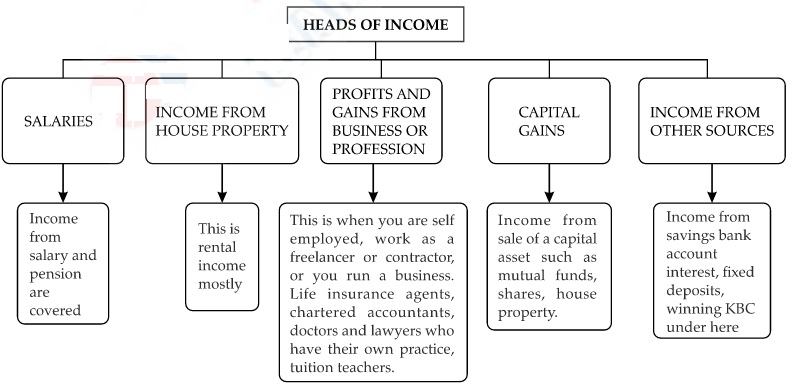
On the basis of the above information a case was given to students. There were five persons A, B, C, D and E having different income sources. 'A' was having doing job and he was also having rental property from which he was getting rent, 'B' have two big houses and he was getting rent from it. 'C' was not doing any job but he sold one of his house during the current financial year. 'D' was a freelancer and self employed and E have savings on which he was getting interest from bank and also won lottery during the current financial year.
On the basis of this information, answer the following questions:
(i) A’s income will come under which heads of income ?
| (a) salaries | (b) income from house property | (c) profits and gains from business | (d) both a and b |
(ii) B’s income source will come under which heads of income ?
| (a) salaries | (b) income from house property | (c) profits and gains from business | (d) capital gains |
(iii) C’s income source will come under which heads of income ?
| (a) salaries | (b) income from house property | (c) profits and gains from business | (d) capital gains |
(iv) D’s income source will come under which heads of income ?
| (a) salaries | (b) income from house property | (c) profits and gains from business | (d) profits and gains from business or profession |
(v) E’s income will come under which heads of income ?
| (a) salaries | (b) income from other sources | (c) profits and gains from business | (d) capital gains |
3.
In XI standard, teacher was discussing the concept of Future Value of Annuity Regular. During his class, he discussed the following few points on this: Rs. 500 was invested in annuity (future value regular) for 10 years at the rate of 14% compounded annually.
On the basis of the above information, answer the following questions:
If C.F. be the periodic payments, (cash flow in each period), the future value F. (n,i) of the annuity is given by:
Future value (F.V.) of an Annuity
\(=\text { C.F. }\left[\frac{(1+i)^{n}-1}{i}\right]\)
(i) What will be the future value of annuity at the end of two years ? Given that (1.14) 2 = 1.2996.
| (a) 1050 | (b) 1020 | (c) 1070 | (d) 1080 |
(ii) What will be the future value of the annuity after 3 years ? Given that (1.14)3 = 1.4815
| (a) 1719.64 | (b) 1788.48 | (c) 1725.64 | (d) 1750 |
(iii) What is the approximate difference between the future value of the annuity for five years and three years ? Given that (1.14) 5 = 1.925.
| (a) 1585.25 | (b) 1585.93 | (c) 1560.75 | (d) 1595.25 |
(iv) What is the difference between the profit earned by future value of the annuity for two years and the RS. 1000 invested compounded for two years with the same interest rate ?
| (a) 250.8 | (b) 229.6 | (c) 228.9 | (d) 220.5 |
(v) If the person invested the same amount for three years in future annuity and if he invest the same amount in compound interest, then what will be the difference between the profits he earned from two investments ?
| (a) 1009.56 | (b) 1008.87 | (c) 1008.10 | (d) 1007.78 |
4.
Roshan invested RS. 50000 in bank at the rate of 10% per annum compounded annually.

On the basis of this information, answer thefollowing questions:
(i) What will be the interest for the first year ?
| (a) 3800 | (b) 2500 | (c) 2800 | (d) 5000 |
(ii) What will be the interest for the second year ?
| (a) 5900 | (b) 4500 | (c) 5500 | (d) 5800 |
(iii) The difference between the simple interest and compound interest for the first year is
| (a) 500 | (b) 100 | (c) 0 | (d) 50 |
(iv) The difference between the simple interest and compound interest for first two years is
| (a) 100 | (b) 800 | (c) 300 | (d) 500 |
(v) After three years, how much amount Roshan will get on the given rate of interest compounded annually ?
| (a) 17550 | (b) 16550 | (c) 15550 | (d) 16450 |
1.
(i) (d): There is inter state supply
Integrated Goods and Services Tax is applicable when there is inter state supply.
(ii) (a): Goods are sold within a state
Integrated Goods and Services Tax is applicable when goods are sold within a state.
(iii) (a): SGST
Since business B sell his product in Madhya Pradesh only, therefore SGST is applicable.
(iv) (a): SGST
Business man A operates in Maharashtra and if he sells his product in Maharashtra only, then SGST is applicable.
(v) (a): false
As discount is not allowed on GST therefore the given statement is false.
2.
(i) (d): both a and b
As A’s source of income from salary and rental property.
(ii) (b): income from house property
As B’s source of income is from rent of house property.
(iii) (d): capital gains
As C sold one of his property, therefore, his income will come under capital gains.
(iv) (d): profits and gains from business or profession
As D is free lancer, therefore, his earning will come under profits and gains from business or profession.
(v) (b): income from other sources
E’s earning source is from savings and lottery, therefore, his earnings will come under income from other sources.
3.
(i) (c): 1070
By using formula,
F.V. of an Annuity =\(=\text { C.F. }\left[\frac{(1+i)^{n}-1}{i}\right]\)
Here, C.F. = 500, i = 0.14, n = 2
By putting these values, we get:
F.V. of an Annuity at the end of two years
\( =500\left[\frac{(1+0.14)^{2}-1}{0.14}\right] \)
\(=\frac{0.2996}{0.14}\)
= 500 x 2.14
= 1070
(ii) (a): 1719.64
After three years future value of an annuity
\( =500\left[\frac{(1+0.14)^{3}-1}{0.14}\right] \)
\(=500\left[\frac{(1.14)^{3}-1}{0.14}\right] \)
\(=500\left(\frac{1.4815-1}{0.14}\right) \)
\(=\frac{500 \times 0.4815}{0.14} \)
\(=\frac{240.75}{0.14} \)
= Rs.1719.64
(iii) (b): 1585.93
After three years future value of the annuity
= 1719.64
After five years future value of the annuity
\(=500\left[\frac{(1+0.14)^{5}-1}{0.14}\right]\)
\( =500\left[\frac{1.925-1}{0.14}\right] \)
\(=500 \times \frac{0.925}{0.14} \)
= 3305.57
Therefore difference
= 3305.57 – 1719.64
= 1585.93
(iv) (b): 229.6
\(\text { Amount }=P\left[1+\frac{r}{100}\right]^{n}\)
r = rate of interest,
n = number of years
P = principal
1000 [1.14]2 = 1299.6
Future Value of annuity after two years = 1070
Difference = 1299.6 – 1070 = 229.6
(v) (b): 1008.87
Future value annuity for three years = 740.77
Compound interest for three years = 2222.31
Difference = 1719.64 – 740.77 = 1008.87
4.
(i) (d): 5000
Interest for the first year is given by
\( \mathrm{I} =\frac{\text { PRT }}{100} \)
\(=\frac{50000 \times 10 \times 1}{100} \)
= 5000
(ii) (c): 5500
We know that, \(\mathrm{A}=P\left(1+\frac{r}{100}\right)^{n}\)
where P is the principal and A is the amount recieved and n is number of years and r is rate of interest.
Interest for the first year = 5000
Principal for the second year will be 55000.
Therefore, interest for the second year
\(=\frac{55000 \times 10 \times 1}{100}\)
= 5500
(iii) (c): 0
Since the compound interest for first year and simple interest for the first year is same therefore difference is 0.
(iv) (d): 500
Simple interest for two years
\(=\frac{50000 \times 2 \times 10}{100}\)
= 10000
Compound interest for two years
= 5000 + 5500 = 10500
Therefore, difference
= 10500 – 10000 = 500
(v) (b): 16550
Compound interest for third year
\(=\frac{60500 \times 1 \times 10}{100}\)
= 6050
Therefore, total interest after three years
= 5000 + 5500 + 6050
= 16550

11th Standard CBSE Syllabus & Materials
11th Standard CBSE
CBSE 11th Business Studies Forms of Business Organisation Sample Question Papers Study Material - QB365 Set A
NEW11th Standard CBSE
CBSE 11th Business Studies Business, Trade and Commerce Sample Question Papers Study Material - QB365 Set A
NEW11th Standard CBSE
CBSE 11th Physics Waves Sample Question Papers Study Material - QB365 Set A
NEW11th Standard CBSE
CBSE 11th Physics Kinetic Theory Sample Question Papers Study Material - QB365 Set A



CBSE 11th Standard CBSE Subjects
CBSE Standards










