
 100% FREE ACCESS
11th Standard CBSE Syllabus & Materials
11th Standard CBSE
CBSE 11th Economics PART-A - Presentation of Data - New Sample Question Papers Study Material - QB365 Set A
NEW11th Standard CBSE
CBSE 11th Economics PART-A - Organisation of Data - New Sample Question Papers Study Material - QB365 Set A
NEW11th Standard CBSE
CBSE 11th Economics PART-A - Collection of Data - New Sample Question Papers Study Material - QB365 Set A
NEW11th Standard CBSE
CBSE 11th Economics PART-A - Introduction to Economics and Statistics - New Sample Question Papers Study Material - QB365 Set A
NEW11th Standard CBSE
CBSE 11th Business Studies International Trade Sample Question Papers Study Material - QB365 Set A
NEW11th Standard CBSE
CBSE 11th Business Studies Evolution and Fundamentals of Business Sample Question Papers Study Material - QB365 Set A

Published on: 09/09/2022
QB365 provides a detailed and simple solution for every Possible Case Study Questions in Class 11 Applied Mathematics Subject - Probability, CBSE. It will help Students to get more practice questions, Students can Practice these question papers in addition to score best marks.
Download CBSE Class 11th Standard CBSE undefined question papers, sample papers, important questions, and previous year solved papers in PDF format. Get free study materials, NCERT solutions, and exam preparation resources for Class 11th Standard CBSE undefined
Questions + Answers key
Take MCQ Biology Test
1.
Varun, Abhay and Rohit were doing shooting. Varun hits the target 4 times in 5 shots, Abhay hits the target 3 times in 4 shots and Rohit hits the target 2 times in 3 shots. Now on the basis of this information answer the following questions.
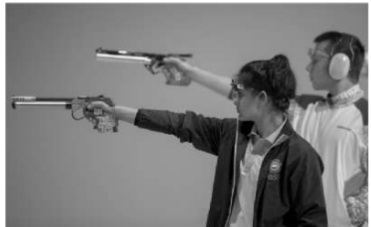
(i) Varun, Abhay and Rohit all may hit the target.
| (a) \(\frac{2}{3}\) | (b) \(\frac{2}{7}\) | (c) \(\frac{1}{5}\) | (d) \(\frac{2}{5}\) |
(ii) What is the probability that Abhay and Rohit may hit but Varun may not hit
| (a) \(\frac{1}{10}\) | (b) \(\frac{1}{20}\) | (c) \(\frac{1}{30}\) | (d) \(\frac{5}{7}\) |
(iii) Probabilty that any two among Varun, Abhay and Rohit may hit the target is
| (a) \(\frac{1}{30}\) | (b) \(\frac{13}{29}\) | (c) \(\frac{13}{37}\) | (d) \(\frac{13}{30}\) |
(iv) What is the probability that none of them will hit the target is
| (a) \(\frac{1}{30}\) | (b) \(\frac{1}{20}\) | (c) \(\frac{2}{15}\) | (d) \(\frac{1}{60}\) |
(v) When we find the probability then sum of all probabilities can be greater then one ? This statement is
| (a) True | (b) False | (c) cant say |
2.
Vijeta and Rohini are playing cards. Total number of playing cards are 52 in numbers. Following events happen while playing the game of choosing a card out of 52 cards.
Answer the following questions accordingly:
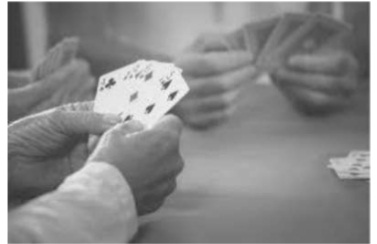
(i) Vijeta draw a card, what is the probability that the drawn card is either red or king ?
| (a) \(\frac{4}{13}\) | (b) \(\frac{4}{15}\) | (c) \(\frac{2}{13}\) | (d) \(\frac{2}{5}\) |
(ii) Rohini draw a card, what is the probability that the card drawn is an ace ?
| (a) \(\frac{1}{13}\) | (b) \(\frac{1}{12}\) | (c) \(\frac{2}{13}\) | (d) \(\frac{1}{10}\) |
(iii) Vijayata draw the card again, now what is the probability that the card drawn is a red card ?
| (a) \(\frac{1}{3}\) | (b) \(\frac{1}{2}\) | (c) \(\frac{3}{7}\) | (d) \(\frac{1}{5}\) |
(iv) Rohini draw the card again, now what is the probability that the card is an ace of red colour ?
| (a) \(\frac{1}{26}\) | (b) \(\frac{1}{13}\) | (c) \(\frac{1}{20}\) | (d) \(\frac{1}{15}\) |
(v) Now, Vijeta draw two cards successively with replacement, find the probability distribution of number of aces when one ace is there in selection.
| (a) \(\frac{5}{16}\) | (b) \(\frac{12}{169}\) | (c) \(\frac{24}{114}\) | (d) \(\frac{24}{169}\) |
3.
Rahul and Ravi planned to play Business Board game with two dice. In which they will get the turn one by one, they roll the dice and continue the game.
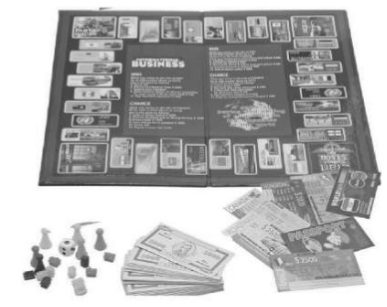
On the basis of the given information answer the following questions:
(i) Ravi got first chance to roll the dice. What is the probability that he got the sum of the two numbers appearing on the top face of the dice is 8 ?
| (a) \(\frac{1}{26}\) | (b) \(\frac{5}{36}\) | (c) \(\frac{1}{18}\) | (d) 0 |
(ii) Rahul got next chance. What is the probability that he got the sum of the two number appearing on the top face of the dice is 13 ?
| (a) 1 | (b) \(\frac{5}{36}\) | (c) \(\frac{1}{18}\) | (d) 0 |
(iii) Now it was Ravi's turn. He rolled the dice. What is the probability that he got the sum of the two numbers appearing on the top face of the dice is less than or equal to 12 ?
| (a) 1 | (b) \(\frac{5}{36}\) | (c) \(\frac{1}{18}\) | (d) 0 |
(iv) Rahul got next change. What is the probability that he got the sum of the two numbers appearing on the top face of the dice is equal 7 ?
| (a) \(\frac{5}{9}\) | (b) \(\frac{5}{36}\) | (c) \(\frac{1}{6}\) | (d) 0 |
(v) Now it was Ravi's turn. He rolled the dice. What is the probability that he got the sum of the two numbers appearing on the top face of the dice is greater than 8
| (a) 1 | (b) \(\frac{5}{36}\) | (c) \(\frac{1}{18}\) | (d) \(\frac{5}{18}\) |
4.
Ravi and Siddhartha are playing cards. Total number of cards are 52 in numbers. Each of them draw cards one by one. On the basis of this game following questions are observed, answer the following questions.
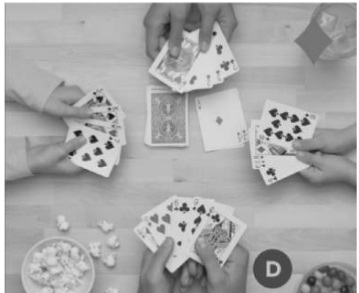
(i) Ravi draw four cards, find the probability that all the four cards are from the same suit.
| (a) \(\frac{4\left({ }^{13} C_{4}\right)}{{ }^{52} C_{4}}\) | (b) \(\frac{{ }^{13} C_{4}}{{ }^{52} C_{4}}\) | (c) \(\frac{2\left({ }^{13} C_{4}\right)}{{ }^{52} C_{4}}\) | (d) \(\frac{{ }^{13} C_{4}}{{ }^{26} C_{4}}\) |
(ii) Siddhartha draw four cards, find the probability that one of the four cards is an ace.
| (a) \(\frac{44821}{54145}\) | (b) \(\frac{11232}{54145}\) | (c) \(\frac{38916}{54145}\) | (d) \(\frac{15229}{54145}\) |
(iii) Ravi draw four cards, find the probability that one card is drawn from each suit.
| (a) \(\frac{197}{25681}\) | (b) \(\frac{2197}{20725}\) | (c) \(\frac{2197}{10828}\) | (d) \(\frac{2197}{20825}\) |
(iv) Ravi again draw four card, find the probability that all the cards are of same colour.
| (a) \(2\left(\frac{{ }^{26} C_{4}}{{ }^{52} C_{4}}\right)\) | (b) \(\frac{{ }^{26} C_{4}}{{ }^{52} C_{4}}\) | (c) \(5\left(\frac{{ }^{26} C_{4}}{{ }^{52} C_{4}}\right)\) | (d) \(4\left(\frac{{ }^{26} C_{4}}{{ }^{52} C_{4}}\right)\) |
(v) Siddhartha draws four cards successively without replacement. What is the probability that all the four cards are kings.
| (a) \(\frac{1}{270725}\) | (b) \(\frac{1}{27725}\) | (c) \(\frac{29}{27725}\) | (d) \(\frac{1}{270725}\) |
1.
(i) (d): \(\frac{2}{5}\)
Probability of Varun hitting the target = \(\frac{4}{5}\)
Probability of Abhay hitting the target = \(\frac{3}{4}\)
Probability of Rohit to hit the target =\(\frac{2}{3}\)
If all may hit the target, then required probabilty
\(=\frac{4}{5} \times \frac{3}{4} \times \frac{2}{3}=\frac{2}{5}\)
(ii) (a): \(\frac{1}{10}\)
Required probability = \(=\left(1-\frac{4}{5}\right) \times \frac{3}{4} \times \frac{2}{3}\)
\(\frac{1}{10}\)
(iii) (d): \(\frac{13}{30}\)
Required probability
\( =\frac{4}{5} \times \frac{3}{4} \times\left(1-\frac{2}{3}\right)+\frac{4}{5} \times\left(1-\frac{3}{4}\right) \times \frac{2}{3}+\left(1-\frac{4}{5}\right) \times \frac{3}{4} \times \frac{2}{3} \)
\(=\frac{4}{5} \times \frac{3}{4} \times \frac{1}{3}+\frac{4}{5} \times \frac{1}{4} \times \frac{2}{3}+\frac{1}{5} \times \frac{3}{4} \times \frac{2}{3} \)
(iv) (d): \(\frac{1}{60}\)
For none of them will hit the target, we have to the find when they will not hit the target individually.
\( =\left(1-\frac{4}{5}\right) \times\left(1-\frac{3}{4}\right) \times\left(1-\frac{2}{3}\right) \)
\(=\frac{1}{5} \times \frac{1}{4} \times \frac{1}{3} \)
\(=\frac{1}{60}\)
(v) (b): False
Total probability can’t be more than one. Hence false.
2.
(i) (a): \(\frac{4}{13}\)
Favourable events are :
Total red cards = 26 ( includes two kings)
Two black kings = total cards =28
Total cards left (favourable) = 52 – 28 = 24
Required probability = \(\frac{24}{52}=\frac{4}{13}\)
(ii) (a): \(\frac{1}{13}\)
Total number of aces = 4
Required probability \(=\frac{4}{52}=\frac{1}{13}\)
(iii) (b): \(\frac{1}{2}\)
Total number of red cards = 26
Required probability \(=\frac{26}{52}=\frac{1}{2}\)
(iv) (a): \(\frac{1}{26}\)
There are two red colour ace cards. Therefore, the required probability is
\(\frac{2}{52}=\frac{1}{26}\)
(v) (d): \(\frac{24}{169}\)
When one ace is there, then X= 1
Required condition:
(i) ace is selected first and then no ace (ii) no ace is selected first and an ace is selected
\(
P(X=1)=\frac{4}{52} \times \frac{48}{52}+\frac{48}{52} \times \frac{4}{52}
\)
\(\Rightarrow \ P(X=1)=\frac{24}{169}\)
3.
(i) (a): \(\frac{1}{26}\)
Favourable cases (2, 6), (6, 2), (4, 4), (5, 3), (3, 5)
Probability of getting the sum as eight =\(\frac{5}{36}\)
(ii) (d): 0
As the sum of numbers on two dice is 13 will not be possible, therefore zero probability.
(iii) (a): 1
As the sum on the two dice will always be less then or equal to 12, therefore probability = 1
(iv) (c): \(\frac{1}{6}\)
Favourable events of getting sum = 7 i.e., (1, 6), (6, 1), (5, 2), (4, 3), (3, 4), (2, 5)
Required probability \(=\frac{6}{36}=\frac{1}{6}\)
(v) (d): \(\frac{5}{18}\)
Favourable events = (6, 3), (3, 6), (5, 4), (4, 5), (5, 5),(5, 6), (6, 5), (6, 6), (4, 6), (6, 4)
Required probability = \(\frac{10}{36}=\frac{5}{18}\)
4.
(i) (a): \(=\frac{4\left({ }^{13} \mathrm{C}_{4}\right)}{{ }^{52} \mathrm{C}_{4}}\)
As we know there are four suits,
Favourable cases are: 13C4 + 13C4 + 13C4 + 13C4
= 4(13C4)
Required probabilty \(=\frac{4\left({ }^{13} \mathrm{C}_{4}\right)}{{ }^{52} \mathrm{C}_{4}}\)
(ii) (d): \(\frac{15229}{54145}\)
Since, there are 4 aces in the pack of 52 cards, therefore, the no.of ways of drawing 4 cards so that no card is an ace = 48C4.
Probability of four cards so that none is an ace
\(=\frac{{ }^{48} C_{4}}{{ }^{52} C_{4}} \)
\(=\frac{48 \times 47 \times 46 \times 45}{52 \times 51 \times 50 \times 49} \)
\(=\frac{38916}{54145}\)
Thus, required probability = \( 1-\frac{38916}{54145} \)
\(= \frac{15229}{54145}\)
(iii) (d): \(\frac{2197}{20825}\)
Favourable cases to draw one card from each suit is:13C1 x 13C1 x 13C1 x 13C1 = (13C1)4
Required probability \( =\frac{\left({ }^{13} C_{1}\right)^{4}}{{ }^{52} C_{4}} \)
\(=\frac{13 \times 13 \times 13 \times 13}{\frac{52 \times 51 \times 50 \times 49}{4 \times 3 \times 2 \times 1}} \)
\(=\frac{2197}{20825}\)
(iv) (a): \(2\left(\frac{{ }^{26} C_{4}}{{ }^{52} C_{4}}\right)\)
Total favourable cases of drawing all cards of same colour = 26C4 x 26C4 = 2(26C4)
Required probability = \(\frac{2\left({ }^{26} \mathrm{C}_{4}\right)}{{ }^{52} \mathrm{C}_{4}}\)
(v) (a): \(\frac{1}{270725}\)
Required probability \(
=\frac{4}{52} \times \frac{3}{51} \times \frac{2}{50} \times \frac{1}{49}
\)
\(=\frac{1}{270725}
\)

11th Standard CBSE Syllabus & Materials
11th Standard CBSE
CBSE 11th Business Studies Forms of Business Organisation Sample Question Papers Study Material - QB365 Set A
NEW11th Standard CBSE
CBSE 11th Business Studies Business, Trade and Commerce Sample Question Papers Study Material - QB365 Set A
NEW11th Standard CBSE
CBSE 11th Physics Waves Sample Question Papers Study Material - QB365 Set A
NEW11th Standard CBSE
CBSE 11th Physics Kinetic Theory Sample Question Papers Study Material - QB365 Set A



CBSE 11th Standard CBSE Subjects
CBSE Standards










