
 100% FREE ACCESS
11th Standard CBSE Syllabus & Materials
11th Standard CBSE
CBSE 11th Economics PART-A - Presentation of Data - New Sample Question Papers Study Material - QB365 Set A
NEW11th Standard CBSE
CBSE 11th Economics PART-A - Organisation of Data - New Sample Question Papers Study Material - QB365 Set A
NEW11th Standard CBSE
CBSE 11th Economics PART-A - Collection of Data - New Sample Question Papers Study Material - QB365 Set A
NEW11th Standard CBSE
CBSE 11th Economics PART-A - Introduction to Economics and Statistics - New Sample Question Papers Study Material - QB365 Set A
NEW11th Standard CBSE
CBSE 11th Business Studies International Trade Sample Question Papers Study Material - QB365 Set A
NEW11th Standard CBSE
CBSE 11th Business Studies Evolution and Fundamentals of Business Sample Question Papers Study Material - QB365 Set A

Published on: 09/09/2022
QB365 provides a detailed and simple solution for every Possible Case Study Questions in Class 11 Biology Subject - Anatomy of Flowering Plants, CBSE. It will help Students to get more practice questions, Students can Practice these question papers in addition to score best marks.
Download CBSE Class 11th Standard CBSE Biology question papers, sample papers, important questions, and previous year solved papers in PDF format. Get free study materials, NCERT solutions, and exam preparation resources for Class 11th Standard CBSE Biology
Questions + Answers key
Take MCQ Biology Test
1.
In plants growing in temperate regions, with pronounced seasons, the secondary xylem elements formed during spring, i.e. early wood or springwood is different from that formed during winter, i.e. latewood or autumn wood.
(a) Write any two characteristics in which the springwood and autumn wood differ from each other.
(b) What is sap wood? What is its function?
2.
The growth of roots and stems of plants in length accomplished by the apical meristems, is called primary growth. The dicotyledonous plants show secondary growth, i.e. an increase in the girth of stem and root with the help of lateral meristems.
(a) Name the lateral meristems involved in secondary growth of dicot stems.
(b) Why is more secondary xylem than secondary phloem formed during secondary growth?
(c) What are secondary medullary rays?
3.
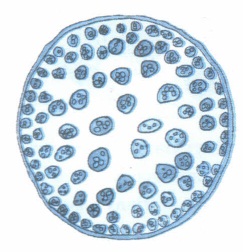
The ground plan of a transverse section of a monocot stem is shown above.
(a) Name the cell type, the hypodermis of monocot stem is made of.
(b) Write any four characteristics of the vascular bundles in a monocot stem.
4.
The anatomy of monocot roots is similar to the dicot roots in many aspects. It has the same tissues like epidermis, cortex, endodermis, pericycle, vascular bundles, pith, etc. Yet, it differs from dicot roots. Write any three features in which the mono cot roots differ from that of dicot roots.
5.
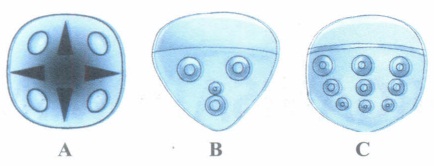
Identify the three types of vascular bundles, A, B and C shown above. Give one example for each type.
6.
Xylem is the conducting tissue of water and minerals from the roots to the stem and leaves. Tracheids and vessels are the major conducting elements of xylem, whose diagrams are given below.
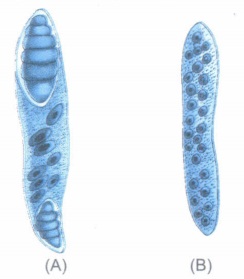
(a) Identify the vessel and the tracheid in the figure.
(b) Write two differences between tracheids and vessels.
7.
The diagrammatic representation of stomatal apparatus of a dicot plant is shown below. Answer the questions that follow:
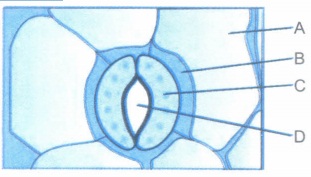
(a) Identify the parts labelled A, B, C and D
(b) How does C differ from B?
8.
Tissues vary depending on their location in the plant body. Their structure and functions also depend on their location in the plant body. On the basis of their structure and location, there are three types of tissue systems.
Name the three types of tissue systems in a plant body. Give one example for each.
9.
The meristems which occur at the tips of roots and shoots, are called apical meristems. They produce primary tissues of the plant body. The shoot apical meristem occupies the distal most region of the stem axis.
(a) How is it protected?
(b) How are axillary buds formed?
(c) What is intercalary meristem?
1.
(a) Differences
| Spring wood | Autumn wood |
| It is lighter in colour | It is darker in colour. |
| The xylary elements are wider | The xylary elements are narrow. |
| It has a lower density | It has a higher density. |
(b) The peripheral region of the secondary xylem (or wood) that is lighter in colour and contains living elements, is called sap wood.
It is involved in the conduction of water and minerals.
2.
(a) Fascicular/vascular cambium and phellogen/cork cambium.
(b) It is because the cambium is more active on its inner side than on its outer side.
(c) Secondary medullary rays are the narrow bands of parenchyma produced by the cambium and pass through the secondary xylem and secondary phloem.
3.
(a) Hypodermis is sclerenchyrnatous.
(b) Vascular bundles of monocot stem are
(i) conjoint (xylem and phloem along the same radius).
(ii) closed (cambium is absent)
(ii) xylem is endarch
(iii) phloem parenchyma is absent
(iv) water-containing cavity is present.
4.
Differences
| Monocot roots | Dicot roots |
| (i) They have more than six xylem bundles, i.e. xylem is polyarch. | They have fewer xylem bundles, 2-6 or diarch to hexarch. |
| (ii) The pith is large and well-developed. | Pith is very small or inconspicuous |
| (iii) Peri cycle has no role in secondary growth. | Pericycle is involved in secondary growth. |
5.
A. Conjoint, open vascular bundle
e.g. Dicot stem
B. Conjoint closed vascular bundle
e.g. Monocot stem
C. Radial vascular bundle
e.g. Dicot and monocot roots
6.
(a) A-Vessel, B-Tracheid
(b) Differences
| Tracheids | Vessels |
| They are single elongated or tubelike cells. | They are cylindrical tube-like structures made of many cells, called vessel members |
| They have tapering ends without any perforation. | Their end walls have perforations. |
7.
(a) A - Epidermal cell
B - Subsidiary cell
C - Guard cell
D - Stomatal pore
(b) C (guard cell) has chloroplasts, but B (subsidiary cell) does not have chloroplasts.
8.
The tissue systems in plants:
(i) Epidermal tissue system, e.g. Epidermis
(ii) Vascular tissue system, e.g. xylem, phloem
(iii) Ground tissue system, e.g. mesophyll of leaves cortex of stem and root.
9.
(a) The shoot apical meristem is protected by the leaf primordia.
(b) During the formation of leaves and elongation of stem, some cells 'left behind' from the shoot apical meristem constitute the axillary buds.
(c) The meristem which occurs between mature tissues, is known as intercalary meristem.

11th Standard CBSE Syllabus & Materials
11th Standard CBSE
CBSE 11th Business Studies Forms of Business Organisation Sample Question Papers Study Material - QB365 Set A
NEW11th Standard CBSE
CBSE 11th Business Studies Business, Trade and Commerce Sample Question Papers Study Material - QB365 Set A
NEW11th Standard CBSE
CBSE 11th Physics Waves Sample Question Papers Study Material - QB365 Set A
NEW11th Standard CBSE
CBSE 11th Physics Kinetic Theory Sample Question Papers Study Material - QB365 Set A



CBSE 11th Standard CBSE Subjects
CBSE Standards









