
 100% FREE ACCESS
11th Standard CBSE Syllabus & Materials
11th Standard CBSE
CBSE 11th Economics PART-A - Presentation of Data - New Sample Question Papers Study Material - QB365 Set A
NEW11th Standard CBSE
CBSE 11th Economics PART-A - Organisation of Data - New Sample Question Papers Study Material - QB365 Set A
NEW11th Standard CBSE
CBSE 11th Economics PART-A - Collection of Data - New Sample Question Papers Study Material - QB365 Set A
NEW11th Standard CBSE
CBSE 11th Economics PART-A - Introduction to Economics and Statistics - New Sample Question Papers Study Material - QB365 Set A
NEW11th Standard CBSE
CBSE 11th Business Studies International Trade Sample Question Papers Study Material - QB365 Set A
NEW11th Standard CBSE
CBSE 11th Business Studies Evolution and Fundamentals of Business Sample Question Papers Study Material - QB365 Set A

Published on: 09/09/2022
QB365 provides a detailed and simple solution for every Possible Case Study Questions in Class 11 Biology Subject - Animal Kingdom, CBSE. It will help Students to get more practice questions, Students can Practice these question papers in addition to score best marks.
Download CBSE Class 11th Standard CBSE Biology question papers, sample papers, important questions, and previous year solved papers in PDF format. Get free study materials, NCERT solutions, and exam preparation resources for Class 11th Standard CBSE Biology
Questions + Answers key
Take MCQ Biology Test
1.
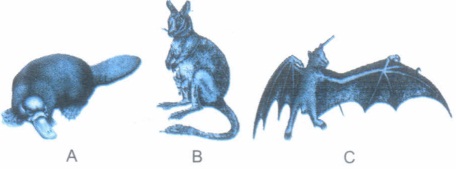
The picture given above shows three different mammals. Identify the animals and write their scientific names and one characteristic feature of each of them, which the other two do not possess.
2.
Mammals and birds (Aves) are vertebrates and homoiotherms. They show double circulation, but, differ in many other aspects.
(a) Write any two adaptations/modifications, a bird has, for its aerial mode of life.
(b) Bring out any four differences between Aves and mammals.
3.
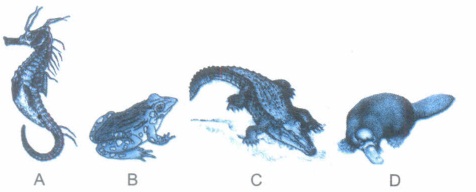
Observe the picture showing some vertebrates and answer the following questions.
(i) Identify the animal(s) with
(a) two-chambered heart
(b) three-chambered heart
(c) four-chambered heart
(ii) Which among them show(s) external fertilisation?
4.
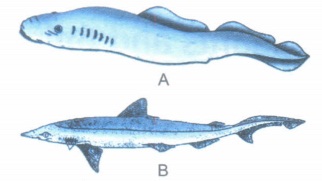
Study the two animals (fishes), A and B in the picture given above and answer the following questions.
(a) Identify the class, which each of them belongs to.
(b) Write four differences between the two
5.
Phylum Chordata includes animals which characteristically possess a notochord either throughout life or during early embryonic life.
(a) Give an example of a sub-phylum and an animal, where the notochord
(i) extends from head to tail and is persistent throughout life.
(ii) is present only in the tail region of the larval stage.
(b) What happens to it in the sub-phylum, which reptiles belong to?
6.
Kamal, a student of class IX has brought a crab and an apple snail from the beach. He has identified them both as members of Phylum Mollusca, as they have a shell. As a senior student of biology, help him to identify the animals correctly.
(a) Name the phylum, crab belongs to and that which apple snail belongs to.
(b) Write any four differences between the animals of the two phyla.
7.
Two animals of Phylum Annelida are shown in the picture given below. Observe them and answer the questions that follow:
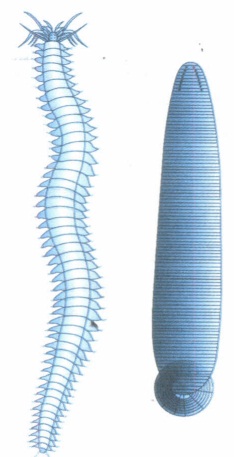
(a) Identify and write the scientific names of the animals A and B.
(b) Write two major differences between them.
8.
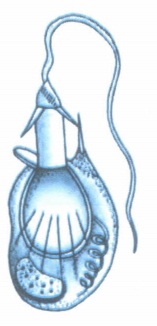
(a) Identify the structure given above and name the phylum, it is characteristically present in.
(b) Where is it generally present in the body of the animals?
(c) Name the cell it contains.
(d) Mention two of its functions.
9.
The diagram given above shows the arrangement of germinal layers.
(i) Identify the parts labelled A, B, C and D.
(ii) What technical term is given to animals with pattern (a) and (b), respectively?
10.
Animals of the phyla like Annelida, Arthropoda, Mollusca, Chordata, etc. have organ system level of organisation. Organ systems in different groups/phyla of animals exhibit various patterns of complexities.
Name and describe the two types of circulatory system among animals and name one phylum as example for each.
11.
Animals are classified on the basis of their symmetry into three categories.
(i) Asymmetrical,
(ii) Radially symmetrical and
(iii) Bilaterally symmetrical.
They are also classified into diploblastic and triploblastic.
(a) Name one phylum and an animal as example for each of the following, where animals are
(i) diploblastic and radially symmetrical.
(ii) triploblastic and radially symmetrical.
(b) Name two phyla, where animals are exclusively marine.
1.
A. Ornithorhynchus
It is an egg-laying/oviparous mammal, while others are viviparous.
B. Macropus
It is a pouched mammal, while others do not have it.
C. Pteropus
It is a flying mammal, while others cannot fly
2.
(a) Adaptations/Modifications
(i) Forelimbs are modified into wings that are covered by feathers.
(ii) The long bones are hollow with air cavities, i.e., pneumatic.
(b) Differences
| Aves | Mammals |
| Jaws are modified into beak and teeth are absent. | Both upper and lower jaws possess teeth. |
| Long bones are hollow and filled with air cavities, i.e., pneumatic. | Bones are not pneumatic. |
| Skin glands and hair are absent. | Skin glands and hair are present. |
| Air sacs are connected to lungs to supplement respiration. | Air sacs are absent. |
| They are oviparous. | Animals are viviparous with a very few exceptions. |
3.
(i) (a) A - Hippocampus
(b) B - Rana (frog)
(c) C - Crocodilus
(d) - Ornithorhynchus
(ii) A - Hippocampus and
B - Rana show external fertilisation.
4.
(a) A - Cyclostomata
B - Chondrichthyes
(b) Differences
| Cyclostomata | Chondrichthyes |
| They are jawless vertebrates. | They possess jaws. |
| They have a circular, sucking mouth. | They have a ventral mouth |
| Body is devoid of scales. | Body is covered by placoid scales. |
| They do not have paired fins. | They have paired fins. |
| They are ectoparasites on fishes. | They are free-living and predaceous. |
| They are oviparous. | Many of them are viviparous. |
5.
(a) (i) Cephalochordata e.g. Amphioxus
(ii) Urochordata e.g. Aseidia, Sealpa
(b) Reptiles belong to the sub-phylum Vertebrata, where the notochord is replaced by vertebral column.
6.
(a) Crab belongs to Phylum Arthropoda.
Apple snail belongs to Phylum Mollusca.
(b) Differences
| Arthropoda | Mollusca |
| Body is segmented and divided into head, thorax and abdomen. | Body is soft and unsegmented and divided into head, muscular foot and visceral mass. |
| They have a chitinous exoskeleton | They have a calcareous exoskeleton. |
| The rasping organ, radula is absent. | The rasping organ, radula is present. |
| Excretion is by malpighian tubules or green glands. | Excretion is by gills or kidneys. |
| Respiration is by gills, tracheal tubes or book lungs. | Respiration is by gills. |
| They have three or four pairs of walking legs and wings in some. | They have a muscular foot for locomation. |
| Body fluid has no respiratory pigment. | Body fluid has phycocyanin. |
7.
(a) A - Nereis, B - Hirudinaria
(b) Differences
| Nereis | Hirudinaria |
| It is marine. | It is terrestrial. |
| It has parapodia for locomotion. | Parapodia are absent. |
| It is dioecious. | It is monoecious |
8.
(a) (i) It is a cnidoblast.
(ii) It is characteristically present in Cnidaria (Coelenterata).
(b) It is present in the tentacles.
(c) Nematocyte
(d) It helps in
(i) anchorage
(ii) capture of prey (food)
(iii) defence.
9.
(i) A - Ectoderm, B - Endoderm, C - Mesoglea, D - Mesoderm
(ii) (a) Diploblastic
(b) Triploblastic
10.
Types of circulatory system
(i) Open circulatory svstem
In this, blood is pumped out of the heart into spaces, where the cells and tissues are directly bathed in it.
e.g. Arthropoda, Mollusca.
(ii) Closed circulatory system
In this, blood is circulated through a series of blood vessels and the tissues and organs are not in direct contact with blood.
e.g. Annelida, Chordata.
11.
(a) (i) Cnidaria - Hydra/Adamsia
Or
Ctenophora - Ctenoplana/Pleurobrachia
(ii) Echinodermata - Asterias/Echinus
(b) Echinodermata and Ctenophora

11th Standard CBSE Syllabus & Materials
11th Standard CBSE
CBSE 11th Business Studies Forms of Business Organisation Sample Question Papers Study Material - QB365 Set A
NEW11th Standard CBSE
CBSE 11th Business Studies Business, Trade and Commerce Sample Question Papers Study Material - QB365 Set A
NEW11th Standard CBSE
CBSE 11th Physics Waves Sample Question Papers Study Material - QB365 Set A
NEW11th Standard CBSE
CBSE 11th Physics Kinetic Theory Sample Question Papers Study Material - QB365 Set A



CBSE 11th Standard CBSE Subjects
CBSE Standards









