
 100% FREE ACCESS
11th Standard CBSE Syllabus & Materials
11th Standard CBSE
CBSE 11th Economics PART-A - Presentation of Data - New Sample Question Papers Study Material - QB365 Set A
NEW11th Standard CBSE
CBSE 11th Economics PART-A - Organisation of Data - New Sample Question Papers Study Material - QB365 Set A
NEW11th Standard CBSE
CBSE 11th Economics PART-A - Collection of Data - New Sample Question Papers Study Material - QB365 Set A
NEW11th Standard CBSE
CBSE 11th Economics PART-A - Introduction to Economics and Statistics - New Sample Question Papers Study Material - QB365 Set A
NEW11th Standard CBSE
CBSE 11th Business Studies International Trade Sample Question Papers Study Material - QB365 Set A
NEW11th Standard CBSE
CBSE 11th Business Studies Evolution and Fundamentals of Business Sample Question Papers Study Material - QB365 Set A

Published on: 09/09/2022
QB365 provides a detailed and simple solution for every Possible Case Study Questions in Class 11 Biology Subject - Biological Classification, CBSE. It will help Students to get more practice questions, Students can Practice these question papers in addition to score best marks.
Download CBSE Class 11th Standard CBSE Biology question papers, sample papers, important questions, and previous year solved papers in PDF format. Get free study materials, NCERT solutions, and exam preparation resources for Class 11th Standard CBSE Biology
Questions + Answers key
Take MCQ Biology Test
1.
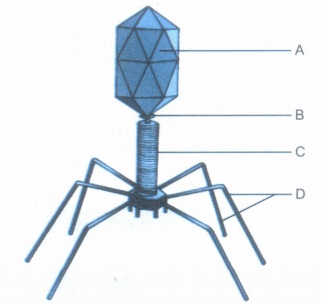
A diagram of a bacteriophage is given above.
(a) Label the parts A, B, C and D marked in the diagram.
(b) Why did viruses not find a place in the classification?
2.
Kingdom Plantae includes all eukaryotic chlorophyUbearing, autotrophic organisms. A few members are parasites or partially heterotrophic like insectivorous plants.
(a) Name two insectivorous plants.
(b) Give an example of a parasitic plant.
(c) All plant cells have a cell wall. What is it mainly made of?
(d) What is meant by alternation of generations?
3.
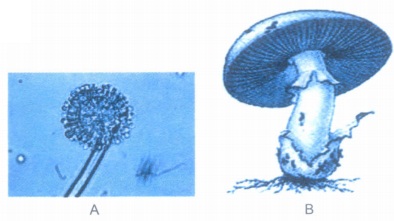
(a) Identify the two fungi shown above.
(b) Name the respective class, which each of them belongs to.
(c) Write two differences between their sexual spores.
4.
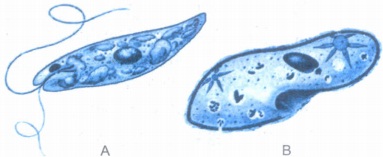
Two organisms of Kingdom Protista are shown above.
(a) Identify the organisms (A) and (B) and assign them to their respective phyla.
(b) Write any two differences between them.
5.
Kingdom Protista is an artificial assemblage of unicellular eukaryotic organisms and its boundaries are not well-defined. This kingdom forms a link with other kingdoms, Plantae, Animalia and Fungi.
(a) Mention two characteristics in which certain protists resemble plants.
(b) Slime moulds resemble fungi in certain aspects and animals in some other aspects. Mention one feature each of fungi and animals, in which slime moulds resemble them.
(c) Mention two features in which protozoans resemble Animalia.
6.
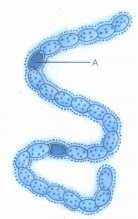
The diagram of a Nostoc filament is shown above. Answer the following questions.
(a) Identify the cell labelled 'A'. What is its significance?
(b) Name the pigment that gives them the characteristic blue-green colour.
(c) What type of nutrition is exhibited by them?
(d) Why does the ground become slippery during rainy season?
7.
Though the bacterial cell structure is very simple, they are very complex in their behaviour. Bacteria as a group show the most extensive metabolic diversity.
(a) Mention the different modes of nutrition shown by bacteria.
(b) How do Archaebacteria differ from other eubacteria?
8.
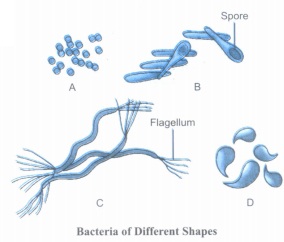
(a) Name the four groups of bacteria (A-D) shown in the figure given above.
(b) Name one disease caused by bacteria (i) in plants and (ii) in human beings, respectively.
9.
Linnaeus classified aU organisms into two kingdoms Plantae and Animalia; this system was used till recently. But now it has been found that the two kingdom system of classification is inadequate.
(a) Give four reasons to justify that the two-kingdom system of classification is inadequate.
(b) Who proposed the five-kingdom classification?
10.
Since the dawn of civilisation, there have been many attempts to classify the living organisms. The classification was done instinctively based on the use of the organisms for human benefits and not on any scientific criteria.
(a) Who was the first to classify organisms on a scientific basis?
(b) How did he classify plants?
(c) How did he classify animals?
1.
(a) A - Head, B - Collar, C - Sheath, D - Tail fibres
(b) The viruses are non-cellular and are characterised by an inert crystalline structure outside their living host cells; since, they are not truly 'living', they did not find a place in classification.
2.
(a) Bladderwort, Venus flytrap
(b) Cuscuta
(c) Cell wall is made of cellulose.
(d) It is the phenomenon in which the diploid sporophytic phase alternates with the haploid gametophytic phase, each producing the other.
3.
(a) A - Aspergillus
B - Agaricus
(b) A belongs to Ascomycetes.
B belongs to Basidiomycetes.
(c)
| Aspergillus | Agaricus |
| Ascospores are produced endogenously. | Basidiospores are produced exogenously. |
| Eight ascospores are formed in an ascus. | Four basidiospores are formed in a basidium. |
4.
(a) A - Euglena - It belongs to Euglenophyta.
B - Paramoecium - It belongs to Protozoa.
(b) Differences
| Euglena | Paramoecium |
| It has photosynthetic pigments similar to green plants. | It does not have any photosynthetic pigment. |
| It has flagella for locomotion. | It has ciIia for locomotion. |
5.
(a) Certain protists resemble plants in having
(i) a rigid cell wall.
(ii) photosynthetic pigments and being photoautotrophs.
(b) Slime moulds resemble
(i) fungi, in being saprotrophs.
(ii) animals, in showing holozoic nutrition, i.e., they engulf the organic food material.
(c) Protozoans resemble animals in
(i) lacking a cell wall for their cells.
(ii) showing holozoic nutrition.
6.
(a) A - Heterocyst; it is a specialised cell where nitrogen fixation occurs.
(b) Phycocyanin.
(c) They are photoautotrophs.
(d) The colonies of cyanobacteria are generally surrounded by a mucilaginous sheath; the cyanobacteria flourish in the ground during rainy season
7.
(a) Bacteria maybe
(i) photoautotrophs
(ii) chemoautotrophs
(iii) parasites
(iv) saprotrophs
(b) Archaebacteria differ from other bacteria in having a different cell wall structure that enables them to survive in extreme conditions.
8.
(a) A - Cocci, B - Bacilli, C - Spirilli, D - Vibrio
(b) (i) Citruscanker
(ii) Cholera/Typhoid/Tetanus
9.
(a) (i) It placed the prokaryotes (bacteria and blue-green algae) along with eukaryotic plants in kingdom Plantae.
(ii) It grouped together the unicellular organisms like Amoeba and Paramoecium with multicellular organisms like man.
(iii) Because of the presence of cell wall, the heterotrophic fungi were placed with autotrophic green plants in kingdom Plantae.
(iv) It has taken into account only the gross morphology as criterion for classification.
(v) There are a large number of organisms, which did not fall into either plant kingdom or animal kingdom.
(b) R. H. Whittaker
10.
(a) Aristotle
(b) He classified plants into trees, shrubs and herbs.
(c) He classified animals into those
(i) with red blood cells.
(ii) without red blood cells.

11th Standard CBSE Syllabus & Materials
11th Standard CBSE
CBSE 11th Business Studies Forms of Business Organisation Sample Question Papers Study Material - QB365 Set A
NEW11th Standard CBSE
CBSE 11th Business Studies Business, Trade and Commerce Sample Question Papers Study Material - QB365 Set A
NEW11th Standard CBSE
CBSE 11th Physics Waves Sample Question Papers Study Material - QB365 Set A
NEW11th Standard CBSE
CBSE 11th Physics Kinetic Theory Sample Question Papers Study Material - QB365 Set A



CBSE 11th Standard CBSE Subjects
CBSE Standards









