
 100% FREE ACCESS
11th Standard CBSE Syllabus & Materials
11th Standard CBSE
CBSE 11th Economics PART-A - Presentation of Data - New Sample Question Papers Study Material - QB365 Set A
NEW11th Standard CBSE
CBSE 11th Economics PART-A - Organisation of Data - New Sample Question Papers Study Material - QB365 Set A
NEW11th Standard CBSE
CBSE 11th Economics PART-A - Collection of Data - New Sample Question Papers Study Material - QB365 Set A
NEW11th Standard CBSE
CBSE 11th Economics PART-A - Introduction to Economics and Statistics - New Sample Question Papers Study Material - QB365 Set A
NEW11th Standard CBSE
CBSE 11th Business Studies International Trade Sample Question Papers Study Material - QB365 Set A
NEW11th Standard CBSE
CBSE 11th Business Studies Evolution and Fundamentals of Business Sample Question Papers Study Material - QB365 Set A

Published on: 09/09/2022
QB365 provides a detailed and simple solution for every Possible Case Study Questions in Class 11 Biology Subject - Biomolecules, CBSE. It will help Students to get more practice questions, Students can Practice these question papers in addition to score best marks.
Download CBSE Class 11th Standard CBSE Biology question papers, sample papers, important questions, and previous year solved papers in PDF format. Get free study materials, NCERT solutions, and exam preparation resources for Class 11th Standard CBSE Biology
Questions + Answers key
Take MCQ Biology Test
1.
Study the following graph showing the effect of substrate concentration on the rate of enzyme activity and answer the questions that follow:
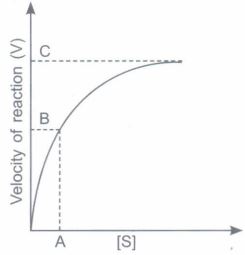
(a) Define what is represented by A.
(b) What does C represent in the graph?
(c) Why is there no further increase in the velocity of enzyme action with addition of substrate?
2.
The following graph shows the concept of activation energy.
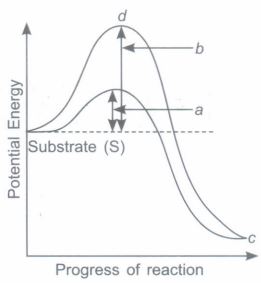
Study the graph and answer the following questions
(i) What do the letters 'a', 'b', 'c' and 'd' represent in the graph?
(il) What is activation energy?
3.
All enzymes (except ribozymes) are proteins. An enzyme, like any other protein, has a primary, secondary and tertiary structure. The protein functions as enzyme in its tertiary structure, where active sites are formed.
(a) What is active site of an enzyme?
(b) How are active sites formed?
(e) Mention one major difference between inorganic catalysts and enzyme catalysts.
4.
The tens and thousands of chemical compounds, called metabolites in a living organism are in a flux and the living state is a non-equilibrium steady-state. Metabolic inputs of energy prevent an equilibrium to be reached.
(a) Why is living state considered a non-equilibrium state?
(b) Living state and metabolism are considered synonymous. Justify the statement.
5.
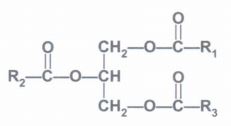
Study the molecular structure of the biomolecule given and answer the following questions.
(a) Identify the molecule shown.
(b) what do R1, R2, and R3 in the molecule represent?
(c) Name the alcohol involved in it. Give its another name.
6.

Study the changes in the structure of an amino acid shown above and answer the following questions.
(a) Mention the specific property of amino acids shown in the above structures. What is its consequence?
(b) What term is given to the form of amino acid in B?
7.
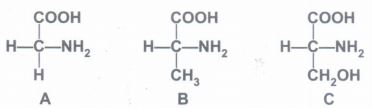
The molecular structures of three amino acids are given above.
(a) Identify the amino acids A, Band C
(b) Mention their respective variable group (designated as R-group).
8.
All the chemical elements found in a sample of earth's crust are also present in a sample of living tissue. But a critical chemical analysis shows that the relative abundance of carbon and hydrogen with respect to other elements is higher in the living organisms.
(a) Name the most abundant chemical compound in living organisms.
(b) What term is given to the carbon compounds in living cells?
(c) Name any two functional groups of such compounds.
(d) Name any two elements present in the 'ash' of plants.
9.
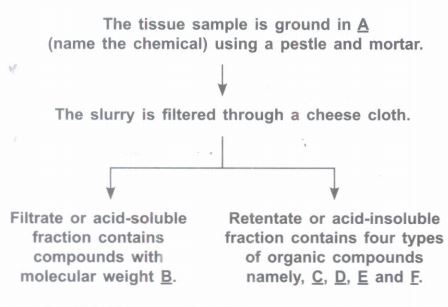
The steps in the chemical analysis of a living tissue sample are shown below. Fill in the blanks A, B, C, D, E and. F.
1.
(a) A represents Km value, which is the substrate concentration at which half-maximum velocity \(\left(\frac{\mathrm{V}_{\max }}{2}\right)\) of the reaction is reached.
(b) C represents the maximum velocity, i.e. Vmax of the reaction.
(c) It is because there is no free enzyme molecule to bind with the substrate molecules added.
2.
(i) 'a' - Activation energy with enzyme
'b' - Activation energy without enzyme
'c' - Product (P)
'd' - Transition state.
(ii) Activation energy refers to the difference in the average energy content of substrate (S) and that of the transition state.
3.
(a) An active site of an enzyme is a crevice or pocket into which the substrate fits.
(b) When the backbone of the protein chain folds upon itself to form the tertiary structure, the chain criss-crosses itself and many crevices or active sites are formed.
(c) Inorganic catalysts work efficiently at high temperatures, but the enzymes get denatured at high temperature.
4.
(a) (i) At equilibrium, the systems cannot perform work.
(ii) But living organisms work continuously and they cannot afford to reach equilibrium.
(b) (i) Living state is a non-equilibrium steady-state, to be able to perform work..
(ii) Living process is a constant effort to prevent equilibrium to be reached; it is achieved by energy input.
(iii) Metabolism provides mechanism for the production of energy; hence living state and metabolism are synonymous and there cannot be living state without metabolism.
5.
(a) It is a triglyceride
(b) R1, R2 and R3 represent the fatly acids.
(c) Glycerol : It is also called trihydroxy propane.
6.
(a) (i) The specific property of amino acids is the ionizable nature of NH2 group and COOH group.
(i) Consequently, the structure of amino acid changes in solutions of different pHs.
(b) Zwitterionic form.
7.
(a) A - Glycine
B - Alanine
C - Serine
(b) A - Hydrogen
B - Methyl group
C - Hydroxy methyl group.
8.
(a) Water
(b) Biomolecules
(c) Aldehydes, Ketones
(d) Calcium, Magnesium.
9.
A - Trichloro-acetic acid
B - 18-800 daltons
C - Polysaccharides
D Nucleic acids
E - Proteins
F - Lipids

11th Standard CBSE Syllabus & Materials
11th Standard CBSE
CBSE 11th Business Studies Forms of Business Organisation Sample Question Papers Study Material - QB365 Set A
NEW11th Standard CBSE
CBSE 11th Business Studies Business, Trade and Commerce Sample Question Papers Study Material - QB365 Set A
NEW11th Standard CBSE
CBSE 11th Physics Waves Sample Question Papers Study Material - QB365 Set A
NEW11th Standard CBSE
CBSE 11th Physics Kinetic Theory Sample Question Papers Study Material - QB365 Set A



CBSE 11th Standard CBSE Subjects
CBSE Standards









