
 100% FREE ACCESS
11th Standard CBSE Syllabus & Materials
11th Standard CBSE
CBSE 11th Economics PART-A - Presentation of Data - New Sample Question Papers Study Material - QB365 Set A
NEW11th Standard CBSE
CBSE 11th Economics PART-A - Organisation of Data - New Sample Question Papers Study Material - QB365 Set A
NEW11th Standard CBSE
CBSE 11th Economics PART-A - Collection of Data - New Sample Question Papers Study Material - QB365 Set A
NEW11th Standard CBSE
CBSE 11th Economics PART-A - Introduction to Economics and Statistics - New Sample Question Papers Study Material - QB365 Set A
NEW11th Standard CBSE
CBSE 11th Business Studies International Trade Sample Question Papers Study Material - QB365 Set A
NEW11th Standard CBSE
CBSE 11th Business Studies Evolution and Fundamentals of Business Sample Question Papers Study Material - QB365 Set A

Published on: 09/09/2022
QB365 provides a detailed and simple solution for every Possible Case Study Questions in Class 11 Biology Subject - Body Fluids and Circulation, CBSE. It will help Students to get more practice questions, Students can Practice these question papers in addition to score best marks.
Download CBSE Class 11th Standard CBSE Biology question papers, sample papers, important questions, and previous year solved papers in PDF format. Get free study materials, NCERT solutions, and exam preparation resources for Class 11th Standard CBSE Biology
Questions + Answers key
Take MCQ Biology Test
1.
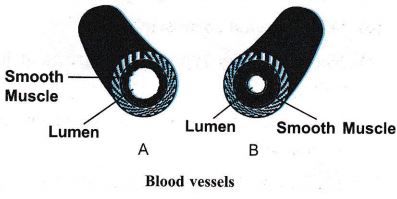
A diagrammatic sectional view of the blood vessels, artery and vein, is shown above. Answer the following questions.
(a) Identify the artery and vein. Justify your identification.
(b) Name the three layers in the wall of artery and vein. Which of them causes the difference in the thickness of the walls?
2.
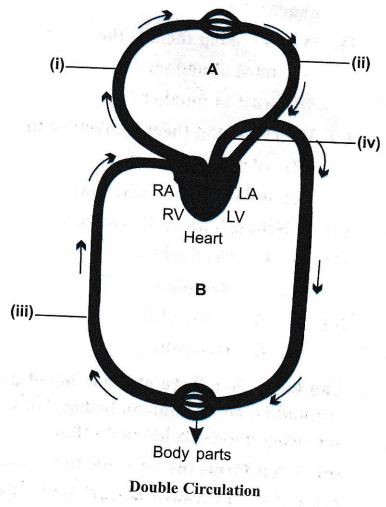
A schematic plan of double circulation in humans is shown above.
Answer the following questions.
(a) Identify and name the two pathways in the double circulation in human beings.
(b) Arteries are the blood vessels that carry blood from the heart to different parts of the body. Name the two major arteries that carry blood from the heart. Mention the difference in the blood they carry.
3.
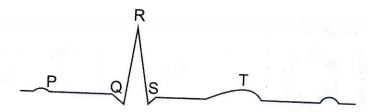
A diagrammatic representation of a standard ECG is given above.
Each of the peaks in the ECG is identified with a Ietter (P, e, R, S, T) which corresponds to a specific electrical activity of the heart.
Answer the following questions.
(a) What doeg f waveirepresent? What happens in the cardiac cycle during this?
(b) When does ventricular contraction start?
(c) What does T wave represent?
(d) How can the heart rate be calculated using ECG?
4.
If you injure your finger while cutting vegetables, the blood stops oozing out of the wound in a short time. Blood exhibits coagulation or clotting, a mechanism to prevent excess loss of blood from the body. A clot or coagulum is formed at the site of injury. The following flow chart shows the steps in the mechanism of coagulation. Fill in the blanks A to F.
When blood comes out of the blood vessels from an injury, the platelets release certain factors.
\(\downarrow\)
These factors stimulate the reactions in the plasma fo form enzyme (A)
\(\downarrow\)
The above enzyme converts (B) in the plasma into (C)
\(\downarrow\)
C converts the inactive (D) into a network of threads, called (E)
\(\downarrow\)
A coagulum or clot is formed when the dead and damaged (F) are trapped in E.
5.
There are two types of blood groupings - the ABO and Rh groups, which are widely used all over the world.
Answer the following questions regarding Regrouping.
(a) What forms the basis for classifying human individuals as Rh-positive and Rh-negative?
(b) If a foetus is suffering from a condition, called erythroblastosis fetal, identify the Rh group of the
(i) mother
(ii) father
(iii) foetus.
(c) How can this condition be avoided?
6.
Amit and Mrinal are good friends. Amit,s father had an injury and needed blood transfusion; he is of blood group B. Mrinal is of blood group A and he had arranged for blood donors.
(a) Name the blood groups that will be suitable for transfusion to Amit's father.
(b) Name the antigen and the antibody present in Mrinal's blood.
(c) Why are persons with blood group O known as 'universal donors'?
7.
You know that there are four blood groups, A, B AB, and O, among human beings. Now, answer the following questions based on that.
(a) What forms the basis for this classification?
(b) Before any transfusion of blood, why should the blood of the donor be matched carefully with that of the recipient?
(c) Why are persons with blood group AB called (universal recipient'?
(d) Name the blood group(s), which
(i) persons with blood group 'O'can receive
(ii) can be donated only to persons with blood group'AB'.
8.
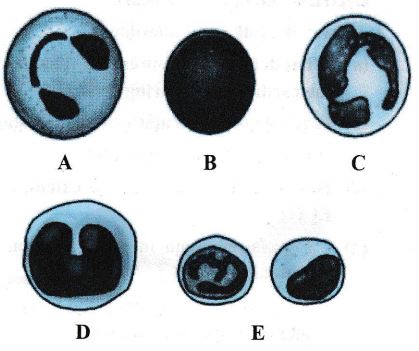
The above diagram shows the different types of leucocytes.
Identify and name the cells as asked in the following questions.
(a) Name the two types of leucocytes that are phagocytic.
(b) Which among them is the
(i) most abundant
(ii) least in number?
(c) Which among them is involved in
(i) allergic r:eactions
(ii) inflammatory reactions?
1.
(a) (i) A is a vein, as it has a large lumen and a thinner wal1.
(ii) B is an artery, as it has a narrow lumen and a thicker wall.
(b) Tunica externa (outermost)
Tunica media (middle)
Tunica intema (innermost)
(i) Tunica media is thicker in arteries than in the veins.
2.
(a) A- Pulmonary circulation
B - Systemic circulation
(b) The two major arteries are:
(i) Pulmonary artery
(a) It carries deoxygenated blood.
(ii) Aorta
(a) It carries oxygenated blood.
3.
(a) (i) P-wave represents the depolarisation of atrial muscles.
(ii) The atria start contracting and blood is pushed into the respective ventricles.
(b) It srarts shortly after e in the standard ECG.
(c) T-wave represents the repolarisation of the ventricles.
(d) BV counting the number of eRS complex in the ECG, the heart rate can be calculated.
4.
A - Thrombokinase
B - Prothrombin
C - Thrombin
D - Fibrinogen
E - Fibrin
F - Formed elements.
5.
(a) The presence or absence of Rh antigen (similar to the one present in Rhesus monkeys), on the surface of red blood cells (RBCs), forms the basis for categorising human individuals as Rh positive or Rh negative.
(b) (i) Rh negative
(ii) Rh positive
(iii) Rh positive
(c) This condition can be avoided by injecting antrRh-antibodies to the mother immediately after the delivery of the first child.
6.
(a) Blood groups O and B.
(b) Antigen A, anti-B antibodies.
(c) Persons with blood group 'O'can donate blood to persons of any of the four blood groups, A, B, A,B or O; hence they are called 'universal donors'.
7.
(a) The presence or absence of antigens A, B, or both A and B on the surface of red blood cells, forms the basis for classification of blood groups.
(b) It is to avoid problems of clumping, i.e., destruction of RBCs.
(c) Persons with blood group AB can receive blood from persons of any of the four blood groups, i.e., A, B, AII, Only O group, or O; hence they are called 'universal recipients'.
(d) (i) Only O group
(ii) Blood group AB.
8.
(a) C Neutrophils and D - Monocyes.
(b) (i) C-Neutrophils
(ii) B - Basophils
(c) (i) A-Eosinophils
(ii) B - Basophils.

11th Standard CBSE Syllabus & Materials
11th Standard CBSE
CBSE 11th Business Studies Forms of Business Organisation Sample Question Papers Study Material - QB365 Set A
NEW11th Standard CBSE
CBSE 11th Business Studies Business, Trade and Commerce Sample Question Papers Study Material - QB365 Set A
NEW11th Standard CBSE
CBSE 11th Physics Waves Sample Question Papers Study Material - QB365 Set A
NEW11th Standard CBSE
CBSE 11th Physics Kinetic Theory Sample Question Papers Study Material - QB365 Set A



CBSE 11th Standard CBSE Subjects
CBSE Standards









