
 100% FREE ACCESS
11th Standard CBSE Syllabus & Materials
11th Standard CBSE
CBSE 11th Economics PART-A - Presentation of Data - New Sample Question Papers Study Material - QB365 Set A
NEW11th Standard CBSE
CBSE 11th Economics PART-A - Organisation of Data - New Sample Question Papers Study Material - QB365 Set A
NEW11th Standard CBSE
CBSE 11th Economics PART-A - Collection of Data - New Sample Question Papers Study Material - QB365 Set A
NEW11th Standard CBSE
CBSE 11th Economics PART-A - Introduction to Economics and Statistics - New Sample Question Papers Study Material - QB365 Set A
NEW11th Standard CBSE
CBSE 11th Business Studies International Trade Sample Question Papers Study Material - QB365 Set A
NEW11th Standard CBSE
CBSE 11th Business Studies Evolution and Fundamentals of Business Sample Question Papers Study Material - QB365 Set A

Published on: 09/09/2022
QB365 provides a detailed and simple solution for every Possible Case Study Questions in Class 11 Biology Subject - Breathing and Exchange of Gases, CBSE. It will help Students to get more practice questions, Students can Practice these question papers in addition to score best marks.
Download CBSE Class 11th Standard CBSE Biology question papers, sample papers, important questions, and previous year solved papers in PDF format. Get free study materials, NCERT solutions, and exam preparation resources for Class 11th Standard CBSE Biology
Questions + Answers key
Take MCQ Biology Test
1.
Study the graph given below and answer the questions that follow:
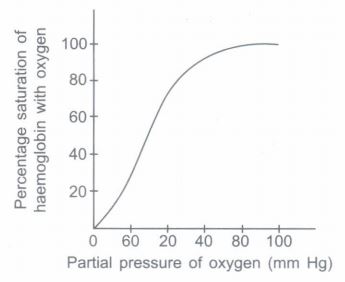
(a) Name and define the curve.
(b) What is the significance of plotting this curve?
(c) How much of oxygen is transported by every 100 ml of blood under normal physiological conditions?
2.
A diagram of a section of an alveolus with a pulmonary capillary is given below. Answer the questions that follow:
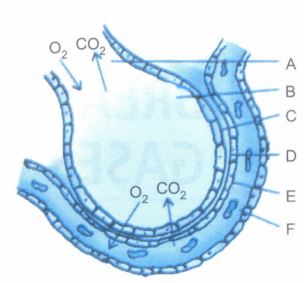
Exchange between Alveolus and Capillaries
(a) Identify the three major layers that form the diffusion membrane. What is the total thickness of the membrane?
(b) Mention the two factors that affect the rate of diffusion of gases
3.
A diagrammatic representation of the transport of oxygen and carbon dioxide in the blood and their exchange at alveolus and the body tissues, is shown below.
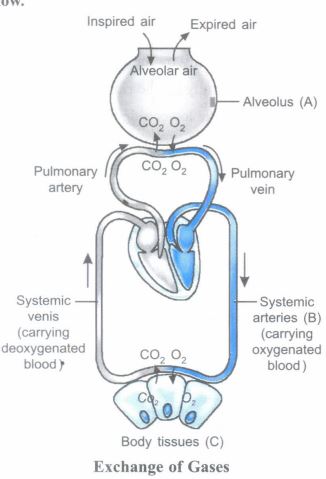
Give the values of PO2 and PCP2 at A, Band C shown in the diagram.
4.
The two stages in the breathing process are shown below. Observe the diagram and answer the question that follow:
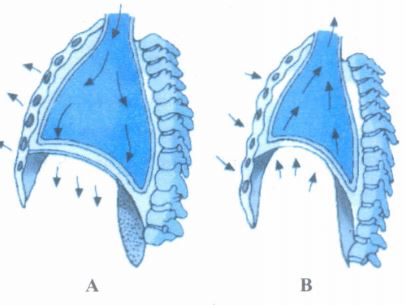
(a) Identify the two stages (A and B) of breathing.
(b) Mention the condition and the position of diaphragm in A and B, respectively.
(c) Compare the intra-pulmonary air pressure in the stages A and B.
5.
The lungs are situated in the thoracic chamber, which is anatomically an air-tight chamber. Answer the following questions regarding this.
(a) Mention the boundaries of the thoracic chamber that make it an air-tight chamber.
(b) What is its significance?
(c) Why is it essential for breathing?
6.
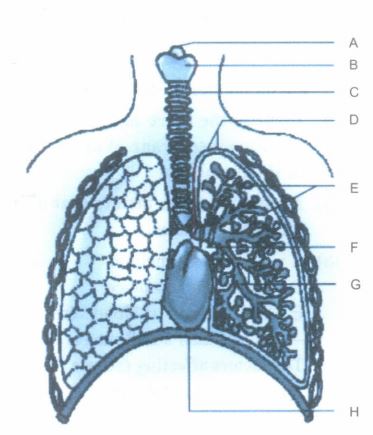
A diagrammatic view of human respiratory system (with a sectional view of the left lung) is shown above. Answer the following questions
(a) Identify any four parts belonging to the conducting part of the respiratory system.
(b) Mention any two functions of the conducting parts of the system other than the transport of air to alveoli.
1.
(a) It is oxygen dissociation curve, i.e., the curve plotted with the percentage saturation of haemoglobin with oxygen against the partial pressure of oxygen. (b) It is useful to study the effect of factors like PCO2 , H+ concentration, etc. on the binding of oxygen with haemoglobin.
(c) 5 ml.
2.
(a) C - Alveolar epithelium
D - Basement substance
E - Endothelium of blood vessel
(i) It is less than a millimetre.
(b) The factors affecting the rate of diffusion include.
(i) solubility of the gas.
(ii) thickness of the membrane.
3.
A - PO2104 mm Hg
PCO240 mm Hg
B - PO2 95 mm Hg
PCO2 40 mm Hg
C - PO2 40 mm Hg
PCO2 45 mm Hg
4.
(a) A - Inspiration
B - Expiration
(b) (i) In A, the diaphragm is contracted and is pulled downwards.
(ii) In B, the diaphragm is relaxed and arched upwards.
(c) (i) In A, the intra-pulmonary air pressure is lower and in B, it is higher than that of the atmospheric air pressure.
5.
(a) The thoracic chamber is bounded
(i) dorsally by the vertebral column
(ii) ventrally by the sternum
(iii) laterally by the ribs
(iv) on the lower side by the diaphragm
(b) This anatomical setup of the lungs in the thoracic cavity is such that any change in the volume of the thoracic cavity will be reflected in the pulmonary volume.
(c) It is essential for breathing because we cannot directly alter the pulmonary volume.
6.
(a) B. Larynx
C. Trachea
F. Bronchus
G. Bronchiole.
(b) (i) It clears the inspired air from foreign particles.
(ii) It brings the air to the body temperature.
(iii) It moistens\humidifies the air. (any two)

11th Standard CBSE Syllabus & Materials
11th Standard CBSE
CBSE 11th Business Studies Forms of Business Organisation Sample Question Papers Study Material - QB365 Set A
NEW11th Standard CBSE
CBSE 11th Business Studies Business, Trade and Commerce Sample Question Papers Study Material - QB365 Set A
NEW11th Standard CBSE
CBSE 11th Physics Waves Sample Question Papers Study Material - QB365 Set A
NEW11th Standard CBSE
CBSE 11th Physics Kinetic Theory Sample Question Papers Study Material - QB365 Set A



CBSE 11th Standard CBSE Subjects
CBSE Standards









