
 100% FREE ACCESS
11th Standard CBSE Syllabus & Materials
11th Standard CBSE
CBSE 11th Economics PART-A - Presentation of Data - New Sample Question Papers Study Material - QB365 Set A
NEW11th Standard CBSE
CBSE 11th Economics PART-A - Organisation of Data - New Sample Question Papers Study Material - QB365 Set A
NEW11th Standard CBSE
CBSE 11th Economics PART-A - Collection of Data - New Sample Question Papers Study Material - QB365 Set A
NEW11th Standard CBSE
CBSE 11th Economics PART-A - Introduction to Economics and Statistics - New Sample Question Papers Study Material - QB365 Set A
NEW11th Standard CBSE
CBSE 11th Business Studies International Trade Sample Question Papers Study Material - QB365 Set A
NEW11th Standard CBSE
CBSE 11th Business Studies Evolution and Fundamentals of Business Sample Question Papers Study Material - QB365 Set A

Published on: 09/09/2022
QB365 provides a detailed and simple solution for every Possible Case Study Questions in Class 11 Biology Subject - Cell Cycle and Cell Division, CBSE. It will help Students to get more practice questions, Students can Practice these question papers in addition to score best marks.
Download CBSE Class 11th Standard CBSE Biology question papers, sample papers, important questions, and previous year solved papers in PDF format. Get free study materials, NCERT solutions, and exam preparation resources for Class 11th Standard CBSE Biology
Questions + Answers key
Take MCQ Biology Test
1.
Study the two stages of cell division in the given figure and answer the questions that follow:
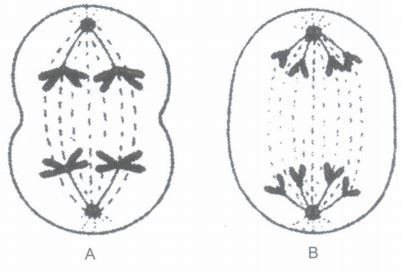
(a) Identify the stage and the type of cell division in A and B.
(b) Write one major difference between the two.
2.
Sexual reproduction involves fusion of two gametes, each with a complete haploid set of chromosomes. In animals, gametes are formed from specialised diploid cells. Meiosis ensures the production of haploid phase in the life cycle of sexually reproducing organisms and fertilisation restores the diploid phase.
(a) Mention the four key features of meiosis.
(b) Why does reduction in the number of chromosomes occur during meiosis?
3.
Mitosis accomplishes not only the segregation of the duplicated chromosomes to daughter nuclei, but the cell itself divides into two daughter cells, by cytokinesis. In animal cells, cytokinesis occurs with the appearance of a furrow in the cell membrane that deepens and joins in the centre to divide the cell, but in plants it is different.
(a) Why cannot the plant cells divide the same way as animalcells?
(b) Name the precursor of cell walls in plant cells. What does it represent in the cell wall?
(c) What will be the consequence, if cytokinesis does not follow karyokinesis? Give an example.
4.
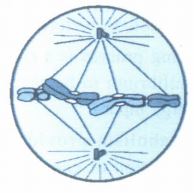
(a) Identify the stage and type of cell division.
(b) Write the two key features of this phase.
(c) Is it a plant cell or animal cell showing the process? Justify your answer.
5.
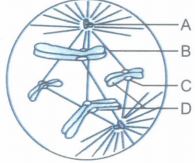
(a) Label the parts A, B, C and D in the diagram given above.
(b) Determine the stage and the event that is represented.
6.
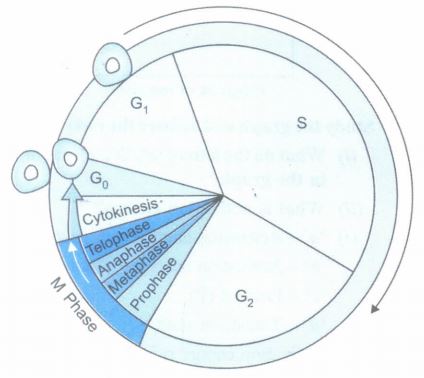
A diagrammatic representation of the cell cycle indicating the formation of two daughter cells from a parent cell is giVen above. Observe the diagram and answer the following questions.
(a) When does replication of DNA take place?
(b) The amount of DNA in G1 phase is denoted as 2C and the chromosome number as 2n. Show
(i) the amount of DNA and
(ii) the chromosome number in prophase.
(c) Why is mitosis called equational division?
1.
(a) A - Anaphase I of meiosis
B - Anaphase of mitosis
(b) (i) During anaphase I (A), the centromeres have not divided; a chromosome with two chromatids held together by a centromere moves to the opposite pole.
(ii) During anaphase (B), the centromere has divided and only one chromatid of a chromosome, now called a daughter chromosome, moves to the pole.
2.
(a) (i) Meiosis involves two sequential cycles of nuclear and cell division, called meiosis I and meiosis II, but only a single cycle of DNA replication.
(ii) Meiosis I is initiated after the chromosomes have replicated to produce identical sister chromatids at S-phase.
(iii) Meiosis involves pairing of homologous chromosomes and recombination between them.
(iv) Four haploid cells are formed at the end of meiosis II.
b) It is because during Anaphase I, the centromeres do not divide and one member of each homologous pair of chromosomes moves to one pole and the other to the opposite pole; hence half the number of chromosomes reach the poles.
3.
(a) Since the plant cells have an inextensible rigid cell wall, they cannot undergo cytokinesis as animal cells do.
(b) (i) Cell plate is the precursor of cell wall.
(ii) It represents the middle lamella.
(c) If cytokinesis does not follow karyokinesis, it will lead to the formation of a multinucleate cell (syncytium) e.g. the liquid endosperm of coconut.
4.
(a) It is the metaphase of mitosis.
(b) Key features of metaphase.
(i) Spindle fibres attach to kinetochores of chromosomes.
(ii) Chromosomes are moved to spindle. equator and get aligned along metaphasic plate through spindle fibres to both poles.
(c) It is an animal cell because centrioles are found in the opposite poles; they have formed the spindle fibres.
5.
(a) A. Centriole
B. Spindle fibre
C. Kinetochore
D. Chromosome
(b) It is the prometaphase, i.e. transition from prophase to metaphase.
(i) Condensation of the chromosomes is complete.
(ii) The chromosomes are moving towards the centre of the spindle.
6.
(a) Replication of DNA occurs in the S-phase of interphase.
(b) (i) 4C
(ii) 2n
(c) Since the number of chromosomes in the parent cell and the daughter cells is the same, mitosis is called equational division.

11th Standard CBSE Syllabus & Materials
11th Standard CBSE
CBSE 11th Business Studies Forms of Business Organisation Sample Question Papers Study Material - QB365 Set A
NEW11th Standard CBSE
CBSE 11th Business Studies Business, Trade and Commerce Sample Question Papers Study Material - QB365 Set A
NEW11th Standard CBSE
CBSE 11th Physics Waves Sample Question Papers Study Material - QB365 Set A
NEW11th Standard CBSE
CBSE 11th Physics Kinetic Theory Sample Question Papers Study Material - QB365 Set A



CBSE 11th Standard CBSE Subjects
CBSE Standards









