
 100% FREE ACCESS
11th Standard CBSE Syllabus & Materials
11th Standard CBSE
CBSE 11th Economics PART-A - Presentation of Data - New Sample Question Papers Study Material - QB365 Set A
NEW11th Standard CBSE
CBSE 11th Economics PART-A - Organisation of Data - New Sample Question Papers Study Material - QB365 Set A
NEW11th Standard CBSE
CBSE 11th Economics PART-A - Collection of Data - New Sample Question Papers Study Material - QB365 Set A
NEW11th Standard CBSE
CBSE 11th Economics PART-A - Introduction to Economics and Statistics - New Sample Question Papers Study Material - QB365 Set A
NEW11th Standard CBSE
CBSE 11th Business Studies International Trade Sample Question Papers Study Material - QB365 Set A
NEW11th Standard CBSE
CBSE 11th Business Studies Evolution and Fundamentals of Business Sample Question Papers Study Material - QB365 Set A

Published on: 09/09/2022
QB365 provides a detailed and simple solution for every Possible Case Study Questions in Class 11 Biology Subject - Cell: The Unit of Life, CBSE. It will help Students to get more practice questions, Students can Practice these question papers in addition to score best marks.
Download CBSE Class 11th Standard CBSE Biology question papers, sample papers, important questions, and previous year solved papers in PDF format. Get free study materials, NCERT solutions, and exam preparation resources for Class 11th Standard CBSE Biology
Questions + Answers key
Take MCQ Biology Test
1.
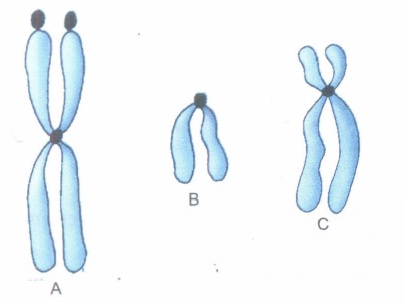
Three types of chromosomes are shown in the figure given above. Answer the following questions.
(a) Identify and name the types of chromosomes, A, Band C.
(b) What forms the basis for such a classification of chromosomes?
(c) What are kinetochores?
2.
Nucleus as a cell organelle was described by Robert Brown (1831). The interphase nucleus under an electron microscope shows a double-layered nuclear membrane, which encloses the nuclear matrix/nucleoplasm.
(a) Name the organelle that is not membrane-bound and present in the nuclear matrix.
(b) Mention its function.
(c) What is perinuclear space?
(d) Name a human cell that lacks a nucleus.
3.
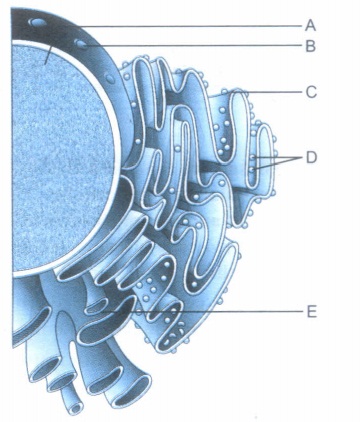
The EM picture of endoplasmic reticulum is given above. Answer the following questions
(a) Identify the rough endoplasmic reticulum and smooth endoplasmic reticulum from among the parts labelled in the above diagram.
(b) Name the two compartments of the intracellular space as divided by the endoplasmic reticulum.
(c) Write the function of SER in animal cells.
4.
Eukaryotic cells have a number of membrane-bound cell organelles that are distinct in their structure and functions. Yet, some of the cell organelles are described together as forming an endomembrane system.
(a) Name the cell organelles included in the en do membrane system.
(b) Why are they considered so?
5.
Cell wall is a non-living rigid structure that forms an outer covering for the plasma membrane in some protists, fungi and plants. It protects the cell from mechanical injuries and infections and helps in cell-to-cell interactions.
(a) name the three layers in the cell wall of a mature plant cell.
(b) Mention any three components of cell wall of algae.
6.
The improved model of the structure of cell membrane proposed by Singer and Nicolson (1972), is called fluid mosaic model. The fluid nature of the membrane is important from the point of view of certain functions.
(a) What is meant by fluidity of membrane?
(b) Mention any four functions for which the fluid nature of the membrane is necessary.
7.
Detailed electron microscopic and other chemical investigations have shown that the cell membrane is composed of lipids, proteins and some carbohydrates.
(a) What per cent of the membrane of human erythrocytes consists of lipids?
(b) Name the major lipid component of membranes.
(c) How are the lipids arranged in the membranes?
(d) What are the two types of membrane proteins based on the ease with which they are extracted?
8.
The prokaryotic cells have certain specialised, differentiated infoldings of the cell membrane. They serve certain specific functions.
(a) What term is given to these infoldings?
(b) Name the three different forms of such infoldings.
(c) Mention two of their functions during cell division.
9.
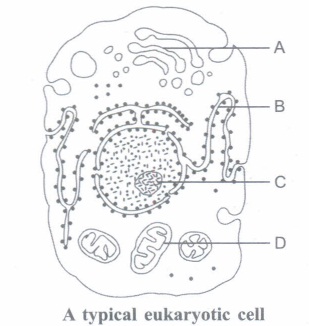
The diagram given above shows the diagrammatic representation of a typical eukaryotic cell.
(a) Identify the following parts
(i) Mitochondria
(ii) Endoplasmic reticulum
(iii) Golgi bodies
(iv) Nucleolus
(b) Name the following:
(i) The longest cells in a human body.
(ii) The organisms with the smallest cells
10.
All organisms are composed of cell(s), i.e. organisms are unicellular or multicellular. The discovery of microscope and its improvement leading to the electron microscope has revealed all the structural details of cells.
(a) Why are cells considered the fundamental structural and functional units of life?
(b) Mention two characteristic features of unicellular organisms.
(c) Name the scientist who
(i) first observed and described living cells.
(ii) showed that cell wall is a unique character of plant cells.
1.
(a) A - Metacentric chromosome
B - Telocentric chromosome
C - Acrocentric chromosome
(b) The position of centromere in the chromosome forms the basis for such a classification
(c) Kinetochores are the disc-shaped structures present on the sides of the centromere.
2.
(a) Nucleolus
(b) It is the site of active synthesis of ribosomal RNA.
(c) The space between the outer and inner nuclear membranes, is called perinuclear space.
(d) Erythrocytes
3.
(a) C is rough endoplasmic reticulum. E is smooth endoplasmic reticulum.
(b) (i) Luminal compartment (inside ER)
(ii) Extra-luminal compartment (cytoplasm i.e., outside the ER)
(c) In animal cells, the SER is the major site of synthesis of lipid-like steroidal hormones.
4.
(a) Endomembrane system includes endoplasmic reticulum, golgi bodies, lysosomes and vacuoles.
(b) They are considered so because their functions are coordinated.
5.
(a) The three layers are
(i) primary wall
(ii) middle lamella
(iii) secondary wall
(b) Algal cell wall is made of
(i) cellulose
(ii) galactans
(iii) mannans
6.
(a) Fluidity refers to the ability of proteins for lateral movement within the overall bilayer of lipids.
(b) Fluid nature of membrane is necessary for functions like
(i) formation of intercellular junctions
(ii) cell growth
(iii) endocytosis
(iv) cell division
(v) secretion
7.
(a) 40 per cent
(b) Phosphoglycerides
(c) The lipids are arranged in a bilayer with the polar head towards the outer sides and the hydrophobic tails towards the inner part.
(d) (i) Extrinsic proteins (ii) Intrinsic/integral proteins
8.
(a) Mesosomes
(b) Vesicles, tubules, lamellae
(c) Functions
(i) They help in cell wall formation.
(ii) They aid in distribution of DNA to the daughter cells.
9.
(a) (i) - D - Mitochondria
(ii) - B - Endoplasmic reticulum
(iii) - A - Golgi bodies
(iv) - C - Nucleolus
(b) (i) Nerve cells
(ii) Mycoplasmas
10.
(a) Cell is considered the fundamental structural and functional unit of life because anything less than a complete structure of a cell does not ensure independent living.
(b) Unicellular organisms are capable of
(i) independent existence.
(ii) performing all the essential life processes.
(c) (i) Anton Von Leeuwenhoek
(ii) Theodore Schwann

11th Standard CBSE Syllabus & Materials
11th Standard CBSE
CBSE 11th Business Studies Forms of Business Organisation Sample Question Papers Study Material - QB365 Set A
NEW11th Standard CBSE
CBSE 11th Business Studies Business, Trade and Commerce Sample Question Papers Study Material - QB365 Set A
NEW11th Standard CBSE
CBSE 11th Physics Waves Sample Question Papers Study Material - QB365 Set A
NEW11th Standard CBSE
CBSE 11th Physics Kinetic Theory Sample Question Papers Study Material - QB365 Set A



CBSE 11th Standard CBSE Subjects
CBSE Standards









