
 100% FREE ACCESS
11th Standard CBSE Syllabus & Materials
11th Standard CBSE
CBSE 11th Economics PART-A - Presentation of Data - New Sample Question Papers Study Material - QB365 Set A
NEW11th Standard CBSE
CBSE 11th Economics PART-A - Organisation of Data - New Sample Question Papers Study Material - QB365 Set A
NEW11th Standard CBSE
CBSE 11th Economics PART-A - Collection of Data - New Sample Question Papers Study Material - QB365 Set A
NEW11th Standard CBSE
CBSE 11th Economics PART-A - Introduction to Economics and Statistics - New Sample Question Papers Study Material - QB365 Set A
NEW11th Standard CBSE
CBSE 11th Business Studies International Trade Sample Question Papers Study Material - QB365 Set A
NEW11th Standard CBSE
CBSE 11th Business Studies Evolution and Fundamentals of Business Sample Question Papers Study Material - QB365 Set A

Published on: 09/09/2022
QB365 provides a detailed and simple solution for every Possible Case Study Questions in Class 11 Biology Subject - Excretory Products and Their Elimination, CBSE. It will help Students to get more practice questions, Students can Practice these question papers in addition to score best marks.
Download CBSE Class 11th Standard CBSE Biology question papers, sample papers, important questions, and previous year solved papers in PDF format. Get free study materials, NCERT solutions, and exam preparation resources for Class 11th Standard CBSE Biology
Questions + Answers key
Take MCQ Biology Test
1.
Mammals/humans can excrete hyperosmotic urine or hypo-osmotic urine depending on the availability of water in the body. The regulation of kidney functioning is under both neural and hormonal control.
(a) Where are the osmoreceptors located in our body?
(b) Mention any two factors that activate the osmoreceptors
(c) Name the hormone secreted under water scarcity. Mention the two ways in which it acts.
2.
The renal tubule consists of Bowman's capsule, proximal convoluted tubule, Henle's loop, distal convoluted tubule and the collecting tubule. 70-80o/o of the glomerular filtrate is reabsorbed in the PCT.
(a) How is the structure of PCT suited for this absorption?
(b) Why is glomerular filtration considered as ultra filtration?
(c) How does the descending limb of Henle's loop differ from the ascending limb in its permeability to substances?
3.
The kidneys have built-in mechanisms for the regulation of glomerular filtration rate. One such mechanism carried out by the juxta glomerular apparatus is shown in the following flow chart. Fill in the blanks A, B. C, D, E and F in the flow chart.
The (A) cells release Renin when there is a fall in (B)
\(\downarrow\)
Renin converts (C) in the in blood into (D)
\(\downarrow\)
D activates the adrenal cortex to release (E)
\(\downarrow\)
E raises the reabsorption of Na+ and water and raises the (F)
4.
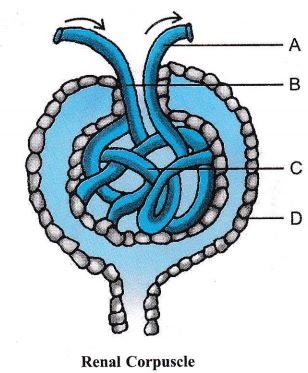
A diagram of a Malpighian body (also called Renal corpuscle) is given above. Answer the following questions
(a) Name the parts labelled as A, B, C and D.
(b) What does the Malpighian body continue as?
(c) What are peritubular capillaries?
5.
Nephrons are the structural and functional of human kidneys; they are the complex tubular structures.
(a) What are the two major parts of a nephron?
(b) What is renal corpuscle?
(c) Name the two types of nephrons in human kidneys.
6.
A survey of the animal kingdom shows that different groups of animals have different types of excretory structures. They depend on their habitats and the nature of the excretory products.
(a) Human kidneys perform not only excretion of nitrogenous wastes, but also another function. Name that function.
(b) Name the excretory structures of
(i) Amphioxus
(ii) Crustaceans (iii) Insects
(iv) Platyhelminths
(v) Annelids.
7.
Animals accumulate nitrogenous wastes, carbon dioxide, water and some inorganic ions as metabolic wastes, which have to be eliminated totally or partially.
(a) Name the most toxic and the least toxic nitrogenous wastes.
(b) Kidneys do not play any significant role in the elimination of Ammonia. How is ammonia eliminated by animals?
(c) What term is given to the animals which excrete urea as their major nitrogenous waste?
(d) How is carbon dioxide eliminated by human beings?
1.
(a) Osmoreceptors are located in the hypothalamus.
(b) They, are activated by changes in the
(i) blood volume
(ii) body fluid volume and
(iii) ionic concentration.
(c) Antidiuretiq hormone/Vasopressin
(i) It induces water reabsorption by DCT.
(ii) It constricts the blood vessels, increases the blood pressure and thereby the GFR.
2.
(a) PCT is lined by simple cuboidal brush-bordered epithelium that increases the surface area for absorption.
(b) Since almost all the constituents of plasma except proteins, arefilterg4 it is called ultrafiltration.
(c) Ascending limb'is permeable to electrolytes, but impermeable to water.
Descending limb is permeable to water, but impermeable to electrolytes.
3.
A - Juxtaglomerular
B - Glomerular filtration rate
C - Angiotensinogen
D - Angiotensin II
E - Aldosterone
F - Blood pressure and glomerular filtration rate.
4.
(a) A - Efferent arteriole
B - Afferent arteriole
C - Glomerulus
D - Bowman's capsule
(b) It continues as the proximal convoluted tubule (PCT).
(c) The fine capillary network formed by the efferent arteriole around the renal tubule, is called peritubular capillaries.
5.
(a) Glomerulus and renal tubule are the two parts of a nephron.
(b) The Bowman's capsule along with the glomerulus in its cavity, is called renal cotpuscle.
(c) Cortical nephrons and juxtamedullary nephrons.
6.
(a) Osmoregulation
(b) (i) Protonephridia
(ii) Green glands
(iii) Malpighian tubules
(iv) Flame cells
(v) Nephridia.
7.
(a) (i) Ammonia is the most toxic.
(ii) Uric acid is the least toxic
(b) Ammonia is eliminated
(i) by diffusion through body surface.
(ii) through surface of gills (in flshes).
(c) Ureoteiic animals.
(d) Carbon dioxide is removed by the lungs

11th Standard CBSE Syllabus & Materials
11th Standard CBSE
CBSE 11th Business Studies Forms of Business Organisation Sample Question Papers Study Material - QB365 Set A
NEW11th Standard CBSE
CBSE 11th Business Studies Business, Trade and Commerce Sample Question Papers Study Material - QB365 Set A
NEW11th Standard CBSE
CBSE 11th Physics Waves Sample Question Papers Study Material - QB365 Set A
NEW11th Standard CBSE
CBSE 11th Physics Kinetic Theory Sample Question Papers Study Material - QB365 Set A



CBSE 11th Standard CBSE Subjects
CBSE Standards









