
 100% FREE ACCESS
11th Standard CBSE Syllabus & Materials
11th Standard CBSE
CBSE 11th Economics PART-A - Presentation of Data - New Sample Question Papers Study Material - QB365 Set A
NEW11th Standard CBSE
CBSE 11th Economics PART-A - Organisation of Data - New Sample Question Papers Study Material - QB365 Set A
NEW11th Standard CBSE
CBSE 11th Economics PART-A - Collection of Data - New Sample Question Papers Study Material - QB365 Set A
NEW11th Standard CBSE
CBSE 11th Economics PART-A - Introduction to Economics and Statistics - New Sample Question Papers Study Material - QB365 Set A
NEW11th Standard CBSE
CBSE 11th Business Studies International Trade Sample Question Papers Study Material - QB365 Set A
NEW11th Standard CBSE
CBSE 11th Business Studies Evolution and Fundamentals of Business Sample Question Papers Study Material - QB365 Set A

Published on: 09/09/2022
QB365 provides a detailed and simple solution for every Possible Case Study Questions in Class 11 Biology Subject - Locomotion and Movement, CBSE. It will help Students to get more practice questions, Students can Practice these question papers in addition to score best marks.
Download CBSE Class 11th Standard CBSE Biology question papers, sample papers, important questions, and previous year solved papers in PDF format. Get free study materials, NCERT solutions, and exam preparation resources for Class 11th Standard CBSE Biology
Questions + Answers key
Take MCQ Biology Test
1.
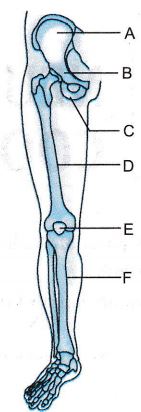
A diagram of the bones of pelvic girdle and hind limb is shown above. Observe the diagram and answer the questions given below
(a) Identify the components of a coxal bone of the pelvic bone.
(b) Name the cavity in the pelvic girdle into which the head of femur fits. What Epe of a joint is it?
(c) Name the type of tissue that makes up pubic symphysis.
2.
The diagram of a pectoral girdle of a human is shown below. Observe the diagram. fill in the blanks in the description ofthe structure of a pectoral girdle of humans.
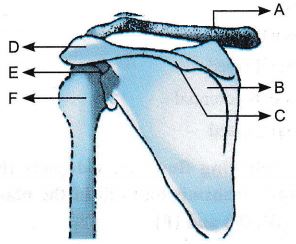
Each pectoral girdle is formed of two bones, ______(A) and ________(B) shown in the diagram. The bone B has an elevated ridge, called __________(C), which projects as a flat expanded process, called _________(D), where the A articulates. Below D is a depression called ________(E), where the ________(F) articulates.
3.
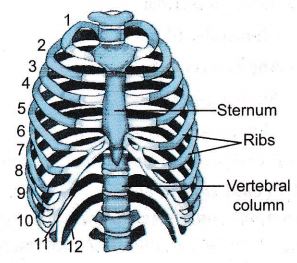
A diagram of human rib cage is given above, Observe the diagram and answer the following questions.
(a) What are true ribs? How many are true ribs in the rib cage?
(b) What are vertebrochondral ribs?
(c) Why are the ribs described as bicephalic?
4.
Radha was running on a treadmill at a great speed for 15 minutes continuously. She stopped the treadmill abruptly and came out. For the next few minutes, she was breathing heavily/fast. Answer the following questions.
(a) What happened to her muscles, when she strenuously exercised?
(b) Why did her breathing rate change?
5.
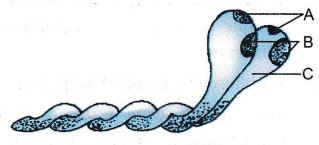
A diagrammatic sketch of a myosin filament is given above. Answer the following questions.
(a) Identify the following in the diagram of myosin filament.
(i) ATP-binding sites
(ii) Actin-binding sites
(b) Name the monomers of myosin.
(c) Expand
(i) HMM and
(ii) LMM.
6.
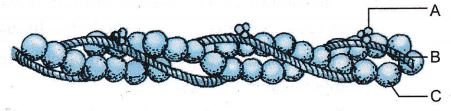
A diagrammatic sketch of an actin filament is shown aboye. Answer the following questions.
(a) Name the parts labelled A, B and C.
(b) What is the significance of A during resting stage?
(c) Name the monomers of C.
1.
(a) A - Ilium,
B - Pubis,
C - Ischium make up the coxal bone.
(b) Acetabulum
(i) It is a ball and socket joint.
(c) Fibrous gsrtilage.
2.
A - Clavicle
B - Scapula
C - Spine
D -Acromion
E - Glenoid cavity
F - Head of humerus.
3.
(a) (i) True ribs are those ribs which are attached dorsally to the thoracic vertebrae and ventrally connected to the stemum.
(ii) The first seven pairs ofribs are true ribs.
(b) Vertebrochondral ribs are the 8th, 9th and 10th pairs of ribs, which are attached dorsally to the thoracic vertebrae and are attached to the,seventh rib by hyaline cartilage.
(c) Each rib is bicephalic because it has two articulation surfaces on its dorsal end.
4.
(a) (i) When she strenuously exercised, her muscles must have experienced deficiency of oxygen.
(ii) The anaerobic metabolism must have resulted in the accumulation of lactic acid leading to muscle fatigue.
(b) The breathing rate has increased to supply more oxygen to the muscles for oxidation of lactic acid to produce more energy.
5.
(a) (i) B
(ii) A
(b) Meromyos
(c) (i) Heavy meromyosin
(ii) Light meromyosin.
6.
(a) A - Troponin
B Tropomyosin
C F-actin
(b) Troponin masks the myosin-binding sites on the actin filament.
(c) Globular actin (G-actin).

11th Standard CBSE Syllabus & Materials
11th Standard CBSE
CBSE 11th Business Studies Forms of Business Organisation Sample Question Papers Study Material - QB365 Set A
NEW11th Standard CBSE
CBSE 11th Business Studies Business, Trade and Commerce Sample Question Papers Study Material - QB365 Set A
NEW11th Standard CBSE
CBSE 11th Physics Waves Sample Question Papers Study Material - QB365 Set A
NEW11th Standard CBSE
CBSE 11th Physics Kinetic Theory Sample Question Papers Study Material - QB365 Set A



CBSE 11th Standard CBSE Subjects
CBSE Standards









