
 100% FREE ACCESS
11th Standard CBSE Syllabus & Materials
11th Standard CBSE
CBSE 11th Economics PART-A - Presentation of Data - New Sample Question Papers Study Material - QB365 Set A
NEW11th Standard CBSE
CBSE 11th Economics PART-A - Organisation of Data - New Sample Question Papers Study Material - QB365 Set A
NEW11th Standard CBSE
CBSE 11th Economics PART-A - Collection of Data - New Sample Question Papers Study Material - QB365 Set A
NEW11th Standard CBSE
CBSE 11th Economics PART-A - Introduction to Economics and Statistics - New Sample Question Papers Study Material - QB365 Set A
NEW11th Standard CBSE
CBSE 11th Business Studies International Trade Sample Question Papers Study Material - QB365 Set A
NEW11th Standard CBSE
CBSE 11th Business Studies Evolution and Fundamentals of Business Sample Question Papers Study Material - QB365 Set A

Published on: 09/09/2022
QB365 provides a detailed and simple solution for every Possible Case Study Questions in Class 11 Biology Subject - Mineral Nutrition, CBSE. It will help Students to get more practice questions, Students can Practice these question papers in addition to score best marks.
Download CBSE Class 11th Standard CBSE Biology question papers, sample papers, important questions, and previous year solved papers in PDF format. Get free study materials, NCERT solutions, and exam preparation resources for Class 11th Standard CBSE Biology
Questions + Answers key
Take MCQ Biology Test
1.
An example of one of the methods of synthesis of amino acids in plants is shown below. Answer the questions that follow:
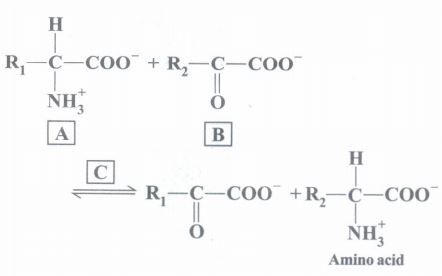
(a) Name the process of synthesis of amino acid shown above.
(b) Fill in the blanks \(\begin{array}{|l|}
\hline \mathrm{A} \\
\hline
\end{array}\) , \(\begin{array}{|l|}
\hline \mathrm{B} \\
\hline
\end{array}\) and \(\begin{array}{|l|}
\hline \mathrm{C} \\
\hline
\end{array}\).
(c) Name the two most important amides in plants.
2.
Given below is the flow chart of the nitrogen cycle showing the relationship among the three main nitrogen pools, i.e. atmospheric, biomass and soil. Study the diagram and answer the questions that follow:
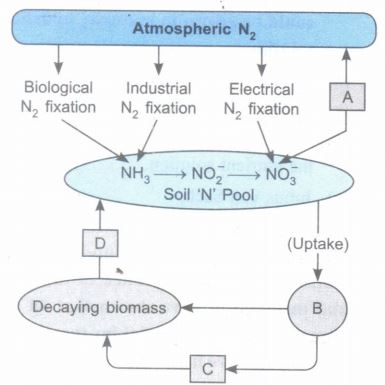
(a) Fill in the blanks, A, B, C and D.
(b) Name two bacteria that carry out the step A.
3.
The micronutrients are always required in minute or trace quantities; their moderate decrease in quantity causes deficiency symptoms to appear while their moderate increase in quantity causes toxicity.
(a) What is meant by toxicity of an element?
(b) How does manganese toxicity cause deficiency symptoms of
(i) iron and
(ii) magnesium?
4.
Plants absorb a number of elements from the soil; about sixty elements are found in different plants. But, studies with reference to mineral nutrition and metabolism have shown that all the elements absorbed are not essential for the plants. Scientists like Arnon, have listed the essential elements based on certain criteria.
Write the three criteria of essentiality of elements in plant nutrition.
5.
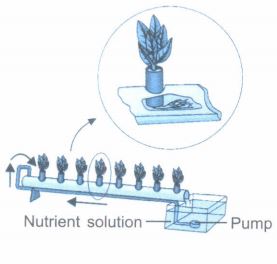
The picture given above shows hydroponic plant production, where plants are grown in a tube that is kept on a slight incline.
(a) What is the role of the pump in this experiment?
(b) What do the arrows indicate?
(c) Name the scientist who first showed that plants could be grown to maturity in defined nutrient solution.
6.
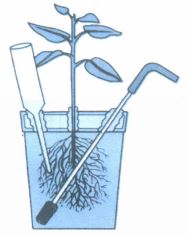
Observe the diagram given above and answer the following questions.
(a) Name the technique shown in the figure.
(b) Name any two plants for which this technique can be emplhyed for their commercial production.
(c) Mention the purpose for which
(i) the feeding funnel and
(ii) the aeration tube are used in this experimental set-up.
1.
(a) The process is transamination.
(b) A - Amino-donor
B - Amino-acceptor
C - Transaminase
(c) Asparagine and glutamine.
2.
(a) A - Denitrification
B - Plant biomass
C - Animal biomass
D - Ammonification.
(b) Pseudomonas and Thiobacillus.
3.
(a) Toxicity of an element refers to the concentration of that element in plant tissues, which reduces the dry weight of the tissues by about ten per cent.
(b) (i) Manganese competes with the uptake of iron.
(ii) It competes with magnesium for uptake and also for binding to the enzymes.
4.
Only those elements with the following features are essential for survival.
(i) The element must be absolutely necessary for normal growth and development; in the absence of the element, the plant will not be able to complete the life cycle.
(ii) The requirement of the element must be specific and not replaceable by any other element.
(iii) The element must be directly involved in the metabolism of the plant.
5.
(a) The pump is to circulate the nutrient solution from a reservoir to the elevated end of the tube.
(b) The arrows indicate the direction of the flow of the nutrient solution.
(c) Julius von Sachs.
6.
(a) Hydroponics is the technique.
(b) Tomato, seedless cucumber, lettuce. (any two)
(c) (i) It is for adding water and nutrients to maintain the concentration of nutrients constant.
(ii) It is for aerating the solution so that oxygen is available to the roots.

11th Standard CBSE Syllabus & Materials
11th Standard CBSE
CBSE 11th Business Studies Forms of Business Organisation Sample Question Papers Study Material - QB365 Set A
NEW11th Standard CBSE
CBSE 11th Business Studies Business, Trade and Commerce Sample Question Papers Study Material - QB365 Set A
NEW11th Standard CBSE
CBSE 11th Physics Waves Sample Question Papers Study Material - QB365 Set A
NEW11th Standard CBSE
CBSE 11th Physics Kinetic Theory Sample Question Papers Study Material - QB365 Set A



CBSE 11th Standard CBSE Subjects
CBSE Standards









