
 100% FREE ACCESS
11th Standard CBSE Syllabus & Materials
11th Standard CBSE
CBSE 11th Economics PART-A - Presentation of Data - New Sample Question Papers Study Material - QB365 Set A
NEW11th Standard CBSE
CBSE 11th Economics PART-A - Organisation of Data - New Sample Question Papers Study Material - QB365 Set A
NEW11th Standard CBSE
CBSE 11th Economics PART-A - Collection of Data - New Sample Question Papers Study Material - QB365 Set A
NEW11th Standard CBSE
CBSE 11th Economics PART-A - Introduction to Economics and Statistics - New Sample Question Papers Study Material - QB365 Set A
NEW11th Standard CBSE
CBSE 11th Business Studies International Trade Sample Question Papers Study Material - QB365 Set A
NEW11th Standard CBSE
CBSE 11th Business Studies Evolution and Fundamentals of Business Sample Question Papers Study Material - QB365 Set A

Published on: 09/09/2022
QB365 provides a detailed and simple solution for every Possible Case Study Questions in Class 11 Biology Subject - Morphology of Flowering Plants, CBSE. It will help Students to get more practice questions, Students can Practice these question papers in addition to score best marks.
Download CBSE Class 11th Standard CBSE Biology question papers, sample papers, important questions, and previous year solved papers in PDF format. Get free study materials, NCERT solutions, and exam preparation resources for Class 11th Standard CBSE Biology
Questions + Answers key
Take MCQ Biology Test
1.
Study the floral diagram given below and answer the questions that follow:
(a) Identify the family, it represents.
(b) Write its floral formula.
(c) Give one example from this family, that is
(i) source of medicine
(ii) used as vegetable
(iii) an ornamental plant
2.
Generally seeds are endospermic in monocotyledonous plants with a few exceptions. In cereals like maize, the seed coat is membranous and is fused with the fruit wall; in them the endosperm is bulky and stores food.
(a) Give an example of a monocot, in which the seed is non-endospermic.
(b) What is the outer covering of endosperm in maize, called?
(c) Name the sheaths in which
(i) the plumule and
(ii) the radicle, are enclosed respectively, in a maize grain.
(d) What is scutellum?
3.
The ovules after fertilisation develop into seeds. The parts/components of a seed are shown below. Answer the questions that follow:
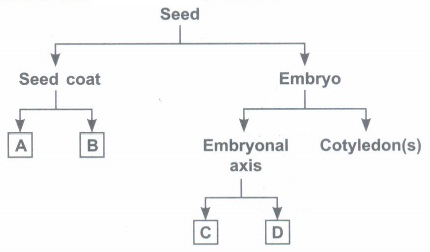
(a) Identify the two layers (A and B) of the seed coat and the two parts (C and D) of the embryonal axis.
(b) Give an example of a seed that (l) has endosperm (it) is non-endospermous
4.
The fruit is a characteristic feature of angiosperms. It is a mature or ripened ovary, usually developed after fertilisation, with a few exceptions.
(a) What are parthenocarpic fruits?
(b) Identify the three parts, the pericarp can be differentiated into, when it is thick and fleshy as in mango.
(c) What type of fruit is coconut?
5.
Placentation refers to the distribution of placenta and the mode of arrangement of ovules within the ovary. The following figure shows three types of placentation, A, Band C.
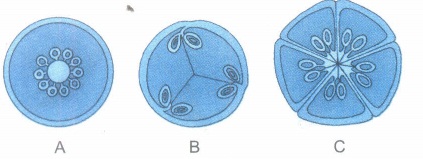
Identify the type of placentation and give one example of each.
6.
Androecium is composed of stamen(s). Each stamen representing the male reproductive organ of a flower consists of a filament and an anther. The pollen grains are produced inside the anther in the pollen sacs.
(a) How many pollen sacs does an anther contain?
(b) What is a staminode?
(c) What are epipetalous stamens? Give an example.
7.
Aestivation refers to the arrangement of sepals or petals in relation to one another in the bud condition. Three different types of aestivation (A, B, C) are given below.
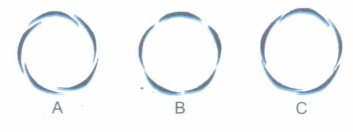
Identify the types of aestivation and give an example of each.
8.
The following diagrams show the position of floral parts on the thalamus.
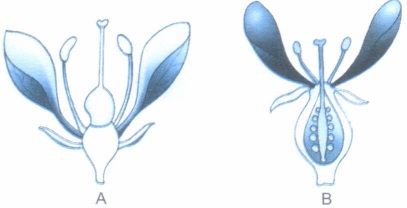
(a) Identify the type of flowers A and B. Give an example of each.
(b) Mention the nature of the ovary in each case.
9.
The flower is the reproductive structure of an angiosperm, meant for sexual reproduction. A typical/complete flower has four different whorls arranged successively on the swollen end of the flower stalk, called pedicel.
(a) What name is given to the swollen end of the pedicel?
(b) Name the accessory whorls of a complete flower.
(c) What is perianth? Give an example.
10.
An axis bearing flowers in a particular fashion, is called an inflorescence. Two major types of inflorescence (A and B) are shown below. Study the figure and answer the questions that follow:
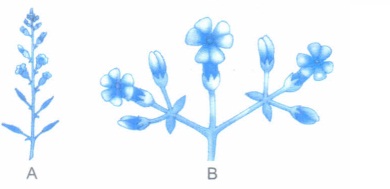
(a) Identify the type of inflorescence, A and B shown above.
(b) What forms the basis for this classification?
(c) Write one more difference between the two.
11.
Two types of compound leaves are shown below.
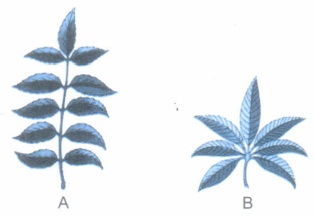
(a) Identify the types of compound leaves, A and B.
(b) Give an example of each.
(c) How do they differ from each other?
12.
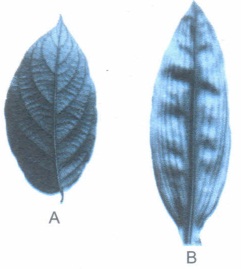
(a) Identify the two types of venation A and B.
(b) What is meant by venation?
(c) Mention two functions the veins perform.
13.
Stem is the above-ground part of a plant and is characterised by the presence of nodes and internodes and axillary and terminal buds. But, in some plants, the stem is modified to perform certain special functions. How is the stem modified in each of the following and mention their functions?
(a) Citrus
(b) Opuntia
(c) Coloeasia
14.
Roots in some plants change their shape and structure and become modified to perform functions other than anchorage and absorption and conduction of water and minerals. They are modified for storage, respiration, additional support, etc.
(a) Name two types of roots that provide additional support to plants and give an example for each.
(b) Name the type of root that helps to get atmospheric oxygen for respiration. Give an example.
15.
The figure given below represents the different regions of a root tip.
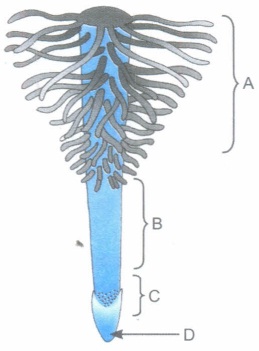
(a) Identify the regions A, B, C and D in the root tip.
(b) Write any two characteristics of the cells present in the region C
1.
(a) It represents Liliaceae.

(c) (i) Aloe
(ii) Asparagus
(iii) Gloriosa, tulips
2.
(a) Orchid
(b) Aleurone layer
(c) (i) Coleoptile
(ii) Coleorhiza
(d) The single, shield-shaped cotyledon of cereal grains, is called scutellum.
3.
(a) A - Testa
B - Tegmen
C - Plurnule
D - Radicle
(b) (i) - Castor
(ii) - Bean
4.
(a) Parthenocarpic fruits are those fruits which are formed without fertilisation of the ovary.
(b) Parts of pericarp
(i) outer, epicarp
(ii) middle, mesocarp
(iii) inner, endocarp
(c) It is a drupe.
5.
A - Free-central placentation
e.g. Dianthus/Primula
B - Parietal placentation
e.g. Mustard/Cucumber
C - Axile placentation
e.g. Tomato/Lemon
6.
(a) Two pollen sacs.
(b) A sterile stamen is called a staminode.
(c) When the stamens are attached to the petals, they are described as epipetalous stamens, e.g. brinjal.
7.
A - Twisted aestivation e.g. corolla of China rose/cotton
B - Valvate aestivation e.g. corolla of Calotropis
C - Imbricate aestivation e.g. corolla of Cassia
8.
(a) A - Hypogynous flower, e.g. mustard/brinjal
B - Epigynous flower, e.g. guava/cucumber
(b) A - The ovary is superior.
B - The ovary is inferior.
9.
(a) Thalamus
(b) Calyx and corolla are the accessory whorls.
(c) When the accessory whorls in a flower cannot be differentiated into calyx and corolla, the term perianth is used, e.g. Lily.
10.
(a) A - Racemose inflorescence
B - Cymose inflorescence
(b) The basis for classification of inflorescence is whether the apex (of the main axis) continues to grow or gets modified into a flower.
(c) (i) In racemose inflorescence, the flowers are borne laterally on the axis in an acropetal succession.
(ii) In cymose inflorescence, the apex terminates in a flower and flowers are arranged in a basipetal order.
11.
(a) A - Pinnately compound leaf
B - Palmately compound leaf
(b) A- e.g. Neem
B - e.g. Silk cotton
(c) In pinnately compound leaves (A), a number of leaflets are arranged along the length of the rachis.
In palmately compound leaves (B), the leaflets are attached at a common point in the tip of the rachis.
12.
(a) A - Reticulate venation
B - Parallel venation
(b) Venation refers to the mode of arrangement of veins and the vein lets in the lamina of a leaf.
(c) Functions of veins
(i) They act as channels for transport of water, minerals and food materials.
(ii) The veins provide rigidity to the leaf blade.
13.
(a) In Citrus, the stem is modified into thorns.
They protect the plant from browsing animals.
(b) In Opuntia, the stem becomes fleshy, flattened and green.
It carries out photosynthesis.
(c) In Colocasia, the stem is underground and swollen with stored food materials.
It is an organ of perennation to tide over unfavourable conditions.
14.
(a) Roots that provide additional support
(i) Prop roots - e.g. Banyan
(ii) Stilt roots - e.g. Sugarcane/Maize
(b) Pneumatophores, e.g. Rhizophora
15.
(a) A - Region of maturation
B - Region of elongation
C - Region of meristematic activity
D - Root cap
(b) The cells in C (meristem)
(i) are thin-walled
(ii) have dense protoplasm
(iii) divide repeatedly

11th Standard CBSE Syllabus & Materials
11th Standard CBSE
CBSE 11th Business Studies Forms of Business Organisation Sample Question Papers Study Material - QB365 Set A
NEW11th Standard CBSE
CBSE 11th Business Studies Business, Trade and Commerce Sample Question Papers Study Material - QB365 Set A
NEW11th Standard CBSE
CBSE 11th Physics Waves Sample Question Papers Study Material - QB365 Set A
NEW11th Standard CBSE
CBSE 11th Physics Kinetic Theory Sample Question Papers Study Material - QB365 Set A



CBSE 11th Standard CBSE Subjects
CBSE Standards









