
 100% FREE ACCESS
11th Standard CBSE Syllabus & Materials
11th Standard CBSE
CBSE 11th Economics PART-A - Presentation of Data - New Sample Question Papers Study Material - QB365 Set A
NEW11th Standard CBSE
CBSE 11th Economics PART-A - Organisation of Data - New Sample Question Papers Study Material - QB365 Set A
NEW11th Standard CBSE
CBSE 11th Economics PART-A - Collection of Data - New Sample Question Papers Study Material - QB365 Set A
NEW11th Standard CBSE
CBSE 11th Economics PART-A - Introduction to Economics and Statistics - New Sample Question Papers Study Material - QB365 Set A
NEW11th Standard CBSE
CBSE 11th Business Studies International Trade Sample Question Papers Study Material - QB365 Set A
NEW11th Standard CBSE
CBSE 11th Business Studies Evolution and Fundamentals of Business Sample Question Papers Study Material - QB365 Set A

Published on: 09/09/2022
QB365 provides a detailed and simple solution for every Possible Case Study Questions in Class 11 Biology Subject - Neural Control and Coordination, CBSE. It will help Students to get more practice questions, Students can Practice these question papers in addition to score best marks.
Download CBSE Class 11th Standard CBSE Biology question papers, sample papers, important questions, and previous year solved papers in PDF format. Get free study materials, NCERT solutions, and exam preparation resources for Class 11th Standard CBSE Biology
Questions + Answers key
Take MCQ Biology Test
1.
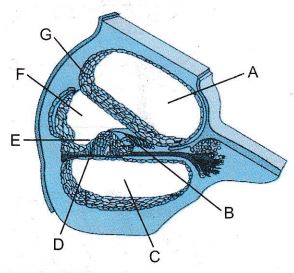
A diagrammatic representation of the sectional view of cochlea is given above.
Identify and name the following structures from the diagram:
(a) The two membranes that divide the perilymph-filled bony labyrinth.
(b) The chamber containing endolymph.
(c) The structure containing auditory receptor hair cells.
(d) The elastic membrane above the rows of hair cells.
(e) The upper chamber containing perilymph.
2.
Anatomically, the human ear can be divided into three regions,
(i) external ear,
(ii) middle ear and
(iii) inner ear. The inner ear, also called labyrinth, consists of two parts,
(i) the coiled part, cochlea and
(ii) the vestibular apparatus
(a) Mention the component parts of the vestibular apparatus.
(b) Name the specific receptors in the vestibular apparatus.
(c) What is the function of vestibular apparatus?
3.
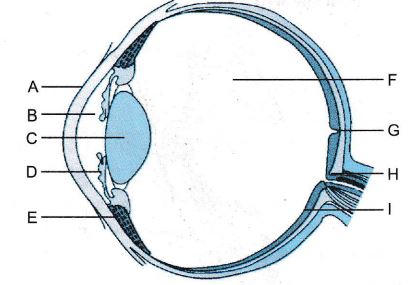
The diagram showing parts of an eye is given above.
Identify and name the part as asked below.
(a) The anterior part of sclera.
(b) The thinned-out portion of the retina that contains only cones.
(c) The thickened anterior part of choroid.
(d) The space between the lens and retina.
(e) The pigmented and opaque structure that forms the coloured portion of the eye.
(f) The point slightly above the posterior pole through which optic nerve leaves the eyeball.
4.
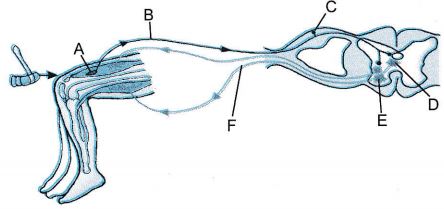
A diagrammatic representation of the reflex action (knee-jerk reflex) is shown above. The components of a reflex arc are labelled.
Identify the labels A to F shown on the diagram.
5.
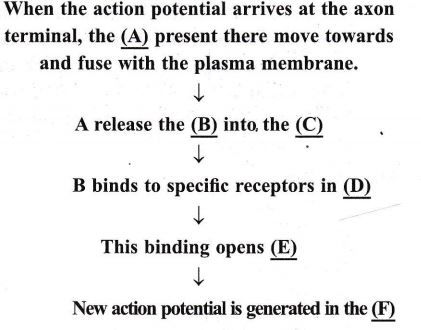
The following flow chart depicts the events in synaptic transmission. Fill in the blanks (A), (B), (C), (D), (E) and (F).
6.
The following flow chart gives the steps in the generation and conduction of a nerve impulse along a nerve fibre. Fill in the blanks A, B, C, D, E and F. At resting/polarised state of the neuron, the electrical potential difference is called ______ (A).
\(\downarrow\)
When the neuron is stimulated at a point, there is a rapid influx of _____(B) and the outer side becomes ______(C) charged.
\(\downarrow\)
The membrane is ______(D) and the potential difference across the membrane, is called _______(E).
\(\downarrow\)
The permeability of the membrane to B is very short-lived and the membrane potential A is restored, i.e. membrane is _______(F).
7.
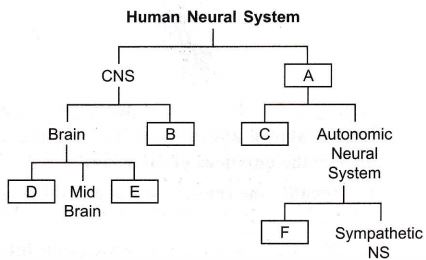
The major parts of the human neural system are depicted below.
Fill in the empty boxes (A to F) with the appropriate words.
1.
(o) G Reissner's membrane
D - Basilar membrane
(b) F Scala media
(c) E - Organ of Corti
(d) B - Tectorial membrane
(e) A Scala vestibuli.
2.
(a) Vestibular apparatus consists of three semicircular canals and an otolith organ, consisting of utricle and saccule.
(b) Crista and macula.
(c) lt is responsible for the maintenance of body balance and posture.
3.
(a) -A-Cornea
(b) -G-Fovea
(c) -E-Ciliarybody
(d) -F -Vitreous chamber
(e) -D-Iris
(f) -H-Blindspot
4.
A - Receptor (muscle spindle)
B - Afferent pathway
C - Dorsal root ganglion
D - Interneuron
E - Motor neuron
F - Efferent pathway.
5.
(A) Synaptic vesicles
(B) Neurotransmitters
(C) Synaptic cleft
(D) Post-synaptic membrane
(E) Ion channels
(F) Post-synaptic neuron.
6.
A. Resting potential
B. Na
C. Negatively
D. Depolarised
E. Action potential
F. Repolarised.
7.
A - PNS (Peripheral nervous system)
B - Spinal cord C - Somatic nervous system
D - Forebrain
E - Hindbrain
F - Parasympathetic nervous system.

11th Standard CBSE Syllabus & Materials
11th Standard CBSE
CBSE 11th Business Studies Forms of Business Organisation Sample Question Papers Study Material - QB365 Set A
NEW11th Standard CBSE
CBSE 11th Business Studies Business, Trade and Commerce Sample Question Papers Study Material - QB365 Set A
NEW11th Standard CBSE
CBSE 11th Physics Waves Sample Question Papers Study Material - QB365 Set A
NEW11th Standard CBSE
CBSE 11th Physics Kinetic Theory Sample Question Papers Study Material - QB365 Set A



CBSE 11th Standard CBSE Subjects
CBSE Standards









