
 100% FREE ACCESS
11th Standard CBSE Syllabus & Materials
11th Standard CBSE
CBSE 11th Economics PART-A - Presentation of Data - New Sample Question Papers Study Material - QB365 Set A
NEW11th Standard CBSE
CBSE 11th Economics PART-A - Organisation of Data - New Sample Question Papers Study Material - QB365 Set A
NEW11th Standard CBSE
CBSE 11th Economics PART-A - Collection of Data - New Sample Question Papers Study Material - QB365 Set A
NEW11th Standard CBSE
CBSE 11th Economics PART-A - Introduction to Economics and Statistics - New Sample Question Papers Study Material - QB365 Set A
NEW11th Standard CBSE
CBSE 11th Business Studies International Trade Sample Question Papers Study Material - QB365 Set A
NEW11th Standard CBSE
CBSE 11th Business Studies Evolution and Fundamentals of Business Sample Question Papers Study Material - QB365 Set A

Published on: 09/09/2022
QB365 provides a detailed and simple solution for every Possible Case Study Questions in Class 11 Biology Subject - Photosynthesis in Higher Plants, CBSE. It will help Students to get more practice questions, Students can Practice these question papers in addition to score best marks.
Download CBSE Class 11th Standard CBSE Biology question papers, sample papers, important questions, and previous year solved papers in PDF format. Get free study materials, NCERT solutions, and exam preparation resources for Class 11th Standard CBSE Biology
Questions + Answers key
Take MCQ Biology Test
1.
The figure given below shows the effect of light intensity on the rate of photosynthesis.
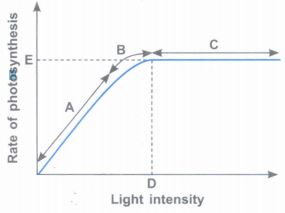
Based on the graph, answer the following questions.
(a) Give two reasons, why there is no increase in the rate of photosynthesis, beyond light intensity at D.
(b) Mention any two factors that could be limiting at point A.
2.
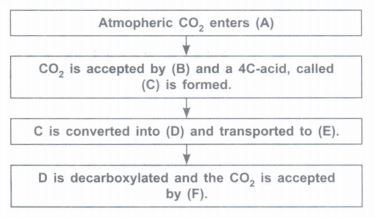
Fill in the blanks (A), (B), (C), (D), (E) and (F) in the following flow-chart, representing the Hatch-Slack pathway.
3.
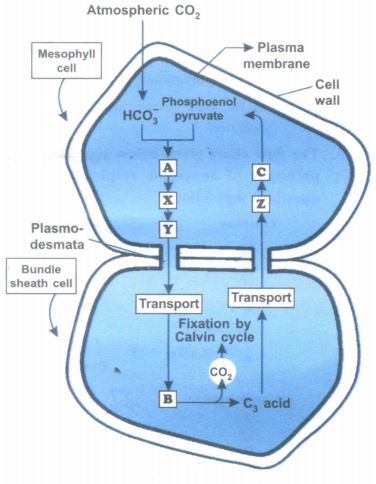
A diagrammatic representation of the Hatch and Slack .pathway of photosynthesis is shown above.
(a) Name the processes A; Band C.
(b) Write the name of:
(i) X
(ii) Y
(iii) Z.
4.
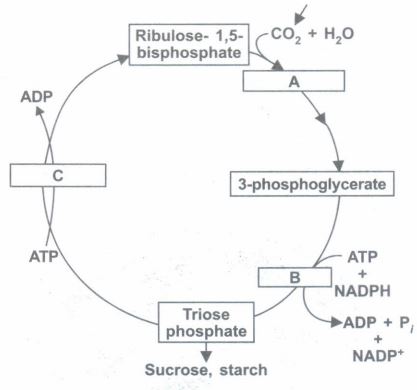
A schematic representation of the Calvin cycle of photosynthesis is given above.
Name the processes A, Band C and mention what happens during each of them.
5.
Observe the flow-chart given below and answer the questions that follow.
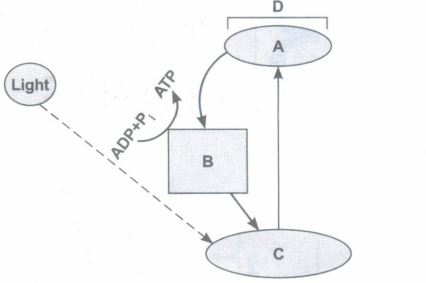
(a) Name the parts labelled A, B, C, and D.
(b) Which type of phosphorylation is possible in this?
(c) Name the exact site where this process occurs in the chloroplast.
6.
\(2 \mathrm{H}_{2} \mathrm{O} \rightarrow 4 \mathrm{H}^{+}+\mathrm{O}_{2}+4 \mathrm{e}^{-}\)
Based on the above equation, answer the following questions.
(a) Name the process, the equation represents.
(b) Mention the fate of each of the products formed.
(c) Where does this process occur in the chloroplast?
7.
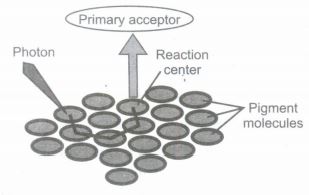
A diagrammatic representation of a Light Harvesting Complex (LHC) is shown in the figure given above. Answer the following questions.
(a) How do the antennae pigments help to make photosynthesis more efficient?
(b) Name the pigment that forms the reaction centre.
(c) Name the reaction centre of photosystem I and photosystem II.
8.
In the following figure, the curve A represents the rate of photosynthesis while the curve B represents the absorption spectrum of chlorophyll-a. Observe the graph and answer the questions that follow:
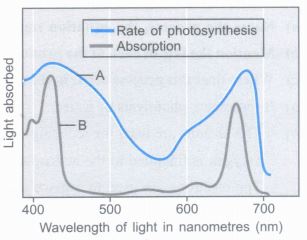
(a) What is absorption spectrum?
(b) Where in the visible spectrum of light, is there maximum photosynthesis?
(c) How is the rate of photosynthesis measured for plotting action spectrum?
9.
If you look at plants, there are so many shades of green in their leaves, even on the same plant. When you separate the leaf pigments through paper chromatography, you find that the colour of the leaves is not due to a single pigment, but due to four different pigments.
(a) What is a pigment?
(b) Name the four different pigments found in leaves.
(c) Can you guess, which is the most abundant leaf pigment in the world?
10.
Study the figure given below and answer the questions that follow:
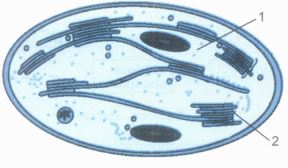
(a) Name the cells where it is present abundantly.
(b) Name the process of photosynthesis that occurs in the parts labelled 1 and 2.
(c) Name the products formed at 2, that are used in the process at 1.
(d) Name the first stable product formed in the process at 1.
11.
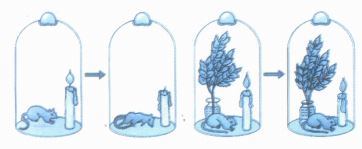
Observe the experimental setup and answer the following questions.
(a) Name the scientist who conducted this experiment.
(b) What did he conclude from this experiment?
(c) Name the scientist who showed that
(i) light is necessary for photosynthesis.
(ii) glucose is made in those parts of a plant that are green.
1.
(a) (i) Some other factor must be limiting.
(ii) High light intensity can damage the chlorophyll.
(b) Temperature, CO2 concentration.
2.
A - Mesophyll cell
B - Phosphoenol pyruvate
C - Oxaloacetic acid
D - Malic acid
E - Bundle sheath cell
F - Ribulose I, 5-bisphosphate.
3.
(a) A - Fixation of CO2
B - Decarboxylation
C - Regeneration
(b) X - Oxaloacetic acid
Y - Malic acid
Z - Pyruvic acid.
4.
A. Carboxylation
(i) Carbon dioxide is accepted by Ribulose 1, 5-bisphosphate to form 3-phosphoglyceric acid.
B. Reduction
(i) Carbohydrate is formed with the utilisation of ATP and NADPH formed during light reaction.
C. Regeneration
(i) Ribulose I, 5-bisphosphate is formed so that the cycle can continue.
5.
(a) A - e- acceptor
B - Electron transport system
C - P700
D - Photosystem I
(b) Cyclic phosphorylation
(e) Stroma lamellae.
6.
(a) It represents photolysis of water.
(b) (i) The protons are used for reducing NADP.
(ii) Oxygen is liberated to the atmosphere.
(iii) The electrons are used to replace the electrons removed from PS II.
(e) This process occurs in the inner side of the thylakoid membrane.
7.
(a) The antennae pigments absorb light at different wavelengths and pass on the energy to the reaction centre and thereby make the process more efficient.
(b) Chlorophyll-a
(e) P700 in PS I and P680 in PS II.
8.
(a) It is a graph plotted with the amount of light absorbed as a function of wavelength.
(b) In the red and blue regions.
(c) It is measured by the amount of oxygen released.
9.
(a) A pigment is a substance that has the ability to absorb light at a specific wavelength.
(b) Chlorophyll-a, Chlorophyll-b, Carotene and Xanthophyll.
(c) Chlorophyll-a.
10.
(a) Mesophyll cells of leaves.
(b) 1. Calvin cycle/Dark reaction of photosynthesis.
2. Photochemical or light reactions of photosynthesis.
(c) ATP and NADPH
(d) 3-phosphoglyceric acid.
11.
(a) Joseph Priestley
(b) He concluded that plants restore to air whatever the breathing animals and the burning candles remove.
(c) (i) Jan Ingenhousz
(ii) Julius von Sachs.

11th Standard CBSE Syllabus & Materials
11th Standard CBSE
CBSE 11th Business Studies Forms of Business Organisation Sample Question Papers Study Material - QB365 Set A
NEW11th Standard CBSE
CBSE 11th Business Studies Business, Trade and Commerce Sample Question Papers Study Material - QB365 Set A
NEW11th Standard CBSE
CBSE 11th Physics Waves Sample Question Papers Study Material - QB365 Set A
NEW11th Standard CBSE
CBSE 11th Physics Kinetic Theory Sample Question Papers Study Material - QB365 Set A



CBSE 11th Standard CBSE Subjects
CBSE Standards









