
 100% FREE ACCESS
11th Standard CBSE Syllabus & Materials
11th Standard CBSE
CBSE 11th Economics PART-A - Presentation of Data - New Sample Question Papers Study Material - QB365 Set A
NEW11th Standard CBSE
CBSE 11th Economics PART-A - Organisation of Data - New Sample Question Papers Study Material - QB365 Set A
NEW11th Standard CBSE
CBSE 11th Economics PART-A - Collection of Data - New Sample Question Papers Study Material - QB365 Set A
NEW11th Standard CBSE
CBSE 11th Economics PART-A - Introduction to Economics and Statistics - New Sample Question Papers Study Material - QB365 Set A
NEW11th Standard CBSE
CBSE 11th Business Studies International Trade Sample Question Papers Study Material - QB365 Set A
NEW11th Standard CBSE
CBSE 11th Business Studies Evolution and Fundamentals of Business Sample Question Papers Study Material - QB365 Set A

Published on: 09/09/2022
QB365 provides a detailed and simple solution for every Possible Case Study Questions in Class 11 Biology Subject - Plant Growth and Development, CBSE. It will help Students to get more practice questions, Students can Practice these question papers in addition to score best marks.
Download CBSE Class 11th Standard CBSE Biology question papers, sample papers, important questions, and previous year solved papers in PDF format. Get free study materials, NCERT solutions, and exam preparation resources for Class 11th Standard CBSE Biology
Questions + Answers key
Take MCQ Biology Test
1.
Some varieties of wheat are known as spring wheat and some others as winter wheat. The spring wheat is sown and planted in spring and harvested by the end of the same season. The winter varieties if planted in spring fail to flower or produce grain within the same season; they are sown in autumn and harvested around the next mid-summer.
(a) What could be the probable reason for this?
(b) What term is used for this phenomenon?
(c) Name the plant hormone that can replace the above phenomenon.
2.
There are some plants which can measure the duration of their exposure to light. Such plants require an exposure to light for a period either exceeding or less than a well-defined critical photoperiod before they could flower. There are plants which do not fall into either of the categories mentioned above. Three types of plants A, Band C are shown in the picture given below. Answer the questions that follow.
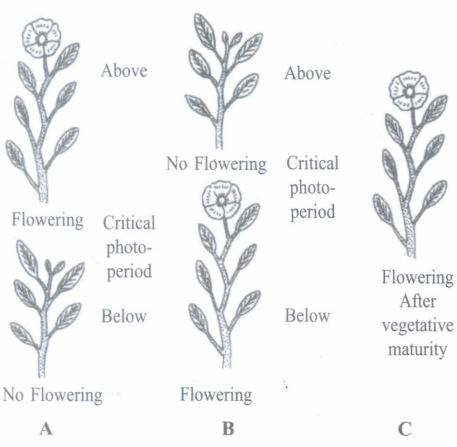
(a) Name the types of plants A, Band C, with reference to their photoperiodic responses.
(b) Name the part of the plant that perceives the photoperiodic (light) stimulus for flowering.
(c) It has been hypothesised that there is a hormonal substance insolved in this phenomenon. Explain.
3.
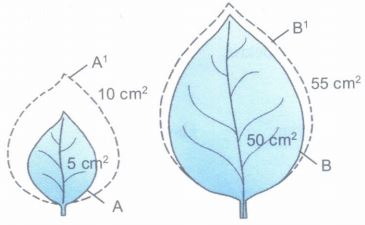
The figure given above is the diagrammatic comparison of the absolute and relative growth rates of two leaves A and B in a given period of time.
(a) What is meant by:
(i) absolute growth rate
(ii) relative growth rate?
(b) Which of them, A or B, shows a higher relative growth rate? Justify your answer.
4.
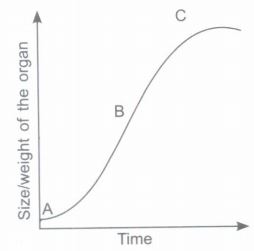
A sigmoid growth curve is shown above. Answer the following questions based on it.
(a) Name the phases of growth A, Band C in the graph.
(b) What type of growth occurs in phase B?
(c) How can it be mathematically expressed?
5.
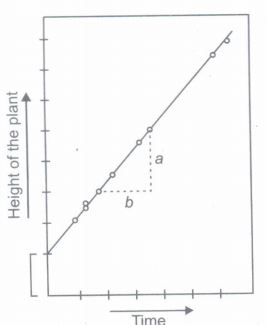
The above diagram shows. a linear growth curve. Answer the following questions based on it.
(a) What type of growth is exhibited in the above graph?
(b) Give an example where such a curve can be obtained.
(c) How can it be mathematically expressed?
6.
An organism or a part of the organism can produce cells during growth in a variety of ways. The following figure is a diagrammatic representation of two types of growth, A and B.
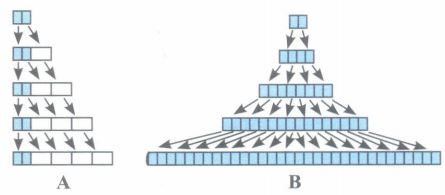
Identify the types of growth A and B. Differentiate between them with an example of each.
7.
The diagram shows the detection of zones of elongation in the primary root. Answer the questions that follow:
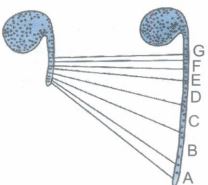
(a) Name the technique used to detect the zones of elongation in the root tip.
(b) Name the zones that have elongated the most.
(c) Mention the three characteristics of the cells in the zones of elongation.
8.
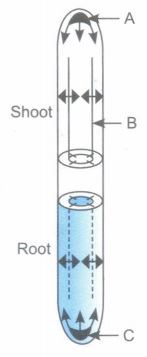
The diagram given below is a diagrammatic representation of the locations of meristems in the shoot and root of a plant.
Answer the questions that follow.
(a) Identify the letters A, B and C marked in the figure.
(b) What do the arrows indicate?
(c) Which among them is/are involved in
(i) primary growth
(ii) secondary growth?
1.
(a) The winter wheat requires an exposure to very cold temperature (winter) for phenomenon.
(b) It is called vernalisation.
(c) Gibberellins can substitute the cold temperature (vernalisation).
2.
(a) A - Long day plant.
B - Short day plant.
C - Day neutral plant.
(b) Leaves
(c) According to the hypothesis, the hormonal substance produced in the leaves after the necessary inductive photoperiod, migrates to the shoot apices and induces flowering.
3.
(a) (i) Absolute growth rate is total growth per unit time.
(ii) Relative growth rate is the total growth per unit time per unit parameter.
(b) Relative growth rate of A = \(\frac{10-5}{5} \times 100\) = 100%
Relative growth rate of B = \(\frac{55-50}{50} \times 100\) = 10%
A shows a higher relative growth rate:.
4.
(a) A - Lag phase
B - Exponential phase
C - Stationary phase
(b) Geometric growth
(c) It is mathematically expressed as
Wt = W0 ert where
Wt = final size (weight, length etc.)
W0 = Initial size (at the beginning)
r = growth rate
e = base of natural logarithm
t = time of growth.
5.
(a) Arithmetic growth
(b) A root elongating at a constant rate.
(c) It is mathematically expressed as
L1 = L0 + rt, where
L1 = length at time 't'
L0 = length at time '0'
r = growth rate.
6.
A - Arithmetic growth.
B - Geometric growth.
Differences
| Arithmetic growth | Geometric growth |
| (a) In this type of growth, one of the two daughter cells formed by mitosis continues to divide. | (a) In this type of growth, both the progeny cells formed after mitoses continue to divide |
| (b) It is seen in the elongation of root. | (b) It is seen in organs/ tissues in exponential phase of growth. |
7.
(a) Parallel line technique.
(b) A, B, C and D.
(c) Characteristics of cells:
(i) Increased vacuolation.
(ii) Deposition of new cell wall.
(iii) Cell enlargement.
8.
(a) A - Shoot apical meristem.
B - Vascular cambium.
C - Root apical meristem.
(b) The arrows indicate the direction of growth of cells and organs.
(c) (i) Shoot apical meristem and root apical meristem.
(ii) Vascular cambium.

11th Standard CBSE Syllabus & Materials
11th Standard CBSE
CBSE 11th Business Studies Forms of Business Organisation Sample Question Papers Study Material - QB365 Set A
NEW11th Standard CBSE
CBSE 11th Business Studies Business, Trade and Commerce Sample Question Papers Study Material - QB365 Set A
NEW11th Standard CBSE
CBSE 11th Physics Waves Sample Question Papers Study Material - QB365 Set A
NEW11th Standard CBSE
CBSE 11th Physics Kinetic Theory Sample Question Papers Study Material - QB365 Set A



CBSE 11th Standard CBSE Subjects
CBSE Standards









